

For many digital marketing agencies, growth creates an unexpected problem: winning more clients can quickly create more work than the existing team can comfortably handle.
A growing client list means more campaigns, reports, meetings, revisions, content, website updates, ad optimisation, SEO tasks, and deadlines. The obvious solution is to hire more staff. But hiring also brings recruitment time, salaries, training, management, infrastructure, and long-term overhead.
That does not mean hiring is always wrong. It means agencies should first examine whether their existing capacity, workflow, resources, and systems are being used efficiently.
Agencies can often increase delivery capacity without immediately increasing headcount by improving processes, automating repetitive work, delegating specialised tasks, standardising fulfilment, using technology, and working with reliable external partners.
This guide explains how agencies can increase capacity without hiring while maintaining quality, client satisfaction, and sustainable growth.
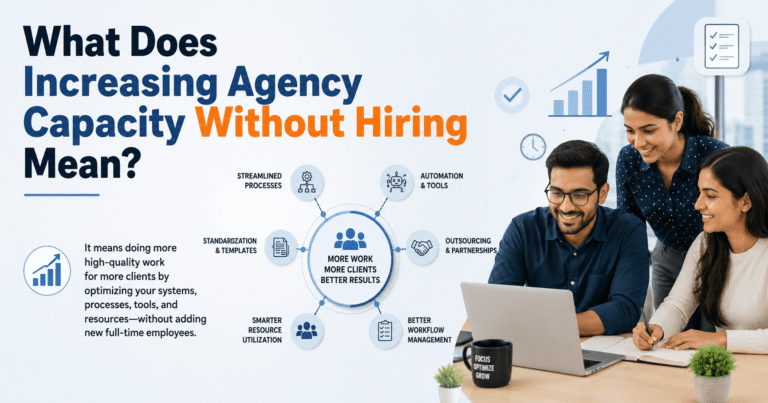
What Does Increasing Agency Capacity Without Hiring Mean?
Increasing agency capacity means being able to handle more clients, projects, campaigns, and deliverables with the resources already available.
The goal is not simply to make employees work faster.
It is to improve the amount of useful output and throughput an agency can produce without creating unsustainable workloads.
For example, an agency may currently have enough team expertise to manage 20 active clients but struggle because employees spend significant time on:
- Manual reporting
- Repetitive client communication
- Data collection
- Administrative tasks
- Unstructured project management
- Revisions
- Task switching
- Manual campaign updates
- Repetitive content processes
- Poorly defined approval systems
In this situation, the capacity problem may not actually be a staff shortage. It may be an operational efficiency problem.
The right approach is to identify where capacity is being lost and then improve the systems surrounding the team.
Why Digital Agencies Struggle With Capacity
Agency workload rarely increases in a perfectly predictable way.
One month may involve a manageable volume of SEO campaigns. The next month, several clients may launch Google Ads campaigns, request new landing pages, require website changes, or need additional content.
This creates pressure across the entire operation.
1. Too Much Manual Work
Manual processes consume time without necessarily adding proportional value.
For example, an account manager may spend hours collecting information for monthly reports when dashboards and automated reporting could handle much of the data preparation.
Similarly, campaign teams may repeatedly perform the same setup tasks instead of using templates and standard processes.
2. Poor Workflow Structure
When processes are unclear, employees spend time deciding:
- What should happen next?
- Who owns the task?
- When is it due?
- Who needs to approve it?
- What information is required?
- What happens if the client requests a revision?
A structured workflow reduces this unnecessary coordination.
3. Excessive Client Revisions
Repeated revisions can significantly affect agency capacity.
Sometimes the issue is not the quality of the deliverable. The problem is unclear expectations at the beginning of the project.
A stronger briefing and approval process can reduce unnecessary back-and-forth.
4. Too Many Responsibilities Per Employee
An employee handling SEO, paid advertising, reporting, client communication, content coordination, and project management simultaneously may appear productive but can become a bottleneck.
The problem is often resource allocation, not a lack of effort.
5. Lack of Specialisation
Some agency tasks require specialist expertise.
Instead of forcing an internal generalist to learn every discipline, agencies can use external specialists or fulfilment partners for selected services.
This creates flexibility without immediately expanding permanent staff.
5. Lack of Specialisation
Some agency tasks require specialist expertise.
Instead of forcing an internal generalist to learn every discipline, agencies can use external specialists or fulfilment partners for selected services.
This creates flexibility without immediately expanding permanent staff.
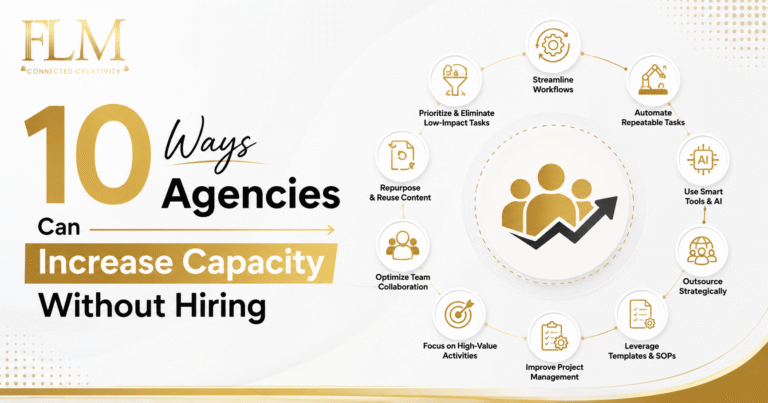
10 Ways Agencies Can Increase Capacity Without Hiring
1. Audit Your Existing Workload
Before changing your team structure, understand where time is actually going.
Create a simple workload map covering:
- Client meetings
- SEO execution
- Keyword research
- Content production
- Campaign management
- Website development
- Reporting
- Client communication
- Project management
- Revisions
- Administrative work
- Quality control
Then identify tasks that consume significant time but contribute limited strategic value.
This creates a clearer picture of current utilization.
The objective is not to eliminate work. It is to determine which work requires internal expertise and which work can be simplified, automated, delegated, or outsourced.
2. Standardise Repetitive Processes
A scalable agency cannot depend entirely on individual employees remembering how every task should be completed.
Create standard operating procedures for recurring activities.
For example, an SEO campaign might follow a consistent process:
- Client onboarding
- Website audit
- Competitor analysis
- Keyword research
- Search intent analysis
- Technical recommendations
- Content planning
- On-page optimisation
- Performance tracking
- Monthly reporting
The exact process will differ by client, but the underlying system can remain consistent.
Standardisation improves consistency and makes delegation easier.
It also reduces the time required to train new contributors or external partners.
3. Use Templates Wherever Appropriate
Templates can improve both speed and consistency.
Agencies can create reusable templates for:
- Campaign briefs
- SEO audits
- Content briefs
- Client onboarding
- Reporting
- Proposal documents
- Meeting agendas
- Social media calendars
- Ad testing
- Landing page requirements
- Project handovers
- Quality-control checklists
Templates should not turn every client into the same project.
Instead, they provide an operational foundation that the team can customise according to client requirements.
4. Automate Repetitive Administrative Work
Automation is one of the most practical ways to increase capacity without hiring.
Potential areas include:
- Client onboarding
- Lead notifications
- Reporting
- Task creation
- Scheduling
- Email notifications
- Data collection
- CRM updates
- Approval reminders
- Internal notifications
- Dashboard updates
The principle is simple:
Automate predictable tasks so people can spend more time on work requiring judgement.
For example, an automated reporting system can collect campaign data while an account manager focuses on interpreting that data and explaining what it means for the client.
Google Analytics allows businesses to measure important interactions as events and identify important actions as key events, helping teams understand which activities matter to business performance.
5. Improve Delegation
Delegation does not mean simply giving someone more work.
Effective delegation requires clear ownership.
For each recurring task, determine:
- Who owns it?
- Who executes it?
- Who reviews it?
- Who approves it?
- What is the deadline?
- What information is required?
- What defines acceptable quality?
A simple responsibility structure can prevent multiple employees from unknowingly working on the same task.
It also reduces unnecessary coordination.
6. Outsource Selected Fulfilment
One of the strongest options for agencies that want additional capacity without immediately hiring is strategic outsourcing.
An agency does not necessarily need to outsource its entire operation.
Instead, it can use external support for selected areas such as:
- SEO fulfilment
- Content production
- Website development
- Graphic design
- PPC campaign execution
- Social media management
- Technical SEO
- Local SEO
- Reporting
- Marketing automation
This can be particularly useful when demand fluctuates.
For example, an agency may have sufficient resources for its regular SEO workload but suddenly acquire several ecommerce clients requiring additional technical and content support.
Rather than immediately hiring permanent specialists, the agency can use a trusted external partner to handle additional fulfilment.
7. Build a Reliable White-Label Fulfilment System
White-label partnerships can provide agencies with additional infrastructure and specialist expertise while allowing the agency to remain client-facing.
A typical arrangement might look like:
Agency → Client strategy & relationship → White-label fulfilment partner → Delivery → Agency quality control → Client
The agency maintains control over communication, positioning, expectations, and client experience while the fulfilment partner supports execution.
This model can help agencies increase capacity while maintaining flexibility.
However, choosing the right partner matters.
Agencies should evaluate:
- Expertise
- Communication
- Turnaround time
- Quality-control systems
- Reporting
- Scalability
- Confidentiality
- Process documentation
- Revision handling
- Technical capabilities
The cheapest partner is not necessarily the most efficient partner.
A low-cost provider that creates repeated revisions can actually reduce capacity.
8. Improve Project Management
Poor project management can create hidden workload.
For example, a designer may be waiting for content, while the content team is waiting for client information, and the account manager is waiting for approval.
The result is delay, confusion, and additional coordination.
A structured project management system should clearly show:
- Task
- Owner
- Deadline
- Status
- Priority
- Dependencies
- Approval stage
- Final deliverable
This creates visibility across the agency.
It also helps managers identify bottlenecks before they become serious problems.
9. Create Capacity for Peak Demand
Not every agency needs the same amount of capacity every month.
Seasonal businesses can create significant workload spikes.
An education institute may require more campaign activity before admissions. An ecommerce company may increase advertising around major shopping periods. A real estate business may suddenly increase campaign requirements after launching a new project.
Instead of maintaining permanent staff for the highest possible workload, agencies can develop flexible resources.
These may include:
- Freelance specialists
- White-label partners
- Contractors
- External developers
- Content specialists
- Design partners
- Paid media specialists
This creates flexibility while keeping fixed overhead under control.
10. Measure Capacity Before Adding Resources
Agencies should measure capacity using data rather than assumptions.
Useful indicators include:
- Active clients per account manager
- Projects completed per month
- Average turnaround time
- Revision frequency
- Billable utilisation
- Delivery delays
- Internal task volume
- Client response time
- Profit margins
- Workload by department
- Outsourced task volume
If capacity is consistently near its practical limit even after workflow optimisation, automation, and delegation, hiring may become the appropriate next step.
The objective is not to avoid hiring forever.
It is to make sure hiring solves a genuine capacity problem.
A Practical Capacity Framework for Agencies
A useful way to evaluate agency capacity is to divide work into four categories.
Keep
Tasks that require strategic thinking, client knowledge, or senior expertise should generally remain internal.
Examples include:
- Strategy
- Client relationships
- Campaign direction
- Business analysis
- Positioning
- High-level optimisation
- Quality control
Simplify
Tasks that are repetitive but still need internal involvement can often be standardised.
Examples include:
- Reporting
- Brief creation
- Research formats
- Client onboarding
- Internal reviews
Automate
Tasks based on predictable triggers can often be automated.
Examples include:
- Notifications
- Scheduling
- Data collection
- CRM updates
- Recurring reports
- Task creation
Outsource
Tasks requiring specialist execution or additional delivery bandwidth may be handled externally.
Examples include:
- Technical development
- Content production
- Design
- SEO fulfilment
- PPC execution
- Social media production
This framework helps agencies use existing resources more intelligently.
How Capacity Improvement Affects Agency Profitability
Capacity is closely connected to profitability.
Suppose an agency wins additional clients but the existing team spends excessive time handling low-value administrative work.
Revenue may increase, but margins can become compressed.
A more efficient workflow allows the agency to generate more output from its existing infrastructure.
This can improve:
- Delivery efficiency
- Profit margins
- Resource utilisation
- Client retention
- Employee productivity
- Revenue scalability
However, agencies should not measure success only through workload volume.
If increasing capacity causes employees to become overloaded or service quality to decline, the model is not sustainable.
Scalability should improve output without sacrificing quality.
Practical Example: Local Service Agency
Consider a hypothetical digital marketing agency serving local businesses in Ahmedabad.
The agency manages SEO, Google Ads, and social media for several clients.
The team is receiving more enquiries but struggles to accept new accounts because account managers spend too much time preparing reports and coordinating repetitive tasks.
Instead of immediately hiring another account manager, the agency could:
- Standardise reporting templates.
- Automate data collection.
- Create a structured onboarding workflow.
- Use dashboards for recurring metrics.
- Delegate routine campaign tasks.
- Outsource selected production work.
- Keep strategy and client communication internally.
- Introduce a formal quality-control process.
The result is not necessarily that every employee suddenly handles twice as many clients.
The more realistic benefit is that unnecessary workload is reduced and the team has more usable bandwidth for strategic work.
Practical Example: Real Estate Marketing Agency
Imagine a real estate-focused agency generating strong client demand.
The agency is handling Google Ads, Meta Ads, landing pages, creative production, lead reporting, and follow-up recommendations.
The account managers are becoming overloaded because every new project requires separate coordination.
Instead of immediately expanding the permanent team, management could create standard campaign structures, reusable landing-page frameworks, reporting dashboards, creative briefing templates, and external fulfilment support.
The internal team can then focus on:
- Strategy
- Lead quality
- Client communication
- Campaign optimisation
- Budget decisions
- Business recommendations
This creates additional delivery capacity without simply adding more people.
How Technology Can Support Agency Capacity
Technology should support a process rather than compensate for a broken process.
An agency should first understand its workflow and then decide where software can improve efficiency.
Useful technology categories include:
- Project management platforms
- CRM systems
- Reporting dashboards
- Analytics platforms
- Automation tools
- Communication systems
- Scheduling platforms
- Content management systems
- Marketing platforms
- AI-assisted productivity tools
For paid campaigns, measurement is particularly important. Google Ads recommends conversion tracking and structured campaign optimisation so agencies can evaluate performance based on meaningful outcomes rather than simply activity.
Google Search Console can similarly help teams examine search queries, clicks, impressions, and click-through rates when assessing organic performance.
The key is not to collect more data simply because technology makes it possible.
The objective is to make better decisions with less manual effort.
What Agencies Should Not Do When Trying to Increase Capacity
Increasing capacity can create problems when agencies focus only on speed.
Avoid these approaches.
Overloading Existing Employees
Giving the team more tasks without improving systems can increase burnout and reduce quality.
Outsourcing Everything
External partners can increase flexibility, but agencies still need internal ownership, strategy, communication, and quality control.
Automating Poor Processes
Automation can make a bad workflow faster without making it better.
Fix the process first.
Accepting Every Client
More clients do not automatically mean better growth.
A poor-fit client can consume disproportionate resources and reduce profitability.
Sacrificing Quality
If increased throughput leads to more errors, revisions, missed deadlines, and unhappy clients, the agency has not truly increased capacity.
Myths vs Facts About Increasing Agency Capacity
Myth | Fact |
More employees are always the solution. | Workflow, automation, delegation, and outsourcing can sometimes unlock existing capacity first. |
Outsourcing means losing control. | A structured partnership with clear ownership and quality control can maintain operational oversight. |
Automation replaces marketers. | Automation is most useful for reducing repetitive work so specialists can focus on judgement and strategy. |
More clients always mean more revenue. | Client profitability depends on workload, pricing, delivery costs, retention, and operational efficiency. |
Working faster solves capacity problems. | Sustainable capacity comes from better systems, prioritisation, resources, and processes. |
The cheapest fulfilment partner is best. | Quality, communication, reliability, expertise, and turnaround can matter more than price alone. |
How to Measure Whether Your Capacity Strategy Is Working
Capacity improvements should be measurable.
Track performance before and after implementing operational changes.
Useful metrics include:
- Average project turnaround
- Tasks completed per employee
- Client response time
- Number of revisions
- Delivery delays
- Client retention
- Gross margin
- Team utilisation
- Outsourcing costs
- Revenue per employee
- Number of active projects
- Quality-control issues
For marketing campaigns, also separate operational efficiency from campaign performance.
An agency can deliver campaigns faster without those campaigns necessarily producing better client outcomes.
Google Ads reporting, for example, includes metrics such as conversion rate, conversion value, and return on ad spend to help advertisers evaluate campaign outcomes.
The same principle applies internally: measure the outcome of capacity improvements rather than simply counting completed tasks.
When Should an Agency Actually Hire?
Hiring still makes sense in many situations.
An agency should seriously consider adding permanent staff when:
- Workload remains consistently high.
- Existing employees are regularly overloaded.
- Specialist expertise is needed continuously.
- Quality is declining because of resource constraints.
- Client demand is predictable.
- Outsourcing costs have become consistently higher than internal staffing.
- Management needs permanent ownership of a function.
- The business has sufficient predictable revenue to support additional overhead.
The goal is not “never hire.”
The better principle is:
Optimise existing capacity first, then hire when sustained demand justifies permanent resources.
How Different Indian Agencies Can Increase Capacity
Capacity strategies can differ by business model.
SEO Agencies
SEO agencies can improve capacity through standardised audits, reusable reporting frameworks, structured content workflows, technical SEO checklists, and specialist fulfilment support.
PPC Agencies
PPC teams can improve efficiency through campaign templates, structured naming conventions, reporting automation, creative testing systems, conversion tracking, and clear optimisation workflows.
Social Media Agencies
Social media teams can use content calendars, approval systems, reusable creative frameworks, scheduling tools, and structured reporting.
Web Development Agencies
Development agencies can improve capacity through reusable components, project templates, documentation, QA systems, and specialist external development resources.
Full-Service Digital Agencies
Full-service agencies often benefit most from clearly separating strategy, account management, production, quality control, and specialised fulfilment.
This allows the agency to manage a broader range of clients without requiring every employee to become an expert in every service.
How White-Label Partnerships Can Support Agency Growth
For agencies that want to expand service offerings without building every department internally, white-label partnerships can provide additional resources and expertise.
For example, an agency specialising in branding could offer SEO, PPC, web development, or local SEO through a white-label fulfilment partner.
The agency remains responsible for the client relationship and strategic direction while the partner supports delivery.
This model can be especially useful for agencies operating across India where client demand can vary between Ahmedabad, Mumbai, Delhi NCR, Bengaluru, Hyderabad, Pune, Surat, and other markets.
However, successful partnerships require clear systems.
The agency should establish:
- Scope of work
- Responsibilities
- Deadlines
- Communication channels
- Reporting standards
- Quality-control procedures
- Revision limits
- Escalation processes
- Client confidentiality requirements
Without these systems, outsourcing can create more coordination rather than less.
Conclusion
Agency growth does not have to mean immediately adding employees.
Sometimes the fastest path to additional capacity is already inside the business.
Better processes can reduce unnecessary work. Automation can remove repetitive tasks. Delegation can improve resource allocation. Templates can increase consistency. Outsourcing can provide flexible specialist support. White-label partnerships can expand fulfilment capabilities.
The important question is not simply:
“How many people do we need?”
It is:
“How effectively are we using the people, systems, technology, and resources we already have?”
Once an agency understands its workload and identifies operational bottlenecks, it can make a more informed decision about whether to automate, delegate, outsource, partner, or hire.
For Indian digital agencies competing in increasingly demanding markets, sustainable scalability comes from building systems that can support growth without sacrificing delivery quality, client experience, or profitability.