

A digital marketing agency can rank a client’s website for valuable keywords and still face a new problem: the client may not be visible when potential customers ask AI-powered search tools for recommendations, comparisons, or solutions.
This is where a White Label SEO AI Citation Strategy becomes relevant.
For agencies, the goal is not simply to create more content or chase mentions across the web. The real objective is to help clients build a stronger, more understandable digital presence so search engines and AI-powered search experiences can discover, interpret, and potentially reference their information.
Google’s current guidance is particularly important here: Google says its generative AI search features rely on its existing Search ranking and quality systems, meaning traditional SEO fundamentals remain important. Google also cautions against treating AEO or GEO as a collection of hacks.
For a white label SEO agency, that changes the way AI search optimization should be delivered.
Instead of selling a mysterious “AI ranking package,” agencies should build a structured service around technical SEO, useful content, entity clarity, topical authority, trustworthy references, measurement, and continuous optimization.
This guide explains how to do that.
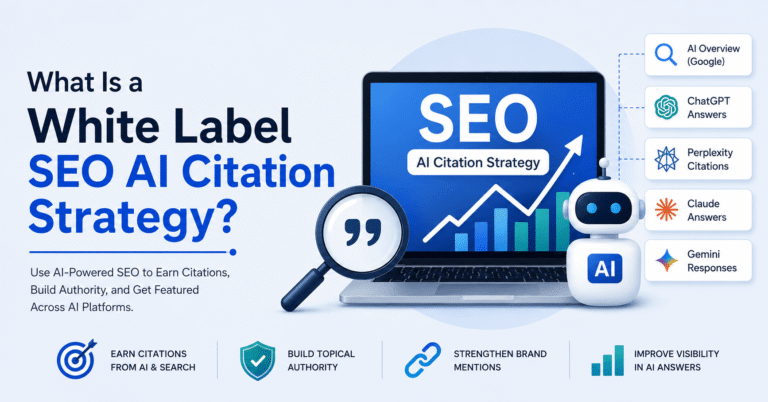
What Is a White Label SEO AI Citation Strategy?
A White Label SEO AI Citation Strategy is a service-delivery framework where an SEO fulfillment partner helps an agency improve a client’s visibility across traditional search and emerging AI-powered search experiences, while the agency delivers the service under its own brand.
The strategy can involve:
- Technical SEO
- Search intent research
- Entity optimization
- Topical authority development
- AI content optimization
- Content gap analysis
- Brand mention analysis
- Digital PR and authority building
- AI citation monitoring
- Search performance tracking
- Conversion analysis
- Competitor research
The important distinction is that AI citation optimization is not the same as guaranteeing that ChatGPT, Google AI features, Gemini, Perplexity, or another system will mention a business.
AI systems select and generate information through complex processes that can change over time.
Therefore, the practical agency objective should be to make a client’s information accurate, useful, discoverable, well-structured, authoritative, and consistent across relevant sources.
That is a much more defensible strategy than promising a specific number of AI citations.
Why AI Citations Matter to White Label SEO Agencies
Search behaviour is becoming more conversational.
Instead of searching only:
“best digital marketing agency Ahmedabad”
a potential customer may ask:
“Which digital marketing agencies in Ahmedabad are suitable for a manufacturing company?”
That second query contains more context.
AI-powered search experiences may need to understand:
- What the company does
- Where it operates
- Which industries it serves
- What services it provides
- What makes it relevant
- Whether other trustworthy sources support its claims
This makes entity optimization for AI search increasingly useful as part of a broader SEO strategy.
Google’s documentation also explains that generative AI search features use content from Google’s Search index and that established SEO best practices remain relevant.
For a white label agency, this creates an opportunity to expand traditional SEO fulfillment into AI search visibility services without abandoning the fundamentals that already support organic search.
AI Citations Are Not the Same as Traditional Rankings
One of the biggest mistakes agencies can make is treating AI search like another conventional ranking position.
Traditional SEO often asks:
“Where does this page rank for this query?”
An AI search strategy asks broader questions:
- Is the brand understood as a relevant entity?
- Is the business mentioned by credible sources?
- Is the website’s information consistent?
- Does the content answer specific questions clearly?
- Does the site demonstrate topical depth?
- Can search systems easily identify important facts?
- Are important services and locations clearly explained?
- Are third-party references supporting the business’s claims?
The difference matters.
A client could rank well for one keyword but have very little visibility in conversational searches.
Conversely, a business might become relevant to a wider group of questions because its website and external presence clearly establish its expertise.
This is why AI Search Optimization should be treated as an extension of good SEO rather than a replacement for it.
Read More:- White Label Entity-Based SEO Strategy
The Core Elements of a White Label AI SEO Strategy
A scalable white label program should have a repeatable framework.
1. Start With Technical SEO
Before thinking about AI citations, check whether search engines can properly access and understand the website.
Review:
- Indexability
- Robots.txt
- XML sitemap
- Canonical URLs
- Internal linking
- Mobile usability
- Page speed
- JavaScript rendering
- HTTPS
- Structured data where appropriate
- Duplicate content
- Broken links
- Website architecture
If important pages cannot be properly crawled or indexed, adding more content will not solve the underlying problem.
Google specifically states that pages need to be indexed to be eligible to appear in its generative AI search features.
Agency lesson: AI optimization should begin with technical SEO, not with a separate collection of “AI tricks.”
2. Build Clear Entity Signals
AI systems need context.
Consider a hypothetical manufacturer based in Ahmedabad.
Its website may say:
“We provide industrial solutions.”
That is vague.
A stronger website might clearly explain:
- Product categories
- Manufacturing capabilities
- Industries served
- Location
- Certifications
- Service areas
- Applications
- Technical specifications
- Company history
- Contact information
This helps establish the business as a recognizable entity rather than a collection of disconnected keywords.
Entity-based SEO strategy therefore becomes particularly useful.
For white label clients, agencies can create an entity information framework covering:
Business → Services → Products → Locations → Industries → People → Expertise → Supporting sources
This structure can then guide website content and off-site optimization.
3. Develop Topical Authority
One article about a service rarely establishes deep expertise. For agencies offering White Label AI SEO Citation Services, building a focused topic cluster can demonstrate expertise across AI search, SEO citations, and content authority.
Instead of publishing ten generic articles about “digital marketing,” an agency could create a focused cluster around:
- AI search citations
- White label AI SEO strategies
- AI-powered content optimization
- Brand mentions in AI search
- Google AI Overview visibility
- ChatGPT and Perplexity citations
- Entity-based SEO
- Topical authority for AI search
- AI search visibility tracking
- Citation and brand authority building
This creates stronger topical authority for AI search because the website demonstrates depth around a clearly defined subject rather than covering broad marketing topics without a connected strategy.
The same approach can be applied to healthcare, manufacturing, SaaS, education, real estate, and ecommerce. A well-structured content cluster helps agencies demonstrate specialized knowledge while supporting their White Label AI SEO Citation Services with relevant, interconnected content.
AI Citation Building: What Should Agencies Actually Do?
The phrase AI citation building can be misleading.
There is no universal directory where an agency can simply submit a client and guarantee AI citations.
Instead, focus on building a stronger information ecosystem.
Website sources
Create authoritative pages covering:
- Core services
- Products
- Locations
- Industries
- FAQs
- Methodologies
- Case studies
- Original research
- Expert insights
External sources
Where appropriate, pursue legitimate opportunities such as:
- Industry publications
- Relevant business directories
- Professional associations
- Local business publications
- News coverage
- Expert interviews
- Partner websites
- Industry resources
Brand consistency
Check whether the following information is consistent:
- Company name
- Address
- Phone number
- Website
- Services
- Locations
- Founder information
- Business descriptions
This does not mean creating hundreds of low-quality profiles.
Quality and relevance are more important than volume.
Why White Label GEO Services Need a Different Delivery Model
Agencies offering White Label GEO Services should avoid packaging GEO as a standalone magic solution.
A better delivery model combines:
SEO foundation
Technical optimization, content, internal linking and search intent.
Entity development
Clear relationships between brands, services, products, people and locations.
Authority development
Relevant, trustworthy third-party references.
Content optimization
Useful answers written for real users.
Monitoring
Tracking where and how the brand appears across relevant search experiences.
Business measurement
Connecting visibility with website engagement, enquiries and conversions.
This approach is easier for an agency to explain to clients.
It also prevents the sales team from making promises that the delivery team cannot control.
Step-by-Step White Label SEO AI Citation Strategy
Step 1: Understand the Client
Before creating an AI search strategy, collect:
- Business model
- Main products or services
- Target customers
- Locations
- Revenue priorities
- Main competitors
- Existing organic traffic
- Important commercial pages
- Conversion actions
- Current content
- Existing brand mentions
A clinic, SaaS company and industrial manufacturer should not receive the same strategy.
Step 2: Map Search Intent
Identify the questions customers ask at different stages.
For example, an Indian real estate company may need visibility for:
Informational
“Best areas to buy property in Ahmedabad”
Commercial investigation
“2 BHK property developers in Ahmedabad”
Transactional
“Book 2 BHK apartment Ahmedabad”
Brand-related
“Company X Ahmedabad reviews”
The content strategy should cover the customer journey rather than only high-volume keywords.
Step 3: Identify Entity Relationships
Create an entity map.
For example:
Brand: ABC Realty
↓
Industry: Real Estate
↓
Services: Residential Projects, Commercial Projects
↓
Location: Ahmedabad, Gujarat
↓
Property Types: Apartments, Villas
↓
Audience: Homebuyers, Investors
↓
Supporting Topics: Pricing, Amenities, Locations, Financing
This makes content planning more coherent.
Step 4: Analyze Competitors
Do not only compare rankings.
Review competitor:
- Content depth
- Brand mentions
- Service pages
- Location coverage
- Reviews
- Author information
- Industry references
- Digital PR
- FAQs
- Internal linking
- Content freshness
Then identify where the client has a genuine opportunity to provide something more useful.
Step 5: Create Citation-Worthy Content
Content should have a reason to be referenced.
Useful formats include:
- Original research
- Detailed comparisons
- Expert explanations
- Data-backed guides
- Industry definitions
- Practical checklists
- Pricing frameworks
- Methodology pages
- Frequently asked questions
- Technical explainers
For example, instead of writing:
“SEO is important for businesses.”
create something more useful:
“How Indian B2B manufacturers can evaluate SEO leads before increasing their content budget.”
The second topic has a clear audience and business problem.
Two Practical Business Scenarios
Example 1: Local Service Business
Consider a hypothetical dental clinic in Ahmedabad.
The clinic receives website visitors but very few phone calls.
The agency initially discovers that the problem is not simply organic traffic.
The website has:
- Generic service descriptions
- No clear treatment pages
- Weak location signals
- Limited FAQs
- No obvious appointment CTA
- Poor conversion tracking
An AI search strategy alone would not fix this.
The agency should first improve the service architecture, local relevance, content quality and conversion path.
Marketing lesson: Better AI visibility cannot compensate for a website that does not clearly explain what the business offers or how customers can contact it.
Example 2: B2B Manufacturer
Imagine a hypothetical Rajkot manufacturer selling industrial components.
The company wants more enquiries and has historically targeted broad keywords such as “industrial products.”
A better strategy could focus on specific:
- Product categories
- Applications
- Industries
- Technical specifications
- Buyer questions
- Service locations
- Comparison topics
The agency can then develop content around those commercial entities and connect them through internal links.
Marketing lesson: AI search visibility becomes more useful when the website clearly explains the relationship between the company, products, applications and customer problems.
How to Measure AI Search Visibility
This is where many agencies need to be careful.
Do not create a report containing only screenshots of AI responses.
Instead, create a broader AI Search Performance Tracking framework.
Track:
- Organic impressions
- Organic clicks
- Search queries
- Important landing pages
- Brand searches
- Referral traffic
- Conversions
- Lead quality
- Engagement
- Relevant brand mentions
- AI search appearances where observable
- Competitor visibility
Google announced dedicated Search Console reports for generative AI features in June 2026. The reports provide views of impressions, pages, countries, devices and dates for visibility within generative AI features, although Google initially described the rollout as being available to a subset of websites.
Google also explains that AI Overviews and AI Mode are included in Search Console’s overall performance reporting.
That gives agencies a more credible foundation for AI citation monitoring and reporting.
White Label AI SEO Reporting: What Clients Actually Need
Clients generally do not need a 50-page report filled with screenshots.
A useful monthly report should answer:
What changed?
Example:
- Organic impressions increased
- Important service pages gained visibility
- New content began receiving impressions
- Brand searches changed
Why did it change?
Explain the likely causes.
What should happen next?
Give clear actions.
For AI visibility, include:
- Important queries monitored
- Relevant AI search observations
- Brand/entity visibility
- Pages supporting visibility
- Content gaps
- Competitor observations
- Recommended actions
Avoid claiming that a single AI response proves permanent visibility.
AI systems and search experiences can change.
White Label AI Search Optimization Across Indian Industries
Healthcare
Focus on:
- Service clarity
- Medical terminology
- Location relevance
- Practitioner information
- Trust signals
- Patient questions
Healthcare content also requires greater care around accuracy and responsible communication.
Real Estate
Focus on:
- Project information
- Location
- Property types
- Amenities
- Buyer questions
- Pricing context
- Developer information
Manufacturing
Focus on:
- Technical specifications
- Applications
- Industries
- Product categories
- Certifications
- B2B buying questions
Education
Focus on:
- Courses
- Eligibility
- Admissions
- Fees
- Locations
- Student questions
- Institution information
Ecommerce
Focus on:
- Product information
- Categories
- Comparisons
- Specifications
- Buying guides
- Reviews
- Availability
Local Businesses
Focus on:
- Google Business Profile
- Location pages
- Services
- Reviews
- Local intent
- Calls
- Directions
- Regional search behaviour
For businesses targeting Ahmedabad, Surat, Vadodara or other Indian cities, location-specific search intent should be considered instead of copying a generic national SEO strategy.
Common White Label AI SEO Mistakes
Myth 1: AI citations can be guaranteed
Fact: No responsible agency should guarantee that a specific AI system will cite a client.
Visibility depends on search systems, query context, source availability, content quality and many other variables.
Myth 2: Publishing AI-generated content is enough
Fact: Content volume does not automatically establish authority.
Google’s current guidance emphasizes useful, unique and people-first content and warns against strategies designed primarily to manipulate generative AI results.
Myth 3: More mentions always mean better AI visibility
Fact: Hundreds of irrelevant mentions can be less useful than a smaller number of relevant, trustworthy references.
Myth 4: Traditional SEO is dead
Fact: Google explicitly states that existing SEO best practices remain relevant to generative AI search experiences.
Myth 5: AI visibility automatically produces leads
Fact: Visibility creates an opportunity. The website, offer, user experience, pricing, trust, sales process and follow-up still influence whether that visibility becomes a business enquiry.
Practical White Label AI Citation Checklist
Before launching an AI search optimization campaign, check:
- Is the client’s business clearly defined?
- Are the main services or products easy to understand?
- Are important pages indexed?
- Is the website technically healthy?
- Are commercial search intents mapped?
- Are entities and relationships clearly explained?
- Does the site have useful topic coverage?
- Are important claims supported by appropriate evidence?
- Is brand information consistent across relevant sources?
- Are local signals accurate?
- Are conversion actions properly tracked?
- Are AI-search observations being monitored carefully?
- Are reports focused on business value rather than vanity metrics?
When Should an Agency Offer White Label AI SEO Services?
This service can make sense when an agency already provides SEO and clients are beginning to ask questions such as:
- “Why isn’t our brand appearing in AI search?”
- “How can we improve visibility in AI answers?”
- “Can you optimize our website for ChatGPT?”
- “How do we appear in Google AI Overviews?”
- “Can you track AI citations?”
- “How can we improve our brand presence in AI search?”
However, agencies should first ensure that the underlying SEO operation is strong.
If the client’s website has poor technical foundations, thin service pages, weak conversion paths and unclear positioning, an AI citation package should not be the first priority.
How SEO and AI Search Strategy Should Work Together
The strongest approach is not:
SEO → stop → AI SEO
It is:
Technical SEO → Search Intent → Content → Entity Clarity → Authority → Conversion Optimization → Measurement → Continuous Improvement
AI search should be considered another way customers may discover information.
That means your client’s website still needs to answer the fundamentals:
Who are you?
What do you offer?
Who do you serve?
Where do you operate?
Why should customers trust you?
What problem do you solve?
What evidence supports your claims?
What should the visitor do next?
If those questions are answered clearly, the website has a stronger foundation for both conventional search and AI-powered discovery.
Conclusion
A White Label SEO AI Citation Strategy should not be sold as an AI shortcut.
For agencies in India, the better opportunity is to build a structured service around technical SEO, entity optimization, topical authority, useful content, relevant brand mentions, trustworthy sources, AI visibility monitoring and conversion-focused measurement.
The most important principle is simple:
Do not optimize only for the possibility of being cited by an AI system. Optimize the client’s entire digital presence so that search engines, AI systems and real customers can understand the business.
That approach is more sustainable, easier to explain to clients and better aligned with current search guidance. Google itself recommends continuing to prioritize SEO fundamentals, unique helpful content and technically accessible websites rather than relying on supposed AEO/GEO hacks.
For agencies considering White Label AI SEO Services, the next step is therefore not to promise an AI citation count. It is to audit the client’s existing search presence, identify genuine information gaps and build a measurable optimization roadmap.