

A white label SEO campaign can have excellent keyword research, regular content publishing, technical audits, and link building—and still feel disorganised.
One common reason is the website’s information architecture.
For example, an agency may receive a client in Ahmedabad with 30 services, several target locations, multiple customer segments, and dozens of keywords. If those keywords are simply assigned to pages without deciding how the pages relate to one another, the website can develop overlapping service pages, weak internal links, confusing URLs, and content that competes with itself.
That is where White Label SEO Information Architecture becomes valuable.
Information architecture is not just about menus. It is about deciding how a client’s services, products, locations, topics, content, and supporting pages should be organised so users can navigate the website and search engines can discover and understand important pages.
Google recommends a logical site structure, relevant internal links, concise anchor text, and accessible important pages.
For agencies delivering SEO behind the scenes, a structured approach also makes fulfilment more consistent.
This guide explains how to build a practical white label SEO site architecture, what to include, what to avoid, and how Indian businesses can use it to create a stronger foundation for organic visibility and qualified enquiries.
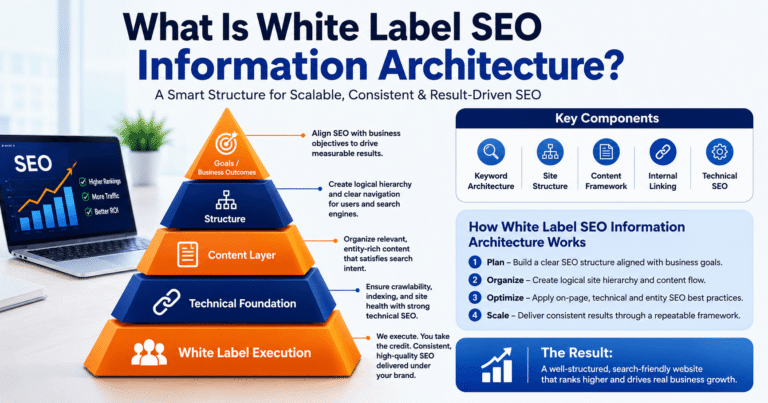
What Is White Label SEO Information Architecture?
Build a scalable SEO information architecture by carefully planning and organising a client’s website structure within a white label SEO delivery model.
It determines:
- Which pages the website needs
- How pages should be grouped
- Which pages are most important
- How services relate to products and locations
- Which content belongs under each topic
- How internal links should connect pages
- How URLs should be structured
- How users move from information to conversion
- How SEO teams should prevent overlapping page intent
In simple terms:
Business structure → Website structure → SEO structure → Internal linking → User journey
A white label provider may perform this work while the agency remains responsible for the client relationship and presents the strategy under its own brand.
This is particularly useful when an agency has several clients but wants a consistent process for technical SEO, content planning, internal linking and website optimisation.
Why Information Architecture Matters for SEO
Imagine a manufacturer in Gujarat that sells:
- Industrial machinery
- CNC equipment
- Automation systems
- Machine components
- Maintenance services
The business also wants customers from Ahmedabad, Surat, Vadodara, Mumbai and Pune.
A basic keyword approach might produce dozens of keywords and pages.
But keywords alone do not answer the more important questions:
- Which page should target the core manufacturing service?
- Which products deserve dedicated pages?
- Should every city have a separate landing page?
- Which informational topics should support commercial pages?
- Which pages should link to one another?
- Which pages are competing for the same search intent?
- Which pages should be prioritised for conversions?
That is the role of information architecture.
Google explains that its systems use site structure and internal links to understand relationships between pages, while its documentation recommends logical site organisation and links to important pages from relevant content.
A well-planned structure therefore helps solve both SEO discoverability and user navigation problems.
White Label SEO Site Architecture vs Traditional Website Structure
A normal website structure is often designed primarily around navigation.
SEO information architecture goes further.
It considers:
Website consideration | SEO information architecture consideration |
Navigation | Search intent |
Menus | Page hierarchy |
Categories | Topic relationships |
Products | Commercial intent |
Blog | Topical support |
Locations | Local search intent |
URLs | Logical hierarchy |
Internal links | Authority and context |
CTAs | Conversion journey |
A website can look attractive while still having a poor SEO structure.
For example, a homepage may link to six major services, but those services may have no supporting content, weak internal links, unclear hierarchy, or overlapping intent.
The objective is not to make a website larger.
The objective is to make its information easier to understand and navigate.
Core Components of White Label SEO Information Architecture
1. Start With Business Information
Do not begin architecture planning with keywords.
Start with the business.
Document:
- Products
- Services
- Locations
- Target customers
- Industries
- Business model
- Primary commercial priorities
- High-value products
- High-margin services
- Customer problems
- Competitors
- Existing website pages
This prevents the SEO team from building an architecture that looks good in a spreadsheet but does not reflect the company’s actual business.
For a healthcare business, treatment categories may be more important.
For an ecommerce business, product categories and attributes may dominate.
For a B2B manufacturer, product families and industry applications may matter more.
2. Map Search Intent Before Creating Pages
Not every keyword deserves a separate URL.
Consider these searches:
- digital marketing agency Ahmedabad
- digital marketing services Ahmedabad
- SEO agency Ahmedabad
- SEO services Ahmedabad
- local SEO services Ahmedabad
There is potential overlap between these terms.
Creating five pages simply because five keyword variations exist can create unnecessary duplication or competing intent.
Instead, ask:
What does the searcher actually want?
Search intent can generally be grouped into:
- Informational
- Commercial investigation
- Transactional
- Navigational
- Local
A strong architecture maps the intent to the appropriate page.
For example:
SEO agency Ahmedabad → service/location landing page
How does SEO work for manufacturers? → informational article
SEO pricing for small businesses → commercial investigation article
Local SEO checklist → supporting educational content
This approach makes the website more coherent than creating pages around every keyword variation.
3. Build a Logical Page Hierarchy
A practical SEO architecture might look like this:
Homepage
│
├── Services
│ ├── SEO
│ ├── Google Ads
│ ├── Meta Ads
│ ├── Local SEO
│ └── Website Development
│
├── Industries
│ ├── Healthcare
│ ├── Ecommerce
│ ├── Manufacturing
│ ├── Real Estate
│ └── Education
│
├── Locations
│ ├── Ahmedabad
│ ├── Surat
│ ├── Vadodara
│ └── Mumbai
│
└── Resources
├── SEO Guides
├── PPC Guides
├── Local SEO
└── Digital Marketing
The exact structure should change according to the business.
A SaaS company may need product-led categories.
An ecommerce store may require category → subcategory → product relationships.
A local service business may need service → location relationships.
The architecture should reflect the actual commercial model, not an SEO template.
Step-by-Step White Label SEO Architecture Strategy
Step 1: Audit the Existing Website
Before recommending new pages, audit what already exists.
Review:
- Indexed pages
- Organic landing pages
- Existing rankings
- Search Console queries
- Organic traffic
- Conversion pages
- Existing URLs
- Orphan pages
- Broken links
- Redirects
- Duplicate or similar pages
- Internal links
- Navigation
- Breadcrumbs
- Blog categories
- Service pages
- Location pages
Google Search Console can help SEO teams understand how a website performs in Google Search, including queries and pages generating search visibility.
The goal is to understand the existing architecture before changing it.
Step 2: Perform Competitor Architecture Analysis
Do not copy competitors.
Study them.
Look at:
- Main navigation
- Service categories
- Product organisation
- Location pages
- Content hubs
- URL patterns
- Internal linking
- Breadcrumbs
- Commercial landing pages
- Supporting content
- FAQ organisation
For example, suppose three competitors have strong rankings for manufacturing SEO terms.
Instead of asking:
“How many pages do they have?”
ask:
“What information do they make easier for customers to find?”
That can reveal opportunities that keyword research alone may miss.
Step 3: Create a Keyword-to-URL Map
A keyword-to-URL map prevents multiple pages from targeting the same intent.
A simple framework:
Search theme | Search intent | Recommended page |
SEO services | Transactional | SEO service page |
SEO pricing | Commercial | Pricing guide |
SEO for manufacturers | Commercial | Industry landing page |
Technical SEO checklist | Informational | Blog guide |
SEO agency Ahmedabad | Local/commercial | Location service page |
The key is to assign one primary purpose to each important page.
Secondary terms can naturally support that page without requiring separate URLs.
Step 4: Design Internal Linking Around Relationships
Internal links should not be added simply because an article needs links.
They should make sense.
For example:
SEO Services
↓
SEO for Manufacturers
↓
Technical SEO for Manufacturing Websites
↓
Manufacturing SEO Checklist
The links create a contextual relationship.
Google specifically recommends relevant internal linking and concise anchor text because links help users and Google understand pages and discover additional content.
For a white label SEO team, internal linking should therefore be part of the content brief rather than an afterthought.
White Label SEO Website Structure for Different Indian Businesses
Local Service Businesses
A local business may need an architecture such as:
Home → Services → Service Details → Locations → Contact
For example:
- Pest control
- Termite treatment
- Commercial pest control
- Residential pest control
- Pest control Ahmedabad
- Pest control Gandhinagar
However, location pages should have a genuine purpose.
Simply replacing “Ahmedabad” with “Surat”, “Vadodara”, and “Rajkot” on nearly identical pages does not create a useful local architecture.
Real Estate Businesses
Real estate websites can become complicated quickly.
A structure may involve:
Property Type → Location → Project → Supporting Information
For example:
- Residential properties
- Apartments
- Villas
- Commercial property
- Ahmedabad
- West Ahmedabad
- New projects
- Buying guides
- Home loan information
The architecture must balance search demand with usability.
A website containing thousands of thin location and property combinations can become difficult to manage.
Manufacturing Businesses
Manufacturers often benefit from:
Industry → Product → Application → Location → Resources
For example:
- Industrial machinery
- CNC machinery
- Automation equipment
- Textile machinery
- Pharmaceutical machinery
- Product specifications
- Industry applications
- Technical guides
This structure helps connect commercial pages with educational content.
It is particularly useful for B2B companies where buyers may research specifications and applications before contacting a supplier.
Ecommerce Businesses
Ecommerce architecture usually needs careful control over:
- Categories
- Subcategories
- Products
- Filters
- Brand pages
- Buying guides
- Comparisons
Faceted navigation can generate many URLs that provide little independent search value.
Therefore, SEO teams should determine which combinations deserve indexable pages and which should remain primarily navigation or filtering mechanisms.
Google’s crawling and indexing documentation specifically covers URL organisation and crawl management for websites with complex structures.
Common White Label SEO Architecture Mistakes
Mistake 1: Creating a Page for Every Keyword
This is one of the most common problems.
Keyword research identifies search demand.
It does not automatically determine the number of pages required.
Better approach: Group keywords according to search intent and business purpose.
Mistake 2: Making Every Page Equally Important
Not every URL deserves the same internal-link prominence.
A high-value service page should generally receive stronger contextual support than a minor informational article.
Create a clear hierarchy of:
- Primary pages
- Supporting pages
- Conversion pages
- Educational pages
Not every URL deserves the same internal-link prominence.
A high-value service page should generally receive stronger contextual support than a minor informational article.
Create a clear hierarchy of:
- Primary pages
- Supporting pages
- Conversion pages
- Educational pages
Paid advertising can generate immediate traffic, while SEO can contribute to longer-term organic visibility.
Combining both requires careful measurement, but an agency can use SEO to complement its broader customer acquisition strategy.
Mistake 3: Ignoring Existing URLs
A new architecture should not automatically replace everything.
Changing URLs unnecessarily can create additional migration and redirect work.
Google recommends logical, human-understandable URL structures.
Before changing a URL, determine whether the change solves a real problem.
Mistake 4: Publishing Location Pages at Scale
Indian businesses often target many cities.
That can create temptation to publish:
SEO Services Ahmedabad
SEO Services Surat
SEO Services Vadodara
SEO Services Rajkot
SEO Services Pune
SEO Services Mumbai
But if every page has substantially the same information, the architecture becomes repetitive.
A location page should exist because the business genuinely serves that location and can provide useful local context.
Mistake 5: Treating the Blog as a Separate Website
A blog should support the commercial architecture.
For example:
SEO Services
can be supported by:
- Technical SEO guide
- Local SEO guide
- SEO pricing guide
- SEO audit checklist
- SEO for manufacturers
- SEO for ecommerce
The blog then becomes part of the site’s topical architecture rather than a collection of disconnected articles.
How to Measure Whether the Architecture Is Working
Do not judge information architecture only by rankings.
Measure several signals.
Search visibility
Monitor:
- Impressions
- Clicks
- Search queries
- Ranking trends
- Landing pages
Website behaviour
Review:
- Engagement
- Navigation paths
- Important page visits
- Form interactions
- Phone clicks
- WhatsApp clicks where tracked
Business outcomes
For lead-generation businesses, track:
- Qualified enquiries
- Calls
- Form submissions
- Sales-qualified leads
- Enquiry-to-sale progression
A manufacturer may care more about qualified RFQs than raw traffic.
A clinic may care about appointment enquiries.
An ecommerce business may focus on transactions and revenue.
The architecture should support the business objective.
Practical Examples
Example 1: Local Service Business
Imagine a hypothetical Ahmedabad-based interior design company.
Its website receives organic traffic, but visitors struggle to understand which services are available.
The website has one large “Services” page containing:
- Residential interiors
- Office interiors
- Modular kitchens
- Renovation
- Commercial design
A better architecture could separate major commercial services where the search intent and customer journey are meaningfully different.
Supporting articles could answer questions about:
- Interior design costs
- Project timelines
- Material selection
- Design styles
- Renovation planning
The lesson is simple:
The solution is not necessarily more content. It may be better organisation.
Example 2: B2B Manufacturer
Consider a hypothetical manufacturer serving customers across Gujarat and Maharashtra.
The website has product descriptions but very little supporting content.
Instead of publishing generic articles such as “Benefits of Digital Marketing,” the SEO team could build content around the company’s actual commercial topics:
- Product applications
- Technical specifications
- Industry use cases
- Maintenance
- Buying considerations
- Product comparisons
- Installation questions
The architecture then connects informational resources to commercial product pages.
That creates a more useful customer journey.
Myths vs Facts
Myth 1: More pages always mean better SEO.
Fact: More pages can create value only when they serve distinct search intent or customer needs. Unnecessary pages can make a website harder to manage.
Myth 2: Every keyword needs its own URL.
Fact: Related keywords can often be addressed effectively on one well-focused page when their search intent is similar.
Myth 3: Internal links are only for navigation.
Fact: Internal links also help users and search engines discover related content and understand relationships between pages.
Myth 4: A beautiful website automatically has good SEO architecture.
Fact: Visual design and information architecture solve different problems. A website can look excellent while having confusing URLs, weak hierarchy and poor internal linking.
Myth 5: Every Indian city needs a dedicated SEO landing page.
Fact: Location pages should provide genuine value and represent real business coverage. City-name variations alone are not a strong reason to create separate pages.
Myth 6: Information architecture guarantees rankings.
Fact: Architecture is one part of SEO. Rankings also depend on content quality, relevance, competition, technical accessibility, authority and many other factors. Google explicitly notes that following its Search Essentials does not guarantee crawling, indexing, or ranking.
White Label SEO Information Architecture Checklist
Before approving a client’s architecture, check:
- Business priorities are documented
- Target audiences are defined
- Primary services/products are identified
- Target locations are confirmed
- Search intent has been mapped
- Existing URLs have been audited
- Keyword-to-URL mapping is complete
- Similar pages have been reviewed for overlap
- Main commercial pages are clearly prioritised
- Supporting content has a defined purpose
- Internal linking relationships are planned
- URLs are logical and readable
- Breadcrumbs are considered where useful
- Location pages provide genuine value
- Conversion paths are clear
- Search Console data has been reviewed
- Analytics and conversion tracking are available
- Architecture supports future content expansion
When Should an Agency Consider Professional White Label SEO Architecture Services?
Professional support can make sense when an agency:
- Has increasing SEO fulfilment demand
- Does not have an experienced technical SEO team
- Manages websites with hundreds or thousands of URLs
- Works with ecommerce clients
- Handles multi-location businesses
- Serves B2B manufacturers
- Needs scalable content architecture
- Has difficulty controlling keyword cannibalisation
- Needs consistent SEO processes across clients
- Wants to expand SEO services without building every capability internally
Flying Lion Media’s white label SEO-related services already cover areas such as keyword research, search-intent analysis, technical SEO, content planning, internal linking, local SEO, ecommerce SEO, competitor analysis and reporting.
The important question is not simply whether an agency can outsource SEO.
It is whether the partner can follow the agency’s strategic standards and produce a consistent client experience.
How White Label SEO Information Architecture Fits Into a Larger SEO Workflow
Information architecture should not operate separately from the rest of SEO.
A practical workflow looks like this:
Business discovery
↓
Competitor analysis
↓
Search intent research
↓
Keyword clustering
↓
Information architecture
↓
Keyword-to-URL mapping
↓
Content planning
↓
Technical SEO
↓
Internal linking
↓
Conversion optimisation
↓
Performance measurement
This is why architecture should ideally be planned before large-scale content production begins.
If an agency publishes 100 articles first and only later decides how they should relate to service pages, fixing the structure can become significantly more complicated.
Conclusion
White Label SEO Information Architecture is not simply a sitemap with keywords added to it.
It is a strategic framework for deciding how a client’s business information should be organised online.
For Indian agencies, this becomes especially valuable when managing clients with multiple services, cities, products, industries or customer segments.
The strongest approach is to begin with the business, understand search intent, analyse the existing website, group related topics, assign clear page purposes, build logical internal links and connect the architecture to measurable business goals.
The goal is not to build the biggest website.
Build the clearest one.
If your agency is dealing with overlapping pages, unstructured content, weak internal linking or growing SEO fulfilment requirements, an architecture audit can be a practical starting point. Flying Lion Media can help evaluate the current structure and develop an SEO roadmap aligned with the client’s business priorities rather than simply adding more keywords.