

White Label Lead Generation For Agencies In India: Indian digital marketing agencies often reach a point where selling lead generation becomes easier than delivering it consistently.
An agency may already have SEO, website design, social media or Google Ads clients asking for more enquiries. The sales team sees an opportunity, but the delivery side creates a different problem: campaign setup, landing pages, tracking, audience research, creative testing, lead qualification, reporting and optimisation all require specialist resources.
Hiring a complete in-house lead-generation team can make sense at a certain scale. But for a growing agency, it can also create fixed salaries, management overhead, tool costs and capacity problems before recurring demand is predictable.
This is where white label lead generation for agencies in India becomes a practical business model.
Instead of building every lead-generation capability internally, an agency can work with a specialist fulfillment partner while keeping the client relationship, communication and brand ownership under its own name.
The important question is not simply whether outsourcing lead generation is possible. The better question is whether the partner, process, tracking and lead-quality standards are strong enough to protect your agency’s reputation.
This guide explains how white label lead generation works, what agencies should look for, how to evaluate lead quality, common mistakes, industry considerations and when outsourcing makes commercial sense.
What Is White Label Lead Generation for Agencies in India?
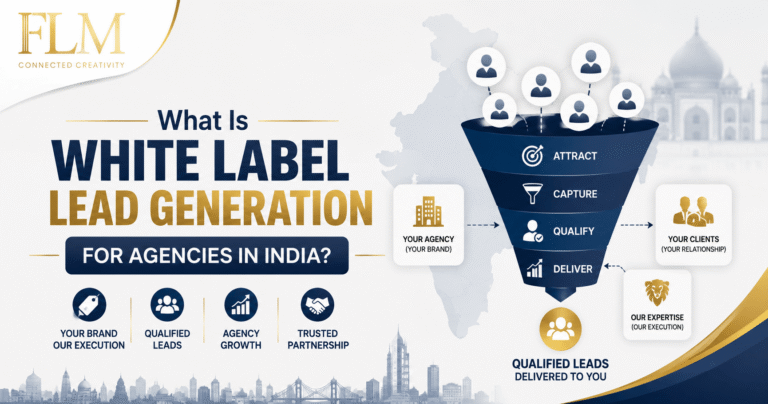
White label lead generation for agencies in India is a fulfillment model in which a specialist provider helps an agency generate and manage potential customer enquiries while the agency presents the service to its own clients under its brand.
The agency typically remains responsible for:
- Client acquisition
- Client relationship management
- Commercial discussions
- Service positioning
- Client communication
- Strategic decisions
The white label partner may handle agreed fulfillment activities such as:
- Audience research
- Competitor analysis
- Campaign planning
- Google Ads
- Meta Ads
- Landing-page recommendations
- Lead-form campaigns
- Conversion tracking
- Campaign optimisation
- Lead-quality analysis
- Performance reporting
The exact division of responsibilities should be agreed before a campaign starts.
A useful way to think about the model is:
Client → Your Agency → White Label Lead Generation Partner → Your Agency → Client
Your agency remains the visible service provider. The fulfillment partner operates behind the scenes according to the agreed workflow.
This is similar to other white-label marketing models where agencies outsource specialist execution while maintaining ownership of the client relationship. Flying Lion Media’s existing white-label material, for example, describes structured fulfillment, defined responsibilities, quality controls, reporting and communication as important parts of an outsourcing relationship.
Why Are Indian Agencies Outsourcing Lead Generation?
The main reason is usually capacity, not simply cost.
Imagine a digital marketing agency in Ahmedabad that has successfully built a portfolio of SEO and website-development clients.
Several clients now ask:
“Can you also generate leads for us?”
The agency has two choices.
It can immediately recruit:
- Performance marketers
- PPC specialists
- Meta Ads specialists
- Designers
- Landing-page developers
- Tracking specialists
- Account managers
Or it can use an experienced lead-generation partner and build internal capability gradually as demand becomes predictable.
For many small and mid-sized agencies, the second approach can reduce the operational pressure associated with adding a completely new service line.
The real advantage is scalability
A good white label partnership can allow an agency to expand its service offering without having to create every specialist role on day one.
However, outsourcing should not mean handing over responsibility blindly.
The agency still needs to understand:
- What is being promised?
- Who is the target audience?
- What counts as a qualified lead?
- Which channels are being used?
- What happens when lead quality falls?
- How are campaigns reported?
- Who approves major changes?
- How quickly are issues escalated?
White label fulfillment works best when these questions are answered before the first campaign launches.
White Label Lead Generation Services: What Should They Include?
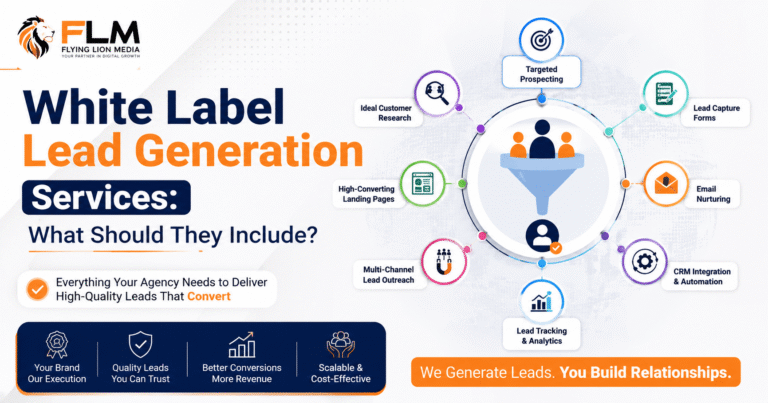
A serious white label lead generation agency should offer more than simply sending traffic to a form.
A complete workflow can include several connected stages.
1. Business and Offer Research
Before launching campaigns, the team should understand:
- What the client sells
- Who buys it
- Where customers are located
- Average order or contract value
- Sales cycle
- Main competitors
- Key differentiators
- Customer objections
- Existing marketing performance
This is especially important for B2B companies.
A manufacturer selling industrial equipment should not be marketed in exactly the same way as a local salon or coaching institute.
2. Audience Research
Lead generation becomes more useful when the audience is clearly defined.
For example, a real estate client might target:
- First-time homebuyers
- Investors
- NRI buyers
- Buyers within a particular budget
- People searching for property in specific locations
A SaaS company could instead target:
- Founders
- Marketing managers
- Sales directors
- Operations managers
- Businesses within a specific employee range
The audience influences the campaign, messaging, landing page and qualification process.
3. Channel Selection
Different businesses require different acquisition channels.
A white label lead generation partner may recommend:
Google Ads
Useful when people are already searching for a product or service.
Meta Ads
Useful when audience targeting, creative and demand generation are important.
SEO
Useful for building long-term organic visibility around relevant commercial searches.
Landing Pages
Useful when a campaign needs a focused conversion experience rather than sending visitors to a generic homepage.
Remarketing
Useful for reconnecting with people who previously interacted with the website or campaign, where appropriate and compliant.
The goal should not be to use every available channel.
The goal is to identify the channels that make sense for the client’s customer journey and budget.
Why Lead Quality Matters More Than Lead Volume
One of the biggest mistakes agencies make when selling lead generation is focusing on the number of leads rather than their business value.
Consider two hypothetical campaigns.
Example 1: Real estate
A real estate company receives 200 enquiries.
That sounds impressive.
But after the sales team reviews them, many are:
- Outside the target location
- Looking for a different property type
- Below the required budget
- Duplicate submissions
- Unreachable contacts
The campaign has generated volume, but the sales team does not consider the leads useful.
Now imagine another campaign generates 60 enquiries, but a significantly higher proportion match the location, budget and property requirements.
The second campaign may be more valuable even though the lead count is lower.
Example 2: B2B manufacturer
Imagine a hypothetical Ahmedabad-based manufacturer offering specialised industrial equipment.
The campaign receives many enquiries for generic manufacturing terms.
However, most visitors are students, job seekers or people researching basic concepts.
The problem is not necessarily the advertising platform.
The targeting and search intent may be wrong.
A better campaign could focus on searches connected to:
- Specific machinery
- Industrial applications
- Product specifications
- Procurement requirements
- Commercial solutions
- Supplier searches
The lesson: lead generation should be evaluated according to lead quality and business relevance, not just raw enquiry volume.
How to Build a White Label Lead Generation Workflow
A repeatable workflow helps your agency deliver a more consistent client experience.
Step 1: Define the client's business goal
Do not build a strategy around search volume alone.
Separate keywords into categories such as:
- Informational
- Commercial investigation
- Transactional
- Local
For example, a B2B manufacturer may benefit more from searches related to a specific product, application, specification, or service than from broad keywords with high traffic potential.
Step 2: Define a qualified lead
This step is frequently overlooked.
A qualified lead might require:
- Correct location
- Relevant service requirement
- Valid contact details
- Appropriate budget
- Relevant company type
- Appropriate project timeline
The definition should vary by business.
For a local clinic, an appointment enquiry may be enough.
For a B2B manufacturer, qualification may require understanding the company, product requirement and purchasing intent.
Step 3: Audit existing assets
Before spending more money, review what already exists.
Check:
- Website
- Landing pages
- Google Business Profile where relevant
- Existing campaigns
- Analytics
- Google Search Console
- Conversion tracking
- CRM
- Previous lead data
- Sales follow-up process
Sometimes the biggest problem is not traffic.
It may be the conversion journey.
Step 4: Analyse competitors
Review competing businesses for:
- Offers
- Landing pages
- Search visibility
- Ad messaging
- Calls to action
- Location targeting
- Lead forms
- Content
- Reviews
- Positioning
The objective is not to copy competitors.
It is to identify opportunities and avoid entering the market without understanding the existing competition.
Step 5: Create the campaign structure
Depending on the business, this can include:
- Search campaigns
- Display or remarketing campaigns
- Meta campaigns
- Lead-form campaigns
- Landing-page campaigns
- Local campaigns
- Content-led acquisition
Each campaign should have a defined purpose.
Step 6: Set up conversion tracking
Tracking is essential because clicks and impressions do not tell the whole story.
Google Ads conversion tracking can measure valuable actions such as sales, leads, phone calls and other website actions.
For agencies, this becomes even more important because the objective is not simply to report advertising activity.
You need to understand whether marketing activity is contributing to actual business opportunities.
Step 7: Connect lead data with sales information
This is where more mature agencies can gain an advantage.
Suppose a campaign produces 100 enquiries.
Your CRM identifies:
- 100 raw leads
- 55 contacted
- 30 qualified
- 12 proposals
- 4 closed opportunities
Now the agency has a much better understanding of the funnel.
Google Ads also supports conversion categories such as qualified leads and converted leads, allowing businesses to connect advertising activity with deeper stages of the sales process.
That is much more useful than reporting only:
“We generated 100 leads.”
How White Label Lead Generation Differs by Industry
There is no universal lead-generation campaign that works equally well across industries.
Healthcare
Healthcare campaigns need careful attention to:
- Location
- Treatment/service intent
- Trust
- Appointment conversion
- Call tracking
- Landing-page clarity
- Compliance considerations
A clinic may care more about appointment enquiries than website traffic.
Real Estate
Real estate campaigns often require:
- Location targeting
- Property type
- Budget qualification
- Project-specific landing pages
- Lead qualification
- Sales follow-up
High enquiry volume can become difficult to manage if qualification is weak.
Education
Education campaigns can be influenced by:
- Admission seasons
- Course demand
- Location
- Student profiles
- Parent decision-making
- Lead response speed
Manufacturing
B2B manufacturing usually requires greater attention to:
- Product specifications
- Industrial applications
- Procurement intent
- Company type
- Geography
- Longer sales cycles
A manufacturer may need fewer but substantially more relevant enquiries.
SaaS
SaaS campaigns can involve:
- Demo requests
- Free trials
- Product enquiries
- Account creation
- Lead qualification
- Sales-assisted conversions
The right KPI depends on the sales model.
White Label Lead Generation vs In-House Lead Generation
Factor | White Label Model | In-House Model |
Initial setup | Usually faster | Requires recruitment and setup |
Specialist access | External specialists | Internal employees |
Fixed staffing cost | Potentially lower | Usually higher |
Control | Requires strong processes | Direct internal control |
Scalability | Can be flexible | Depends on team capacity |
Management | Partner management required | Employee management required |
Best suited for | Growing agencies | Agencies with established demand |
Client relationship | Owned by agency | Owned by agency |
Neither model is automatically better.
An agency with predictable recurring demand, strong margins and sufficient workload may eventually benefit from an internal team.
A smaller agency testing a new service may prefer a white label partner while validating demand.
Common White Label Lead Generation Mistakes
Mistake 1: Choosing a partner based only on price
The cheapest provider may not produce the lowest overall business cost.
Poor lead quality can create:
- Sales-team waste
- Client complaints
- Refund discussions
- Account-management workload
- Retention problems
Evaluate delivery quality, communication and reporting alongside price.
Mistake 2: Promising a fixed number of leads
Lead generation depends on:
- Industry
- Competition
- Budget
- Offer
- Audience
- Location
- Landing page
- Sales process
- Market demand
A responsible agency should avoid guaranteeing a specific number of leads.
Mistake 3: Ignoring lead qualification
If every form submission is called a successful lead, the reporting can become misleading.
Define qualification criteria before launching.
Mistake 4: Sending every campaign to the homepage
A homepage often contains too many competing messages.
A dedicated landing page may provide a clearer path for a specific campaign.
Mistake 5: Reporting only clicks and leads
Clicks and lead counts are useful, but they do not explain the entire sales journey.
Where reliable data is available, agencies should also examine:
- Cost per lead
- Qualified leads
- Conversion rate
- Sales opportunities
- Cost per qualified lead
- Closed business
Mistake 6: Treating WhatsApp as the entire CRM
WhatsApp can be useful for rapid communication in India, but important lead status, qualification and follow-up information should be documented systematically.
6 Myths About White Label Lead Generation
Myth 1: More leads always mean better performance
Fact: Lead relevance and qualification matter. A smaller number of high-intent enquiries can be more useful than a large volume of poorly matched leads.
Myth 2: The biggest advertising budget always wins
Fact: Budget matters, but targeting, offer, creative, landing-page experience, tracking and optimisation also affect campaign performance.
Myth 3: White label means low quality
Fact: Quality depends on the partner’s expertise, processes, communication, QA and accountability.
Myth 4: SEO generates leads immediately
Fact: SEO is generally a longer-term acquisition channel, and improvements can take time. Google notes that search-result changes can take days to months depending on the situation and that rankings are not guaranteed.
Myth 5: One campaign structure works for every client
Fact: A local clinic, SaaS company, manufacturer and real estate company have different buying journeys.
Myth 6: Outsourcing means the agency loses control
Fact: A properly structured white label relationship can preserve agency control through defined scope, approvals, reporting and communication processes.
How to Measure a White Label Lead Generation Campaign
A useful reporting framework should answer five questions:
- How much traffic or reach did we generate?
- How many people took the desired action?
- How many enquiries were qualified?
- How many became genuine sales opportunities?
- What should we change next?
Important metrics may include:
- Leads
- Qualified leads
- Cost per lead
- Cost per qualified lead
- Conversion rate
- Click-through rate
- Landing-page conversion rate
- Sales opportunities
- Closed customers
- Revenue where reliable attribution exists
Google recommends establishing conversion measurement so businesses can understand which campaigns, keywords and other advertising elements are contributing to meaningful actions.
For more mature campaigns, connecting CRM outcomes back to advertising data can provide an even clearer view of lead quality.
When Should an Indian Agency Consider White Label Lead Generation?
White label lead generation can make sense when your agency:
- Already has clients asking for lead generation
- Has sales capability but limited fulfillment capacity
- Wants to add performance marketing
- Does not want to immediately hire a full specialist team
- Needs additional campaign capacity
- Wants to serve clients across multiple industries
- Needs a repeatable fulfillment process
- Wants to focus internal resources on strategy and client relationships
It may be less suitable when your agency has no clear service positioning, no sales process, no defined target market or no ability to manage client relationships.
Outsourcing cannot fix an unclear business model.
It should strengthen an existing agency operation.
How to Choose a White Label Lead Generation Partner
Before signing an agreement, ask potential partners:
1. What exactly do you handle?
Understand whether the provider handles strategy, campaigns, landing pages, tracking, reporting, optimisation or only selected tasks.
2. How do you define a qualified lead?
This should be discussed before campaigns begin.
3. How is reporting handled?
Look for reports that explain business outcomes rather than simply displaying platform screenshots.
4. How are poor-quality leads investigated?
There should be a process for analysing:
- Search terms
- Audience
- Geography
- Form submissions
- Duplicate enquiries
- Spam
- Sales feedback
5. How are client accounts managed?
Clarify access, communication, approvals and ownership.
6. Can the service scale?
If your agency wins ten additional clients, the partner should have a realistic fulfillment process for increased workload.
7. Is the arrangement genuinely white label?
Your agency should understand how branding, communication, reporting and client-facing materials will work.
Practical Scenario: A Growing Indian Digital Agency
Consider a hypothetical digital marketing agency in Ahmedabad.
The agency has strong website-development capabilities and around several ongoing clients. Existing customers are now asking for Google Ads and lead generation.
The agency’s founders do not want to recruit a complete performance marketing department immediately.
A sensible approach could be:
Phase 1: Define its lead-generation service.
Phase 2: Select a specialist fulfillment partner.
Phase 3: Establish qualification criteria.
Phase 4: Build campaign and reporting processes.
Phase 5: Launch with selected clients.
Phase 6: Review lead quality and sales feedback.
Phase 7: Improve the process before expanding.
The lesson is that outsourcing should be treated as an operating system, not simply as a way to transfer tasks.
Conclusion
White label lead generation for agencies in India can help digital agencies expand their service portfolio without immediately building every specialist capability internally.
But outsourcing alone does not create successful campaigns.
The strongest model combines:
- Clear positioning
- Defined target audiences
- Strong campaign strategy
- Accurate conversion tracking
- Relevant landing pages
- Lead qualification
- Transparent reporting
- Sales feedback
- Continuous optimisation
For an Indian agency, the real value of a white label partner is not simply the ability to launch another advertising campaign. It is the ability to build a repeatable fulfillment system that supports client growth while allowing the agency to retain control of the relationship.
If your agency is already receiving requests for lead generation but lacks the internal capacity to deliver it consistently, the next step is to evaluate your current workflow, client demand and fulfillment requirements.
Flying Lion Media can help agencies assess those requirements and explore a practical white label lead-generation approach without making unrealistic promises about outcomes.

One Response