

A digital marketing campaign can generate 500 enquiries in a month and still fail to produce meaningful business. The problem is not always the advertising platform, the budget, or the sales team. Sometimes the campaign is attracting the wrong people in the first place.
Imagine a real estate developer running Meta Ads for a new residential project in Ahmedabad. The campaign generates 300 enquiries at ₹150 per lead. The marketing dashboard looks impressive. But when the sales team calls, most people are looking for properties below the advertised price, some are outside the target location, and others do not remember submitting the form.
Meanwhile, a second campaign generates only 80 enquiries at ₹450 each. Yet 25 people have the right budget, 12 schedule site visits, and 3 eventually book apartments.
Which campaign performed better?
The second campaign may be the better investment, even though its cost per lead is three times higher. The answer depends on the quality of the enquiries, the sales outcomes, and the cost of acquiring an actual customer.
This is where many digital marketing reports fail. They celebrate leads, clicks, and low acquisition costs without asking whether those leads can realistically become paying customers.
In this guide, we will explain how to evaluate lead quality in digital marketing, distinguish genuine prospects from misleading enquiries, and build a practical system for improving campaign decisions.
A note on scope: This article uses real estate as its primary example because buyer qualification is particularly important in high-value property sales. The same principles apply to other businesses, including education, healthcare, B2B services, and ecommerce. The numerical examples and case studies below are illustrative scenarios, not verified client results or claims of personal campaign experience.
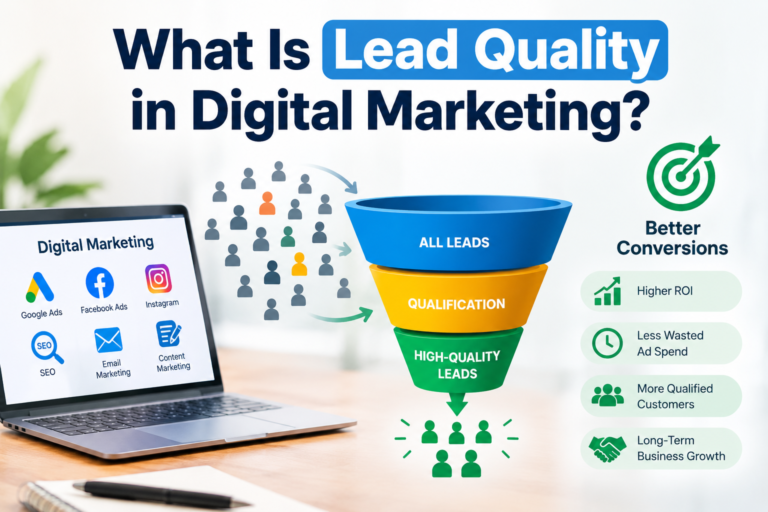
What Is Lead Quality in Digital Marketing?
Lead quality measures how closely an enquiry matches the business’s target customer and how likely that person is to take a meaningful next step toward purchasing.
A lead is not automatically valuable because someone has:
- Submitted a Facebook or Instagram form.
- Clicked a WhatsApp advertisement.
- Downloaded a brochure.
- Requested a callback.
- Entered a phone number on a landing page.
Those actions show some level of interest. They do not establish buying intent, financial suitability, or readiness.
For example, someone enquiring about a ₹90 lakh apartment may be a strong prospect if their budget is ₹85–95 lakh, they want to buy within three months, and the location meets their needs.
Someone else may submit the same enquiry simply to compare prices for a future purchase. That person is not necessarily a bad lead. They may be an early-stage prospect who needs nurturing rather than immediate sales follow-up.
The important distinction is this:
Lead quality is not simply whether someone will buy today. It is whether the lead is a realistic fit for the offer and whether the business has a sensible next step for that person.
Lead quality versus lead quantity
| Metric | What it tells you | What it does not tell you |
|---|---|---|
| Total leads | How many enquiries arrived | Whether they match your target |
| Cost per lead (CPL) | How much each enquiry cost | Whether the enquiry can convert |
| Qualified leads | How many meet agreed criteria | Whether they will eventually buy |
| Sales-qualified leads | How many are accepted for active sales follow-up | Whether the sale is guaranteed |
| Customers acquired | How many actual purchases occurred | Whether the acquisition was profitable |
A business that measures only total leads and CPL is evaluating the top of its marketing funnel while ignoring the commercial outcome.
Why Businesses Get Poor-Quality Leads Even When Ads Look Successful
Poor lead quality rarely has one single cause. It usually develops because the campaign attracts people with different needs, the offer is unclear, the form captures too little information, or the sales team does not distinguish between genuine prospects and casual enquiries.
Problem 1: The advertisement attracts attention but not the right audience
An advertisement saying “Luxury Apartments in Ahmedabad – Book Your Dream Home Today” may attract thousands of clicks.
But who is responding?
- Someone searching for a ₹40 lakh apartment.
- Someone interested in a ₹2 crore penthouse.
- Someone looking for a rental property.
- Someone researching the market without an immediate purchase plan.
These are four different audiences. A single generic campaign may attract all of them without giving the sales team enough information to prioritise.
My recommendation: Be specific about the offer before asking people to submit their contact details. If the project is intended for buyers with budgets of ₹80 lakh and above, communicate the approximate price range clearly. Hiding the price to maximise form submissions often creates more work for the sales team.
Problem 2: Low CPL becomes the wrong performance target
| Metric | Campaign A | Campaign B |
|---|---|---|
| Advertising spend | ₹30,000 | ₹30,000 |
| Leads generated | 300 | 100 |
| Cost per lead | ₹100 | ₹300 |
| Qualified leads | 30 | 40 |
| Cost per qualified lead | ₹1,000 | ₹750 |
Campaign A generated three times as many enquiries, but Campaign B generated more qualified leads at a lower cost per qualified lead.
This is why a low cost per lead should never be treated as proof of campaign success.
Problem 3: The form is too easy to submit but too difficult to act on
A form that asks only for a name and phone number may produce a large number of enquiries.
However, when the sales team calls, it may not know:
- What product or service the person wants.
- Whether the person has the required budget.
- Whether they are looking to purchase now or later.
- Whether the phone number is valid.
- Whether the enquiry came from a genuine person.
Do not respond by creating a 20-question form. Excessive questions can discourage serious prospects from submitting it.
Instead, ask the few questions that determine whether the offer is a reasonable fit.
Problem 4: The sales team labels every unanswered call as a bad lead
A prospect may be working, driving, attending a meeting, or unable to answer an unfamiliar number.
One unanswered call does not establish poor lead quality.
A sensible follow-up system should distinguish between:
- Invalid phone numbers.
- Duplicate enquiries.
- People who never respond after a reasonable follow-up sequence.
- Prospects who respond but do not qualify.
- Qualified prospects who need more time.
If the sales team immediately marks every missed call as “junk”, marketing receives inaccurate feedback and may optimise campaigns based on the wrong information.
Step-by-Step Action Plan to Evaluate Lead Quality
The following process is designed for businesses that receive leads through Meta Ads, Google Ads, landing pages, WhatsApp, online marketplaces, and organic search.
Step 1: Define what a qualified lead actually means
Before measuring lead quality, marketing and sales must agree on the definition of a qualified lead.
For a residential property campaign, the criteria might include:
- The person is interested in buying rather than renting.
- The preferred property configuration is available.
- Their budget is reasonably aligned with the project.
- Their preferred location is within the project’s practical catchment.
- Their buying timeline is known.
- They are willing to have a relevant conversation with the sales team.
For a B2B agency, the criteria could be different: business type, monthly marketing budget, decision-making authority, and the service required.
A qualified lead should not be defined merely as someone who answered a phone call.
Why this matters: If the marketing team considers every form submission qualified while the sales team only considers people ready to purchase immediately, the two teams will argue about performance without measuring the same thing.
Mistake to avoid: Making qualification criteria so restrictive that all early-stage buyers are discarded. A person buying in six months may be commercially valuable even if they are not ready for a sales meeting today.
Step 2: Check whether the lead matches your target audience
The first practical test is relevance.
Ask whether the person belongs to the audience for which the campaign was created.
For real estate, check location, property type, price range, and buying purpose.
For a digital marketing agency, check industry, service requirement, business size, and whether the prospect expects services that the agency actually provides.
You should also check whether the lead came from the intended geographical market.
For example, if a campaign targets Ahmedabad, enquiries from another city may be irrelevant for a local property project. However, an NRI or an outstation buyer looking for a property in Ahmedabad should not automatically be rejected just because their current location is elsewhere.
Pro tip: Use campaign-specific landing pages and forms. A lead generated by an affordable housing campaign should not be mixed with enquiries for a premium residential project without identifying which offer the person responded to.
Step 3: Assess budget fit without making assumptions
Budget is one of the most useful qualification signals, particularly for high-value purchases.
Suppose the advertised apartments start at ₹85 lakh.
A person whose stated budget is ₹80–90 lakh may be a strong fit, depending on the available inventory and additional costs.
A person whose budget is ₹45 lakh may not be a fit for that specific project. But the enquiry could still be valuable if the business offers another suitable property.
Do not automatically treat budget mismatch as low intent. It may be a product mismatch.
For services, the equivalent question is whether the prospect’s budget is sufficient for the actual scope of work.
What to avoid: Asking people for their exact salary, bank balance, or unnecessary financial information at the first stage. A broad budget range is usually enough to establish initial suitability.
Step 4: Understand buying intent and timeline
A good qualification system distinguishes between interest and readiness.
A property lead might be:
- Ready to visit this week.
- Planning to purchase in one to three months.
- Comparing projects over the next six months.
- Exploring prices without a confirmed buying plan.
All four may be genuine enquiries, but they require different follow-up.
A ready buyer should receive prompt assistance with availability, site visits, and relevant documents.
A prospect who is still researching should receive useful information without aggressive sales pressure.
For a B2B agency, buying intent may be indicated by a prospect asking for a proposal, explaining a current business problem, or requesting a meeting about a specific service.
Mistake to avoid: Treating a prospect who says “I am not buying this month” as a permanently lost lead. A well-managed nurturing process may convert that person later.
Step 5: Verify contact validity and genuine engagement
A lead with an invalid phone number cannot enter the normal sales process.
But there is an important difference between an invalid number and a valid number that has not yet responded.
Use the following checks:
- Check whether the phone number or email address is correctly formatted.
- Identify duplicate enquiries from the same person.
- Confirm whether the person remembers the offer.
- Ask whether they are interested in the advertised product or service.
- Record whether they agree to a suitable next step.
For example, a prospect who confirms their interest, explains their budget, and agrees to a meeting is demonstrating stronger engagement than someone who submitted a form accidentally.
However, engagement alone is not enough. A person can enthusiastically enquire about a property that is completely outside their budget.
Step 6: Evaluate lead quality through sales outcomes
Marketing should not stop measuring performance when a lead becomes qualified.
Track what happens next:
- Was a meaningful conversation completed?
- Was a meeting or site visit scheduled?
- Did the prospect attend?
- Did the person request a quotation or proposal?
- Did the prospect enter negotiation?
- Did the business acquire a customer?
For property campaigns, a site visit is a useful intermediate outcome, but it is not a sale.
A prospect who attends a site visit and discovers that the project does not meet their requirements should not necessarily be classified as a bad marketing lead. The campaign may have accurately identified a potential buyer, while the property itself was not the right match.
The more expensive mistake is repeatedly paying to attract people who have no realistic interest in the offer.
Step 7: Calculate cost per qualified lead
Once qualified leads are defined, calculate their acquisition cost.
CostperQualifiedLead=MarketingSpendQualifiedLeads
Example:
A business spends ₹60,000 and generates 200 enquiries.
After qualification, 40 leads meet its criteria.
₹60,00040=₹1,500
The cost per qualified lead is ₹1,500.
Now compare that with another campaign that spends ₹60,000, generates 100 leads, and qualifies 50.
₹60,00050=₹1,200
The second campaign produces fewer enquiries but better-qualified leads at a lower cost.
This metric is more useful than raw CPL, but it still does not establish profitability. A qualified lead may never purchase.
Step 8: Compare lead quality by source, campaign, and creative
Do not evaluate the entire advertising account as one unit.
Separate performance by:
- Meta Ads versus Google Ads.
- Campaign and ad set.
- Search keyword or search intent.
- Creative and landing page.
- Lead form versus WhatsApp enquiry.
- Organic versus paid traffic.
- Sales representative, where follow-up quality is being evaluated.
Suppose one Meta campaign generates many enquiries from people looking for low-priced properties, while another attracts fewer enquiries from buyers whose budgets match the advertised price range. Comparing both campaigns helps you Identify leads that are more likely to convert and focus your budget on attracting relevant prospects rather than simply generating more enquiries.
If both campaigns are grouped together, the stronger campaign can be hidden by the weaker one.
Pro tip: Keep the same qualification definition across campaigns. If one campaign is judged by valid phone numbers and another by site visits, the comparison is not fair.
Step 9: Feed qualified outcomes back into advertising platforms
Where supported, send meaningful downstream conversion events to your advertising platform.
For example, a property business may track:
- Lead submitted.
- Qualified lead.
- Site visit completed.
- Booking completed.
Google Ads and Meta offer conversion measurement capabilities, including the ability to use suitable offline or CRM conversion data in supported configurations.
The important condition is data quality.
If your CRM marks every lead as qualified, feeding that event back into advertising does not improve targeting. It simply teaches the system to optimise for an inaccurate definition.
Also check applicable consent, privacy, platform policies, and data-protection requirements before sharing customer information.
A Practical Lead Quality Scoring System
A lead score can help a sales team prioritise enquiries when the number of incoming leads is too large for everyone to receive immediate attention.
It should be treated as a decision-support tool, not an objective prediction of whether someone will buy.
Here is a simple example for a residential property campaign.
| Qualification Factor | Example Scoring |
|---|---|
| Budget matches advertised property | 0–25 |
| Preferred location matches | 0–20 |
| Buying timeline is clear | 0–20 |
| Property type matches | 0–15 |
| Genuine engagement and next-step interest | 0–20 |
| Maximum Score | 100 |
| Score | Suggested Action |
|---|---|
| 75–100 | Prioritise active sales follow-up |
| 50–74 | Clarify requirements and nurture |
| Below 50 | Review mismatch; redirect or nurture if appropriate |
These thresholds are examples. They should be adjusted after examining actual sales outcomes.
A lead scoring system should never use sensitive personal characteristics or arbitrary assumptions about a person’s ability to purchase.
Example: Two property enquiries
Lead A
- Budget: ₹90 lakh.
- Preferred location: matches project.
- Timeline: two months.
- Configuration: available 3 BHK.
- Agrees to a site visit.
Lead A would receive a high score because the offer and requirements are aligned.
Lead B
- Budget: ₹50 lakh.
- Preferred location: matches project.
- Timeline: six months.
- Configuration: available 3 BHK.
- Interested in receiving price information.
Lead B might receive a lower score for the current project but should not be dismissed as an invalid enquiry.
If the business has suitable inventory in another price range, Lead B may be a better opportunity for that alternative.
Case Studies: What Better Lead Evaluation Can Change
The following case studies are hypothetical examples constructed to demonstrate the calculations. They are not real client campaigns, independently audited performance, or personal advisory results.
Case Study 1: Residential Developer – End-User Campaign
A residential developer in Ahmedabad runs a campaign for apartments priced around ₹85 lakh to ₹1.10 crore.
The initial campaign generates 400 enquiries over one month.
| Metric | Initial Campaign |
|---|---|
| Advertising spend | ₹80,000 |
| Total leads | 400 |
| Cost per lead | ₹200 |
| Qualified leads | 40 |
| Cost per qualified lead | ₹2,000 |
| Site visits completed | 12 |
| Bookings | 1 |
The sales team reports that many leads expected properties below ₹60 lakh. The campaign had not communicated its price range clearly.
The developer changes the landing page to display the approximate starting price, property configuration, and location before the form.
| Metric | Revised Campaign |
|---|---|
| Advertising spend | ₹80,000 |
| Total leads | 220 |
| Cost per lead | ₹364 |
| Qualified leads | 55 |
| Cost per qualified lead | ₹1,455 |
| Site visits completed | 20 |
| Bookings | 3 |
The second campaign produces fewer leads but more qualified prospects and site visits.
Lesson: A higher CPL can be acceptable when it is accompanied by a lower cost per qualified lead and stronger sales outcomes. The result should still be assessed over a sufficiently large period because three bookings are too few to establish a reliable long-term conversion rate.
Case Study 2: B2B Digital Marketing Agency – Lead Qualification
A digital marketing agency generates enquiries from businesses seeking advertising services.
The agency initially measures success by the number of forms submitted.
Over time, it discovers that many prospects:
- Have no advertising budget.
- Need services outside the agency’s capabilities.
- Are looking for free consultations only.
- Expect immediate sales guarantees.
The agency revises its enquiry form to ask about business type, service required, approximate monthly budget, and the current marketing problem.
Its illustrative campaign results are:
| Metric | Before | After |
|---|---|---|
| Advertising spend | ₹50,000 | ₹50,000 |
| Leads | 250 | 150 |
| Qualified leads | 25 | 45 |
| Cost per qualified lead | ₹2,000 | ₹1,111 |
| Proposals sent | 10 | 25 |
| Customers acquired | 2 | 5 |
Testimonials and Social Proof: What You Should Actually Publish
Testimonials can help potential customers understand whether a business delivers a useful service. But fabricated testimonials damage trust and may create misleading advertising.
The following are illustrative testimonial formats only, not genuine customer statements. Do not publish them as real reviews or attribute them to actual buyers without permission and verification.
Example testimonial format – Residential buyer
“We were comparing several projects and initially struggled to understand which enquiries were worth following up on. Having our budget and preferred location clarified early helped us focus on the properties that actually suited our requirements.”
Replace with a genuine, consented statement from a verified buyer. Include the person’s actual buyer category and location only if they have agreed to share those details.
Example testimonial format – Business owner
“We used to judge our campaigns mainly by how many leads came in. After tracking qualified enquiries and sales meetings separately, we could see which campaigns were actually useful to our business.”
Replace with a real customer statement supported by campaign records and appropriate permission.
For credibility, a real testimonial should be accompanied by enough context to understand what was measured. A statement such as “lead quality improved by 300%” is meaningless unless the starting metric, measurement period, and qualification definition are explained.
Read More :- Affordable Digital Marketing Solutions for Startups in India: A Practical Guide to Growing on a Small Budget
Verified Data, Market Context, and Reliable Sources
Lead quality should be evaluated using first-party business records wherever possible.
For a real estate marketing campaign, relevant evidence may include:
- CRM records showing enquiry source and qualification status.
- Sales call notes and verified site visit records.
- Booking records and transaction outcomes.
- Campaign expenditure from advertising accounts.
- Landing-page analytics and form submission records.
For other businesses, use the equivalent records: sales-qualified opportunities, completed consultations, proposals, contracts, or actual purchases.
What external benchmarks can and cannot tell you
Published benchmarks may offer context, but they are not a substitute for your own data.
A conversion rate reported for a luxury real estate campaign in Mumbai may not apply to an affordable housing project in Ahmedabad.
Likewise, a B2B campaign targeting large enterprises cannot be judged against the same qualification criteria as a campaign targeting small local businesses.
When reviewing external reports, check:
- Who conducted the research?
- What period was measured?
- What does the source define as a lead?
- Is the conversion measured from form submission to booking, or from qualified lead to booking?
- Is the sample size large enough to make the comparison useful?
A published conversion rate is not automatically a target your business should achieve.
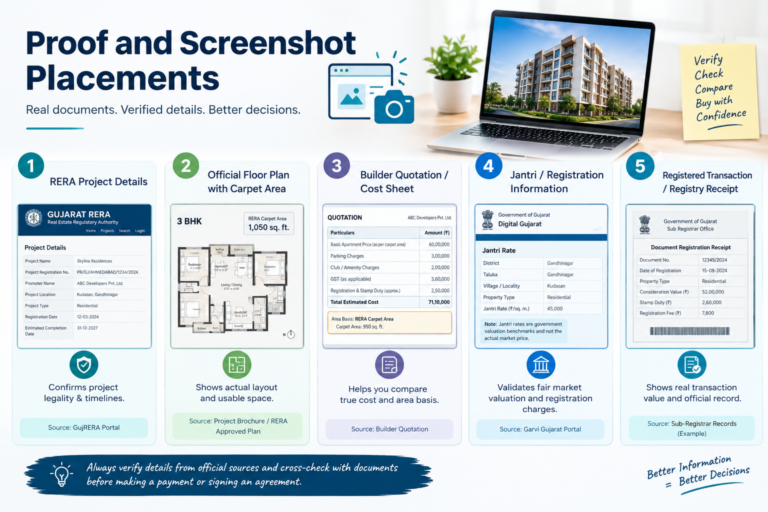
Proof and Screenshot Placements
Who This Lead Quality Guide Is Not For
This guide is not designed for businesses that want to manipulate advertising platforms by labelling every enquiry as qualified.
It is also not a suitable approach for anyone expecting a scoring formula to guarantee sales.
Businesses that should rethink their lead-generation strategy
You may need to fix your offer before trying to improve lead quality if:
- Your product or service is unclear.
- Your pricing is not competitive for your target audience.
- Your landing page promises benefits that the business cannot deliver.
- Your sales team cannot follow up within a reasonable time.
- Your company does not have a clear definition of a qualified lead.
- Your business has no reliable records of what happens after a form submission.
If a project is priced well above the budget of the people responding, increasing lead volume is unlikely to solve the underlying mismatch.
Businesses that should not expect immediate results
If you sell high-value products, complex services, or property, your sales cycle may be long.
Someone who enquires today might need several months to make a decision.
It would be a mistake to reject all those prospects simply because they did not buy within the current reporting month.
This guide also will not help with:
- Buying fake leads or contact databases.
- Guaranteeing a particular conversion rate.
- Short-term manipulation of campaign metrics.
- Inflating qualified-lead numbers to impress clients.
- Using misleading offers to collect personal contact information.
A trustworthy lead-generation system should help a business make better decisions, not make its reports look better.
If I Were Evaluating Leads Today
If I were responsible for a digital marketing campaign today, I would make one decision before increasing the advertising budget:
I would stop optimising for the cheapest lead until I knew which campaigns were producing qualified prospects and actual sales.
Here is what I would prioritise.
The first thing I would check
I would review the last 30–90 days of enquiries and identify:
- The percentage of valid contacts.
- The percentage of leads that matched the target audience.
- The percentage that became qualified.
- The percentage that progressed to a sales meeting or site visit.
- The number of actual customers acquired.
The reporting period should be adjusted for the length of the sales cycle.
If the campaign is producing a large number of enquiries but very few qualified prospects, I would examine the advertisement and landing page before increasing the budget.
The campaign I would choose
I would favour the campaign that produces a consistent flow of relevant, qualified enquiries at an acquisition cost the business can afford.
I would not automatically select the campaign with the highest lead score or the lowest CPL.
A campaign with a lower volume of enquiries may be better, but only if its downstream outcomes support that conclusion.
What I would negotiate hardest
If an agency or marketing team reports that it generated 1,000 leads, I would ask:
- How many were valid?
- How many were qualified?
- How many were accepted by sales?
- How many reached a meaningful sales stage?
- How much did each qualified lead cost?
- How many customers were acquired?
If those questions cannot be answered, I would not approve a larger advertising budget based on lead volume alone.
One red flag I would not ignore
I would be particularly concerned if the marketing team and sales team used different definitions of a qualified lead.
That disagreement makes campaign comparisons unreliable and encourages both teams to blame each other.
Before changing the campaign, I would establish one shared definition and require both teams to use it consistently.
Conclusion:
Evaluating lead quality in digital marketing is not about finding a perfect scoring formula or rejecting every prospect who is not ready to purchase immediately.
It is about identifying the people who genuinely match the offer, understanding where they are in the buying process, and measuring whether marketing enquiries eventually contribute to business outcomes.
Remember these five principles:
- Do not confuse lead volume with commercial value.
- Define qualified leads before evaluating campaign performance.
- Measure cost per qualified lead, not only cost per lead.
- Track the sales journey from enquiry to actual customer acquisition.
- Use campaign data to improve the offer, targeting, and follow-up—not to manufacture impressive reports.
If you are reviewing your own campaigns, begin with a simple exercise: take the last 50–100 enquiries and classify them using a consistent definition of validity, relevance, qualification, and sales progress.
That exercise may reveal that your campaign is attracting the wrong audience. It may also reveal that your campaign is working but the sales team is failing to follow up.
Either finding is more useful than blindly increasing the advertising budget.
Helpful next step: Create a simple lead-quality checklist for your sales and marketing team. Record the lead source, target-audience fit, budget or service suitability, timeline, qualification status, and next action. Review it together every week.
Do not pressure every prospect to buy. Help the right prospects move forward, and give the others a clear, respectful next step.