

Winning new clients is only one part of growing a digital marketing agency. The real challenge begins after a project is signed. Many agencies struggle to manage increasing workloads, maintain consistent service quality, meet tight deadlines, and hire experienced professionals for every marketing discipline. As client expectations grow, these operational challenges can slow business growth and affect long-term client relationships.
This is where understanding the White Label Digital Marketing Process becomes valuable. Rather than expanding an in-house team for every service, agencies can collaborate with experienced white label partners who work behind the scenes while the agency retains complete ownership of the client relationship. This approach allows agencies to deliver a broader range of services without significantly increasing operational complexity.
However, successful outsourcing is not simply about assigning tasks to another company. It requires a structured process that includes careful strategy, detailed planning, thorough research, client onboarding, seamless communication, effective coordination, ongoing monitoring, and continuous optimization. Each stage plays an important role in ensuring campaigns are delivered professionally and consistently.
For agencies serving businesses across India—from startups in Bengaluru and Ahmedabad to manufacturers, healthcare providers, educational institutions, real estate companies, and eCommerce brands—having a well-defined workflow can improve efficiency, maintain quality, support long-term growth, and strengthen client retention.
In this guide, we’ll walk through each stage of the White Label Digital Marketing Process, explain why it matters, highlight common mistakes agencies should avoid, and share practical insights that can help agencies scale confidently while continuing to deliver excellent client experiences.
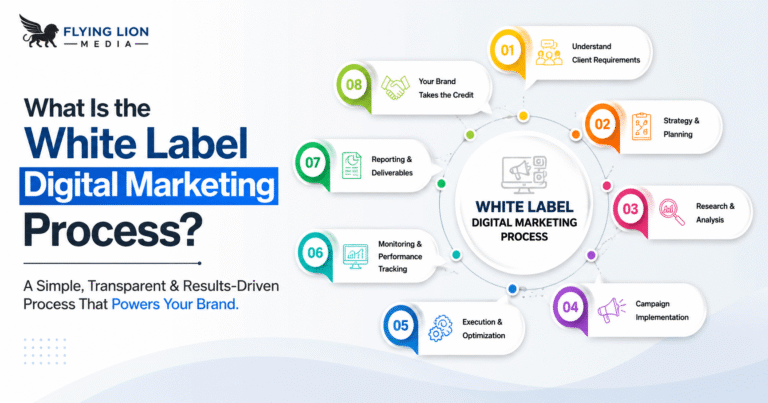
What Is the White Label Digital Marketing Process?
The White Label Digital Marketing Process is a structured workflow that enables a digital marketing agency to outsource marketing services to a specialized partner while presenting the completed work under its own brand. The end client continues to interact only with the agency, while the white label provider manages the technical execution behind the scenes.
Unlike traditional outsourcing, where clients may know who is performing the work, white label partnerships operate with complete confidentiality. The agency remains responsible for client relationships, strategic direction, and business development, while the fulfillment partner focuses on delivering agreed services according to predefined standards.
A typical white label process includes several connected stages:
- Client discovery and consultation
- Project planning and strategy development
- Requirement analysis and campaign preparation
- Service execution
- Quality review and testing
- Client reporting
- Performance optimization
- Ongoing support and continuous improvement
Each stage depends on clear workflow management, consistent communication, accurate reporting, and regular feedback. Missing or rushing any step can lead to delays, misunderstandings, or inconsistent results.
For Indian agencies working with businesses in competitive sectors such as healthcare, real estate, manufacturing, education, finance, or local services, following a documented process helps improve transparency, maintain accuracy, and ensure every campaign aligns with the client’s goals and expectations.
Why More Indian Agencies Are Choosing White Label Marketing
The Indian digital marketing industry has become increasingly competitive. Businesses now expect agencies to offer a complete range of services, including SEO, Google Ads, Meta Ads, content marketing, website development, marketing automation, local SEO, and analytics. Building an in-house team with expertise across all these areas can be costly and time-consuming, especially for small and mid-sized agencies.
A well-managed white label process enables agencies to:
- Expand service offerings without hiring large internal teams.
- Improve project delivery through specialized expertise.
- Scale operations during periods of high demand.
- Maintain consistent service quality with structured review processes.
- Focus internal resources on sales, client relationships, and business development.
- Increase operational efficiency while controlling costs.
- Deliver branded reports that strengthen client trust.
- Adapt to changing client requirements with greater scalability.
For agencies aiming to grow sustainably, a documented white label workflow is more than an operational process—it becomes a strategic framework for delivering consistent value while maintaining long-term business relationships.
Step-by-Step White Label Digital Marketing Process
A successful White Label Digital Marketing Process is more than outsourcing tasks—it is a structured framework that ensures every campaign moves smoothly from client onboarding to long-term optimization. Agencies that follow a documented process are better equipped to deliver consistent quality, maintain transparency, and build lasting client relationships.
Below is a practical workflow that many successful digital marketing agencies follow when working with a white label partner.
1. Client Discovery and Consultation
Every successful project begins with understanding the client’s business rather than jumping directly into execution.
During the initial consultation, the agency gathers information about:
- Business objectives
- Target audience
- Products or services
- Industry competition
- Current marketing efforts
- Budget expectations
- Growth goals
- Previous campaign performance
For example, an Ahmedabad-based manufacturer may want to generate B2B enquiries across India, while an eCommerce brand may prioritize increasing online sales. Their marketing strategies will naturally differ.
A thorough consultation reduces misunderstandings later in the project and helps create realistic expectations.
Best Practice
Never recommend SEO, PPC, or social media services before understanding the client’s actual business objectives.
2. Requirement Analysis and Business Audit
Once the consultation is complete, the next step is conducting a detailed analysis and audit.
This phase helps identify existing strengths, weaknesses, and opportunities.
Typical activities include:
- Website audit
- Technical SEO review
- Competitor analysis
- Google Analytics review
- Google Search Console analysis
- Google Business Profile evaluation
- Existing advertising performance
- Landing page assessment
- Conversion tracking review
Instead of assuming what is wrong, experienced marketers rely on data to make informed decisions.
Why This Step Matters
Many businesses believe they need more website traffic when the actual problem is poor conversion tracking, slow landing pages, or weak follow-up processes.
3. Strategy Development and Campaign Planning
After completing the research, the agency and white label partner create a customized strategy.
This includes:
- Marketing objectives
- Channel selection
- Target audience segmentation
- Budget allocation
- Campaign timelines
- Content planning
- Keyword research
- Performance benchmarks
A well-defined planning stage ensures every stakeholder understands project priorities before execution begins.
For example:
A healthcare clinic may prioritize Local SEO and Google Ads, while a SaaS company may benefit more from content marketing combined with performance advertising.
4. Proposal Approval and Client Onboarding
Understanding how the White Label Digital Marketing Process Works starts with a well-defined proposal and a structured onboarding process. Before any work begins, agencies present a comprehensive proposal outlining the scope of work, deliverables, project timelines, pricing, reporting frequency, and communication process. This ensures complete transparency and aligns expectations between the agency and its white label partner.
Once the proposal is approved, the onboarding phase begins. During this stage, the team gathers all the essential information and access required to execute campaigns efficiently.
Typical onboarding tasks include:
- Collecting website access
- Google Ads account permissions
- Google Analytics access
- Google Search Console verification
- Social media account access
- Brand guidelines
- CRM details
- Marketing assets
A smooth onboarding process prevents unnecessary project delays, improves collaboration, and enables faster campaign execution while maintaining a seamless experience for both agencies and their clients.
5. Team Coordination and Project Assignment
After onboarding, the project moves into execution planning.
The white label partner assigns specialists based on project requirements.
Depending on the campaign, responsibilities may include:
- SEO Specialists
- Google Ads Experts
- Meta Ads Managers
- Content Writers
- Graphic Designers
- Web Developers
- Marketing Automation Specialists
Effective coordination, assignment, and delegation ensure every team member understands their role.
Most professional agencies use project management systems to track progress and deadlines.
6. Campaign Execution
This is where the actual marketing work begins.
Execution may involve:
SEO Services
- Keyword research
- On-page SEO
- Technical optimization
- Content optimization
- Internal linking
- Local SEO improvements
Google Ads
- Campaign creation
- Audience targeting
- Ad copy development
- Conversion tracking
- Bid strategy implementation
Social Media
- Content calendar
- Creative design
- Caption writing
- Publishing
- Community management
Website Development
- Landing page creation
- Speed optimization
- Mobile responsiveness
- User experience improvements
At this stage, execution, implementation, and workflow management become critical.
Every deliverable should follow predefined quality standards before being shared with the agency.
7. Quality Assurance and Internal Review
One of the biggest differences between experienced white label providers and inexperienced freelancers is the quality assurance process.
Before client delivery, every project should undergo an internal review.
Quality checks may include:
- Grammar review
- SEO compliance
- Design consistency
- Technical testing
- Mobile responsiveness
- Link verification
- Conversion tracking validation
- Brand guideline compliance
This stage improves:
- Accuracy
- Consistency
- Quality
- Compliance
Skipping internal reviews often leads to client dissatisfaction and unnecessary revisions.
8. Client Reporting and Communication
Transparent reporting helps build trust.
Instead of sending raw marketing data, agencies should explain:
- Completed work
- Campaign progress
- Traffic trends
- Lead quality
- Keyword improvements
- Advertising performance
- Recommended next steps
Professional reports combine analytics, insights, and actionable recommendations.
Clients appreciate understanding why performance changes—not just seeing numbers.
9. Performance Monitoring and Optimization
Digital marketing is never a one-time activity.
Campaigns require continuous monitoring to identify:
- High-performing keywords
- Poor-performing ads
- User behaviour
- Landing page performance
- Bounce rate
- Conversion rate
- Cost per lead
- Return on ad spend
Based on these metrics, marketers implement ongoing optimization.
Examples include:
- Improving ad copy
- Adjusting bidding strategies
- Updating website content
- Enhancing landing pages
- Refining audience targeting
- Expanding successful campaigns
Continuous optimization improves long-term campaign performance while helping businesses make informed marketing decisions.
10. Ongoing Support, Feedback, and Growth
The final stage is continuous improvement.
Successful agencies don’t stop after campaign delivery.
Instead, they provide ongoing:
- Technical support
- Monthly consultations
- Performance discussions
- Strategy updates
- Market research
- Campaign refinements
Regular feedback sessions help agencies understand changing business priorities and identify new opportunities.
This long-term approach improves:
- Client retention
- Business growth
- Customer satisfaction
- Partnership strength
- Operational efficiency
As businesses evolve, the white label process should also adapt to changing market conditions, customer behaviour, and marketing goals.
Benefits of the White Label Digital Marketing Process
A structured White Label Digital Marketing Process is more than an operational workflow—it is a scalable business model that enables agencies to expand services, improve delivery standards, and focus on long-term client relationships. When implemented correctly, it helps agencies balance growth with quality while avoiding many of the challenges associated with rapid expansion.
Below are the key benefits agencies can expect from following a well-defined white label process.
1. Scale Your Agency Without Increasing Fixed Costs
Hiring full-time specialists for SEO, Google Ads, Meta Ads, website development, content marketing, graphic design, and marketing automation requires significant investment. Beyond salaries, agencies must also account for recruitment, training, software subscriptions, and employee retention.
A white label partnership allows agencies to access experienced professionals only when needed, making it easier to handle fluctuating workloads without substantially increasing fixed operational expenses.
This approach is particularly beneficial for growing agencies that want to expand their service offerings while maintaining healthy profit margins.
2. Deliver Multiple Services Under One Brand
Many businesses prefer working with a single agency that can manage their complete digital marketing strategy instead of coordinating multiple vendors.
Through a structured white label process, agencies can confidently offer services such as:
- Search Engine Optimization (SEO)
- Google Ads Management
- Meta Ads Management
- Local SEO
- Website Development
- Content Marketing
- Social Media Marketing
- Marketing Automation
- Conversion Rate Optimization (CRO)
The client experiences a seamless service while the agency manages communication and strategy.
3. Improve Project Delivery and Operational Efficiency
Without a documented workflow, projects often suffer from unclear responsibilities, missed deadlines, and inconsistent quality.
A structured process introduces:
- Defined workflows
- Clear task assignments
- Better coordination
- Standard operating procedures (SOPs)
- Organized communication
- Timely delivery
- Performance monitoring
Improved operational efficiency helps agencies complete projects more consistently, even as the number of clients grows.
4. Maintain Consistent Quality Across Every Campaign
One challenge many agencies face during rapid growth is maintaining the same level of quality across multiple client accounts.
A professional white label process includes:
- Internal quality reviews
- Technical audits
- Content proofreading
- Campaign testing
- Performance validation
- Compliance checks
- Brand consistency reviews
These quality control measures reduce errors and improve client confidence in the agency’s services.
5. Allow Internal Teams to Focus on Business Growth
Agency owners often spend too much time managing day-to-day campaign execution instead of focusing on business development.
With reliable white label support, internal teams can dedicate more time to:
- Client acquisition
- Strategic consulting
- Sales meetings
- Proposal development
- Account management
- Customer relationship building
This shift from operational work to strategic activities can create more opportunities for sustainable growth.
6. Increase Client Retention Through Better Service
Clients are more likely to continue working with an agency that consistently delivers quality work, communicates clearly, and adapts to changing business needs.
A structured white label process supports retention through:
- Regular reporting
- Continuous optimization
- Transparent communication
- Faster response times
- Reliable support
- Ongoing strategic recommendations
Long-term client relationships are often more valuable than constantly acquiring new customers.
7. Adapt Quickly to Changing Market Demands
Digital marketing trends, platform algorithms, and consumer behavior change frequently.
White label specialists typically stay updated with:
- Google algorithm updates
- Meta Ads platform changes
- SEO best practices
- Analytics improvements
- Automation technologies
- Conversion optimization techniques
This enables agencies to respond more quickly without constantly investing in internal training programs.
7. Adapt Quickly to Changing Market Demands
Feature | White Label Digital Marketing | In-House Marketing Team |
Initial Investment | Lower | Higher |
Recruitment Time | Minimal | Significant |
Scalability | High | Moderate |
Access to Specialists | Immediate | Depends on hiring |
Operational Flexibility | High | Limited |
Training Requirements | Minimal | Ongoing |
Fixed Salary Costs | Lower | Higher |
Technology Investment | Shared | Agency-funded |
Time to Launch Services | Faster | Slower |
Resource Management | Simplified | More Complex |
Why the White Label Digital Marketing Model Is Growing in India
India’s digital economy continues to evolve rapidly, creating opportunities for agencies that can deliver specialized marketing services across industries and regions.
Several factors are contributing to the increasing adoption of white label partnerships:
Rising Demand for Full-Service Agencies
Businesses now expect agencies to handle everything from SEO and paid advertising to website development and automation. White label partnerships help agencies meet these expectations without hiring large teams.
Growth of Small and Mid-Sized Agencies
Many agencies in Tier 2 and Tier 3 cities are expanding their service portfolios to compete with larger firms. White label models provide access to specialized expertise without significant upfront investment.
Increased Focus on Performance Marketing
Clients are paying closer attention to measurable outcomes such as qualified leads, conversion rates, and customer acquisition costs. This has increased demand for experienced specialists who can manage performance-driven campaigns.
Flexible Business Models
As remote collaboration becomes more common, agencies can work seamlessly with white label partners across India, enabling faster project execution and broader service capabilities.
Business Opportunities for Agencies Using White Label Services
A structured white label process opens new opportunities across multiple sectors.
Healthcare
Medical clinics and hospitals often require Local SEO, Google Ads, website optimization, and patient-focused content marketing.
Real Estate
Developers and property consultants need lead generation campaigns, landing pages, and paid advertising strategies tailored to high-value enquiries.
Manufacturing
Manufacturers benefit from SEO, LinkedIn marketing, B2B lead generation, and conversion-focused websites that target decision-makers rather than general traffic.
Education
Schools, coaching institutes, and universities rely on seasonal campaigns, admission-focused landing pages, and local search visibility.
Ecommerce
Online retailers require integrated strategies involving SEO, paid advertising, product optimization, remarketing, and conversion rate improvements.
Professional Services
Law firms, consultants, architects, financial advisors, and accounting firms often seek trusted agencies capable of managing both local visibility and lead generation.
By partnering with a reliable white label provider, agencies can confidently serve these industries without needing deep in-house expertise in every marketing discipline.
How to Choose the Right White Label Digital Marketing Partner
Selecting the right partner is one of the most important decisions in the white label process. Beyond technical skills, agencies should evaluate how well the provider aligns with their workflows, communication standards, and long-term business goals.
Evaluate Industry Experience
Look for partners with practical experience across different industries rather than relying solely on generic marketing knowledge.
Assess Communication Processes
Clear communication reduces delays, improves coordination, and ensures projects stay aligned with client expectations.
Review Quality Assurance Practices
Ask how deliverables are reviewed before they reach your agency. A strong quality assurance process minimizes revisions and protects your brand reputation.
Understand Reporting Standards
Choose a partner that provides transparent, branded reports with actionable insights instead of overwhelming clients with raw data.
Verify Scalability
Your partner should be capable of handling increased workloads as your agency grows, without compromising delivery timelines or quality.
Prioritize Confidentiality
Ensure the provider works under strict non-disclosure agreements (NDAs) and respects your agency’s ownership of client relationships.
Consider Technical Capabilities
Evaluate whether the partner can support your current and future service offerings, including SEO, paid advertising, website development, analytics, automation, and content marketing.
Common Mistakes Agencies Make in the White Label Digital Marketing Process
A white label partnership can help an agency scale efficiently, but only when the underlying process is well managed. Many agencies focus on acquiring new clients while overlooking the operational systems needed to deliver consistent results. These oversights can lead to missed deadlines, communication gaps, and dissatisfied clients.
Below are some of the most common mistakes agencies should avoid.
1. Choosing a Partner Based Only on Price
Cost is an important consideration, but selecting the lowest-priced provider often creates larger problems later.
A provider with limited experience may struggle with:
- Campaign execution
- Technical SEO
- PPC optimization
- Content quality
- Reporting accuracy
- Deadline management
Instead of comparing only pricing, evaluate the provider’s expertise, communication process, quality assurance standards, and ability to scale with your agency.
2. Starting Without a Clear Strategy
Many agencies rush into campaign execution before fully understanding the client’s objectives.
Without a documented strategy, campaigns often suffer from:
- Unclear goals
- Poor audience targeting
- Weak messaging
- Inconsistent deliverables
- Unrealistic expectations
Every project should begin with proper research, planning, competitor analysis, and measurable business objectives.
3. Poor Communication Between Teams
Communication gaps are one of the biggest reasons white label projects fail.
Common issues include:
- Missing project updates
- Unclear instructions
- Delayed approvals
- Conflicting priorities
- Incomplete client information
Using project management tools, shared documentation, and scheduled review meetings helps maintain transparency throughout the workflow.
4. Ignoring Quality Assurance
Delivering work without internal review increases the likelihood of errors.
Examples include:
- Incorrect SEO implementation
- Broken website links
- Ad copy mistakes
- Poor grammar
- Incorrect tracking codes
- Design inconsistencies
A structured quality review before client delivery protects both the agency’s reputation and client confidence.
5. Focusing Only on Traffic Instead of Business Results
Many businesses judge success solely by website traffic.
However, experienced marketers know that higher traffic does not always translate into more enquiries or sales.
Important performance indicators include:
- Qualified leads
- Conversion rate
- Cost per acquisition
- Customer lifetime value
- Return on advertising spend
- Lead quality
- Sales conversion
Successful agencies align marketing activities with real business outcomes rather than vanity metrics.
6. Failing to Measure Campaign Performance
Launching campaigns without ongoing monitoring limits opportunities for improvement.
Regular reporting should evaluate:
- Keyword performance
- Landing page engagement
- Ad performance
- Lead quality
- User behavior
- Conversion tracking
- Customer acquisition trends
Continuous optimization is what turns average campaigns into long-term growth strategies.
Practical Business Examples
Example 1: A Local Service Business Receiving Traffic but Very Few Calls
Imagine a plumbing company operating in Ahmedabad. The agency successfully improves website traffic through SEO, but enquiries remain low.
After reviewing the campaign, the white label team discovers several issues:
- No call tracking
- Slow mobile page speed
- Weak call-to-action buttons
- Outdated contact form
- Limited Google Business Profile optimization
Instead of simply increasing traffic, the team focuses on improving the website experience and local visibility. Over time, the business begins receiving more relevant phone calls because visitors can now contact the company more easily.
Marketing Lesson:
Traffic creates opportunities, but user experience and conversion optimization determine whether visitors become customers.
Example 2: A Real Estate Company Generating Low-Quality Leads
A real estate developer launches paid advertising to promote new residential projects.
Although lead volume appears high, the sales team reports that many enquiries are irrelevant.
After conducting a campaign analysis, the agency identifies several issues:
- Broad audience targeting
- Generic ad messaging
- Weak landing page qualification
- No lead scoring process
The campaign is restructured with:
- Better audience segmentation
- Location-specific messaging
- Project-focused landing pages
- Improved lead qualification forms
The total number of leads decreases slightly, but the sales team receives more relevant enquiries that match the target buyer profile.
Marketing Lesson:
Lead quality often matters more than lead quantity.
White Label Digital Marketing Process Myths vs Facts
Myth | Fact |
White label marketing is only for large agencies. | Small and mid-sized agencies often benefit the most because they can expand services without major hiring costs. |
Outsourcing always reduces service quality. | Quality depends on the provider’s expertise, review process, communication, and documented workflow—not on outsourcing itself. |
White label providers replace the agency. | The agency continues managing client relationships, strategy, and branding while the provider handles service delivery behind the scenes. |
More clients automatically mean more profit. | Sustainable growth depends on operational efficiency, quality control, and effective resource management. |
Digital marketing campaigns only need to be launched once. | Ongoing monitoring, optimization, testing, and reporting are essential for maintaining long-term performance. |
Reporting is just about sharing numbers. | Good reports explain what happened, why it happened, and what actions should be taken next. |
White Label Digital Marketing Process :FAQs
1. What is the White Label Digital Marketing Process?
2. Who should use white label digital marketing services?
3. How does the White Label Digital Marketing Process work?
4. What are the benefits of a white label digital marketing process?
5. Is white label digital marketing suitable for small agencies?
Conclusion
A well-defined White Label Digital Marketing Process is the foundation of a successful agency partnership. By following a structured workflow—from client discovery and strategy development to campaign execution, quality assurance, reporting, and continuous optimization—agencies can deliver high-quality digital marketing services while maintaining complete control over their brand and client relationships.
For agencies in India, where client expectations and competition continue to grow, a reliable white label process offers the flexibility to scale operations, expand service offerings, and improve operational efficiency without the overhead of building a large in-house team. More importantly, it allows agencies to focus on strategic planning, customer relationships, and long-term business growth instead of day-to-day execution.
Whether you’re a startup agency, an established marketing firm, or a web design company looking to diversify your services, investing in the right white label partner and a transparent workflow can help you build stronger client trust, deliver consistent results, and create a sustainable path for future growth. The key is to choose a partner that values quality, communication, and continuous improvement—because successful white label marketing is built on collaboration, not just outsourcing.