

White Label Client Feedback Management: Boost Client Retention: A white label partnership can look successful from the outside while becoming difficult to manage behind the scenes. Campaigns may be delivered on time, reports may be prepared, and services may be technically correct—but if client feedback is scattered across WhatsApp messages, emails, calls, spreadsheets, and team chats, small issues can quickly become larger relationship problems.
This is where White Label Client Feedback Management becomes important.
For agencies that outsource SEO, PPC, social media, content, website development, or other marketing services, feedback is not simply a collection of comments. It is part of the operational system connecting the agency, white label fulfillment team, and end client.
A structured approach helps agencies understand client expectations, collect useful opinions, manage revisions, resolve concerns, improve quality, and maintain trust without exposing the white label relationship.
For Indian digital marketing agencies, this becomes especially relevant when managing multiple clients across different cities, industries, budgets, and communication preferences.
This guide explains how to build a practical client feedback process, what commonly goes wrong, how to measure performance, and when professional white label support can make agency operations easier.
What Is White Label Client Feedback Management?
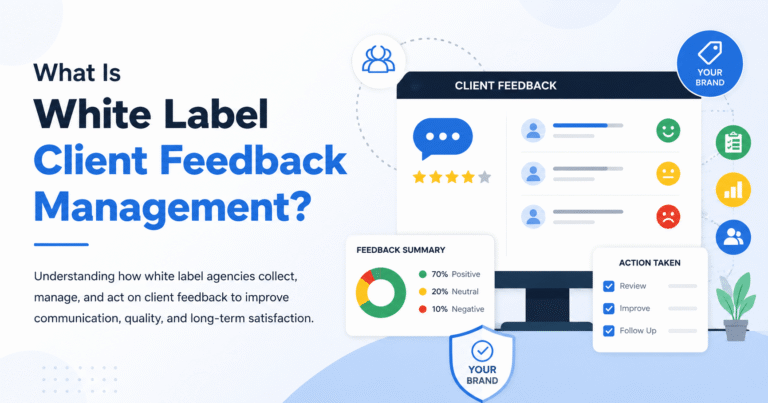
White Label Client Feedback Management is the structured process of collecting, organizing, analyzing, responding to, and acting on client feedback while services are delivered under an agency’s brand.
Instead of treating feedback as random messages, the agency creates a repeatable workflow.
A typical process looks like this:
- Collect client feedback through an agreed channel.
- Document the request or concern.
- Categorize the feedback by priority and service.
- Send relevant information to the fulfillment team.
- Track revisions or required actions.
- Review the completed work.
- Deliver the updated work to the client.
- Record the final response and outcome.
- Identify recurring patterns.
- Use those insights to improve future delivery.
The important point is that the client should experience one consistent agency relationship.
The fulfillment partner may perform SEO work, create advertisements, develop landing pages, or prepare content, but the agency remains responsible for managing communication and the overall customer experience.
Why Client Feedback Matters in White Label Marketing
Feedback provides information that performance reports cannot always reveal.
Analytics can show traffic, conversions, engagement, campaign performance, and other measurable outcomes. Client feedback can explain why something feels right or wrong from the business owner’s perspective.
For example, a report may show that a campaign generated enquiries. The client may respond that most enquiries were irrelevant.
Both pieces of information matter.
The first measures activity. The second reveals business quality.
Strong feedback management therefore connects client experience with operational decision-making.
It can help agencies identify:
- Unclear client expectations
- Repeated revision requests
- Communication gaps
- Delivery problems
- Quality concerns
- Missed deadlines
- Incorrect targeting
- Reporting confusion
- Poor campaign alignment
- Service-related issues
- Opportunities for improvement
This creates a feedback loop between delivery, client satisfaction, and service quality.
Why Agencies Struggle With Client Feedback
The problem is rarely that clients refuse to provide feedback.
More often, agencies lack a consistent process for handling it.
Feedback Comes Through Too Many Channels
One client may send a WhatsApp message, another may email, and another may mention a change during a phone call.
When these responses are not documented properly, important requests can be missed.
An agency may then deliver an updated campaign based on incomplete information.
Clients Give Vague Feedback
Comments such as:
- “Make it better.”
- “This doesn’t look right.”
- “Change the targeting.”
- “I don’t like the design.”
- “Need more leads.”
do not give a fulfillment team enough direction.
The account manager needs to convert vague opinions into actionable requests.
For example:
“The client wants the campaign to focus more heavily on homeowners in Ahmedabad rather than general audiences.”
That is much easier for a specialist to act on.
Revisions Become Uncontrolled
A reasonable revision process can turn into endless changes when requests are not documented.
This creates problems with:
- Time
- Delivery
- Accountability
- Quality
- Team workload
- Client satisfaction
A good workflow defines what was requested, who approved it, what changed, and whether additional revisions are required.
Expectations Are Not Defined Early
Many client concerns begin before the first deliverable.
If the client expects daily updates while the agency provides weekly reporting, dissatisfaction can appear even when the actual marketing work is progressing correctly.
Clear expectations reduce this type of friction.
The White Label Client Feedback Management Process
A practical feedback workflow does not need to be complicated.
The following framework works well for SEO, PPC, social media, content marketing, website development, and other white label services.
1. Establish a Clear Communication Process
Decide where client communication should happen.
For example, an agency might use:
- Email for formal approvals
- A project management system for tasks
- WhatsApp for quick updates
- Video calls for strategy discussions
- A CRM for client records
- Shared documents for campaign information
The exact tools matter less than consistency.
If every client uses a different process, the agency’s internal coordination becomes unnecessarily difficult.
2. Define Client Expectations
Before work begins, document:
- Services included
- Deliverables
- Deadlines
- Approval responsibilities
- Revision limits
- Reporting frequency
- Communication channels
- Escalation procedures
- Campaign objectives
- Success measurements
This documentation becomes a reference point when disagreements occur.
3. Collect Specific Feedback
Instead of asking only, “Are you happy with the work?”, ask questions that generate useful responses.
For example:
- Is the messaging aligned with your current offer?
- Is the target audience correct?
- Are the leads relevant to your business?
- Does the content reflect your brand?
- Is anything missing?
- What should be changed before approval?
- Are there concerns about the current campaign direction?
Specific questions produce more actionable responses.
4. Categorize the Feedback
Every response does not require the same level of attention.
You can categorize feedback as:
Critical: Issues affecting campaigns, compliance, billing, deadlines, or major business objectives.
High priority: Important changes that should be addressed quickly.
Standard: Normal revisions or suggestions.
Strategic: Ideas that may improve future performance but do not require immediate implementation.
This helps the team prioritize work rather than reacting to every message with equal urgency.
5. Document the Request
Documentation creates accountability.
Record:
- Client name
- Service
- Date
- Request
- Priority
- Responsible person
- Deadline
- Current status
- Revision history
- Final resolution
This is particularly valuable when an agency handles many accounts.
6. Translate Feedback Into Action
A client may describe a business problem rather than a technical solution.
For example:
“We are getting too many enquiries from people who only want pricing.”
The fulfillment team should not simply change a campaign randomly.
The agency should investigate:
- Search terms
- Audience targeting
- Ad messaging
- Landing page content
- Offer positioning
- Lead qualification
- Conversion tracking
- Sales follow-up
The client’s opinion becomes an input for analysis rather than an instruction to blindly implement.
7. Review Before Client Delivery
The agency should review the completed work before sending it to the client.
This additional quality check is especially important in white label relationships.
The client should not have to discover obvious errors before the agency does.
Review areas may include:
- Branding
- Grammar
- Targeting
- Links
- Tracking
- Visual quality
- Offer details
- Location targeting
- Campaign settings
- Reporting accuracy
8. Close the Feedback Loop
Do not simply complete a revision and move on.
Tell the client what changed.
For example:
“We updated the landing page messaging to focus on commercial buyers, revised the CTA, and adjusted the form fields based on your feedback.”
This demonstrates responsiveness and makes the process transparent.
How to Turn Feedback Into Business Insights
The biggest opportunity in client feedback management is not collecting more responses.
It is learning from them.
Suppose several clients repeatedly complain that reports are difficult to understand.
The problem may not be individual clients.
It may indicate that the agency’s reporting system needs improvement.
Similarly, repeated comments about slow approvals could indicate that the approval workflow is unclear.
Feedback should therefore be analyzed for patterns.
Look for recurring themes involving:
- Satisfaction
- Communication
- Quality
- Delivery
- Responsiveness
- Reporting
- Support
- Performance
- Collaboration
- Expectations
This analysis can reveal operational weaknesses before they affect retention.
Using Surveys and Forms Effectively
Surveys can be useful when an agency wants structured feedback across multiple accounts.
For example, a simple quarterly survey might ask clients to rate:
- Communication
- Service quality
- Reporting
- Responsiveness
- Strategic support
- Delivery consistency
- Overall satisfaction
An open-ended question can then ask:
“What is one thing we could improve?”
Google Forms, for example, supports surveys and real-time response analysis, making it suitable for straightforward feedback collection.
However, surveys should not replace conversations.
A rating of 6/10 tells you that something is wrong. A follow-up conversation can help identify what actually needs to change.
Measuring Client Feedback Management
A feedback system should itself be measured.
Useful indicators include:
Feedback Response Time
How quickly does the agency acknowledge client feedback?
Resolution Time
How long does it take to address a request or concern?
Revision Frequency
Are particular services generating excessive revisions?
Recurring Issues
Which problems appear repeatedly?
Client Satisfaction
Are clients becoming more satisfied over time?
Retention
Do better communication and service quality contribute to stronger client relationships?
Approval Time
How long does it take clients to approve deliverables?
Escalation Rate
How often do normal requests become serious concerns?
These measurements provide a clearer picture of operational performance.
Feedback Should Be Connected With Marketing Performance
Client feedback should not exist separately from marketing data.
For example, if a real estate agency says lead quality is declining, the agency should investigate campaign data rather than simply accepting or rejecting the feedback.
Review:
- Search queries
- Audience targeting
- Location performance
- Ad messaging
- Landing page conversion
- Lead forms
- CRM records
- Sales feedback
- Conversion tracking
Likewise, Google Analytics can help businesses evaluate engagement behaviour through metrics such as engagement rate, but those metrics should be interpreted alongside business outcomes and client feedback.
The goal is to combine client experience + marketing data + business results.
Practical Example: Local Service Business
Consider a hypothetical Ahmedabad-based home service company working with a white label digital marketing agency.
The client says:
“We are receiving enquiries, but many people are asking for services we don’t provide.”
Instead of immediately changing the entire campaign, the agency reviews the feedback alongside campaign data.
The team discovers that broad search terms are attracting irrelevant users.
The solution may involve:
- Reviewing search terms.
- Adding negative keywords.
- Refining ad messaging.
- Improving landing page service descriptions.
- Reviewing location targeting.
- Tracking lead quality after changes.
The important lesson is that client feedback identified the symptom, while campaign analysis helped identify the underlying problem.
Practical Example: Real Estate Lead Quality
Imagine a real estate company receiving a large number of enquiries through paid advertising.
At first, the campaign appears successful because lead volume is high.
The client, however, reports that many enquiries come from people with unsuitable budgets or from locations outside the project’s target market.
A strong feedback process would record this concern and connect it with:
- Audience signals
- Location targeting
- Search queries
- Ad copy
- Property positioning
- Lead form questions
- CRM outcomes
- Sales-team feedback
The agency can then optimize for qualified opportunities, not simply more form submissions.
This distinction is important because marketing performance should ultimately be evaluated against business objectives rather than vanity metrics.
White Label Client Feedback Management Across Different Industries
Different industries require different feedback priorities.
Healthcare
Healthcare businesses may care strongly about appointment quality, location, trust signals, service-specific enquiries, and patient communication.
Real Estate
Real estate feedback often focuses on lead quality, property interest, budget, location, and sales readiness.
Manufacturing
Manufacturers may need feedback about B2B enquiry quality, technical requirements, geography, decision-maker relevance, and longer sales cycles.
Education
Education institutes may focus on admission enquiries, course interest, location, seasonal demand, and parent/student expectations.
Ecommerce
Ecommerce businesses may provide feedback about product demand, conversion rates, creative performance, customer behaviour, repeat purchases, and campaign profitability.
SaaS
SaaS businesses may focus on demo quality, trial users, customer acquisition, onboarding, product positioning, and lead qualification.
The feedback system should therefore be flexible enough to reflect each business model.
Common Mistakes Agencies Should Avoid
Mistake 1: Treating Every Comment as an Immediate Instruction
Feedback needs interpretation.
A client may identify a symptom rather than the actual technical problem.
Mistake 2: Ignoring Negative Feedback
Negative feedback is uncomfortable, but it can reveal important issues.
A concern that is documented and resolved is more useful than a concern that disappears inside a WhatsApp chat.
Mistake 3: Asking for Feedback Without Acting on It
Repeatedly asking for opinions without making improvements can reduce trust.
Mistake 4: Promising Every Revision
Not every client suggestion is strategically correct.
The agency should explain when a proposed change could negatively affect performance.
Mistake 5: Allowing Unlimited Revisions
Without boundaries, revisions can affect profitability, timelines, and delivery consistency.
Mistake 6: Measuring Satisfaction Without Business Performance
A client may like the communication but still be unhappy with lead quality.
Both relationship experience and marketing performance matter.
Myths vs Facts
Myth: More client feedback is always better.
Fact: Useful, specific feedback is more valuable than large quantities of vague responses.
Myth: Every client request should be implemented.
Fact: Feedback should be evaluated against strategy, data, feasibility, and business objectives.
Myth: Client satisfaction depends only on marketing results.
Fact: Communication, transparency, responsiveness, quality, expectations, and support also influence the client experience.
Myth: A feedback form is enough.
Fact: Forms collect information, but effective management requires analysis, action, follow-up, and resolution.
Myth: White label clients should never know about operational processes.
Fact: The client does not need unnecessary fulfillment details, but the agency still needs strong internal documentation and accountability.
When Should an Agency Consider Professional White Label Support?
Managing client relationships becomes increasingly difficult as an agency adds accounts and services.
You may need a stronger white label fulfillment and feedback system when:
- Your internal team is overloaded.
- Revisions frequently delay delivery.
- Clients are asking for frequent status updates.
- Campaign execution is inconsistent.
- Reporting takes too much staff time.
- Your agency wants to add SEO, PPC, social media, or website services without hiring a large internal team.
- Feedback is getting lost between account managers and specialists.
- You need scalable delivery processes.
The objective should not be to outsource communication blindly.
Instead, create clear ownership between the agency and fulfillment partner.
The agency owns the client relationship. The fulfillment team supports delivery. Feedback moves through a documented process between the two.
Conclusion
White Label Client Feedback Management is ultimately about creating a reliable connection between what clients expect, what marketing data shows, and what the delivery team actually does.
The strongest process is not necessarily the most complicated.
It is the one that makes feedback visible, actionable, measurable, and accountable.
For Indian digital marketing agencies, this becomes particularly important as client portfolios expand across Ahmedabad, Mumbai, Bengaluru, Delhi, Pune, Hyderabad, and other markets.
Whether you manage five accounts or fifty, the basic principles remain the same:
Listen → Document → Analyze → Prioritize → Act → Review → Communicate → Improve.
Client feedback should not be treated as a complaint system. It should become an operational source of insights that helps agencies improve service quality, strengthen relationships, increase client trust, and build a more scalable business.
If your agency is struggling with delivery capacity, repeated revisions, fragmented communication, or growing client demands, a structured white label fulfillment model may be worth evaluating. The right approach depends on your services, client expectations, internal capabilities, and growth plans.