

When a digital marketing agency wins more clients, the biggest challenge is not always sales. It is fulfillment.
Your agency may have strong client relationships, an effective sales process, and a growing pipeline, but if campaigns are delayed, revisions keep increasing, reporting is inconsistent, or your internal team becomes overloaded, growth can quickly turn into an operational problem.
This is where a White Label Campaign Fulfillment Process becomes valuable.
A structured fulfillment system allows an agency to outsource campaign execution to a specialized partner while keeping the client relationship, communication, and brand ownership under its own name. Instead of building a larger internal team for every new service or client, the agency can use an organized workflow for strategy, execution, monitoring, optimization, reporting, and quality control.
For Indian agencies, this can be especially useful when serving multiple clients across different industries, cities, budgets, and marketing channels.
This guide explains how a white label campaign fulfillment process works, what each stage involves, common mistakes to avoid, and how agencies can build a more scalable delivery system.
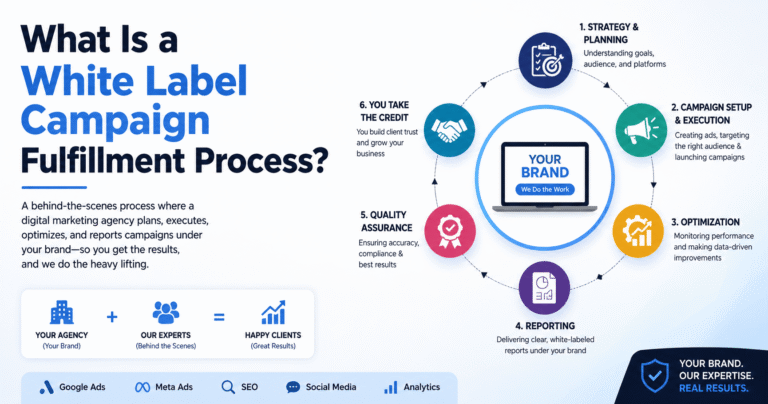
What Is a White Label Campaign Fulfillment Process?
A white label campaign fulfillment process is the structured workflow used by an agency and its fulfillment partner to plan, execute, monitor, optimize, and report marketing campaigns under the agency’s brand.
The agency generally owns the client relationship, objectives, communication, and commercial agreement, while the fulfillment team manages some or all of the specialized marketing tasks behind the scenes.
A typical process looks like this:
- Client onboarding
- Campaign briefing
- Requirements and objective collection
- Research and strategy
- Campaign planning
- Execution
- Quality assurance
- Client approval
- Monitoring and optimization
- Reporting
- Revision and improvement
- Scaling
The exact workflow depends on whether the campaign involves SEO, Google Ads, Meta Ads, social media, content, website development, or multiple channels.
The important point is that fulfillment should not be treated as simply “outsourcing tasks.”
It is a coordinated system designed to deliver consistent work while protecting quality, timelines, communication, and client expectations.
Why Agencies Need a Structured Fulfillment Process
Many agencies initially manage campaign fulfillment informally.
A client sends a WhatsApp message. Someone forwards the requirements to a freelancer. Another team member creates the campaign. Reporting is prepared at the end of the month.
This may work with a few clients.
It becomes difficult when the agency manages dozens of campaigns simultaneously.
Without a defined workflow, agencies can experience:
- Missed deadlines
- Incomplete briefs
- Repeated revisions
- Poor communication
- Inconsistent quality
- Unclear responsibilities
- Reporting delays
- Resource shortages
- Campaign errors
- Reduced productivity
- Lower profit margins
A white label fulfillment partner can help solve these issues, but only when the partnership has a clear process.
Flying Lion Media’s own white label model emphasizes campaign delivery under the partner agency’s branding, dedicated specialists, confidentiality, scalable services, and transparent reporting.
The goal is not simply to move work outside your agency.
The goal is to create a reliable extension of your team.
Step-by-Step White Label Campaign Fulfillment Process
1. Client Onboarding
Everything starts with onboarding.
Before campaign execution begins, the agency should collect the information required to understand the client’s business.
This may include:
- Business information
- Products or services
- Target audience
- Locations served
- Competitors
- Existing marketing activity
- Website details
- Advertising accounts
- Social media accounts
- Previous campaign data
- Budget
- Business objectives
- Expected deliverables
For example, a real estate client in Ahmedabad may want leads for premium residential properties, while a manufacturer in Gujarat may be looking for distributor or procurement enquiries.
The campaign cannot be planned effectively until these differences are understood.
A good onboarding process reduces confusion later because the fulfillment team starts with documented requirements rather than assumptions.
2. Create a Detailed Campaign Brief
The campaign brief becomes the operational foundation for effective campaign fulfillment for agencies. It should clearly explain:
What the client wants
Who the target audience is
Which locations should be targeted
Which services or products should be promoted
What the campaign objective is
Which platforms will be used
What assets are required
What deadlines apply
What approval process should be followed
How success will be measured
The brief should be specific enough that a specialist can understand the assignment without repeatedly asking basic questions.
This is particularly important for white label partnerships because the fulfillment team may not communicate directly with the end client. The agency must therefore establish a reliable communication process between its client-facing team and the fulfillment team. A well-documented brief helps keep campaign fulfillment for agencies organized, consistent, and aligned with the client’s expectations.
3. Research and Strategy
Execution should not begin immediately after receiving the brief.
First, the team needs to understand the market.
Depending on the campaign, research can include:
- Competitor analysis
- Keyword research
- Search intent analysis
- Audience research
- Previous campaign performance
- Website analysis
- Landing page evaluation
- Creative analysis
- Customer journey review
- Location analysis
- Offer evaluation
For example, a manufacturing company targeting India-wide buyers may need a completely different strategy from a local dental clinic targeting customers within a limited radius.
The strategy should connect the campaign objective with the target audience, available resources, budget, and expected customer journey.
4. Campaign Planning
Once research is complete, the fulfillment team converts the strategy into an actionable campaign plan.
Planning can include:
- Channel selection
- Audience segmentation
- Campaign structure
- Content requirements
- Creative requirements
- Keyword groups
- Landing pages
- Budget allocation
- Scheduling
- Tracking requirements
- Reporting framework
For paid campaigns, planning may involve deciding how different audiences, products, locations, or services should be separated.
For SEO campaigns, planning may involve content priorities, technical improvements, keyword groups, and page optimization.
For social media campaigns, the workflow may include content calendars, creative concepts, captions, publishing schedules, and engagement activities.
5. Campaign Execution
Execution is where the planned strategy becomes actual marketing activity.
Depending on the service, this could involve:
- Creating advertisements
- Writing content
- Designing graphics
- Publishing social media posts
- Building landing pages
- Optimizing website pages
- Configuring campaigns
- Creating audience segments
- Implementing tracking
- Managing keywords
- Preparing email campaigns
- Setting up remarketing
- Updating campaign assets
The advantage of using specialized fulfillment is that different tasks can be handled by people with specific expertise.
For example, an agency does not necessarily need to hire a full-time PPC specialist, graphic designer, SEO strategist, content writer, and developer simply because it has acquired several new clients.
A reliable fulfillment partner can provide access to these resources according to campaign requirements.
6. Quality Assurance
Quality assurance is one of the most important stages of the process.
A campaign should not automatically reach the client immediately after execution.
Before delivery, the team should check:
- Spelling and grammar
- Branding
- Links
- Tracking
- Targeting
- Campaign settings
- Landing pages
- Creative dimensions
- Offers
- Contact information
- Location targeting
- Compliance requirements
- Reporting configuration
For example, a Google Ads campaign could have excellent advertisements but still perform poorly if conversion tracking is incorrectly configured.
Google Analytics supports events and key events for measuring important interactions, while Google Ads conversions can be created from relevant Analytics key events for campaign measurement and optimization.
Quality control therefore needs to cover both visible deliverables and technical implementation.
7. Client Approval
For campaigns involving creative assets, content, landing pages, or major strategy changes, approval may be required.
The white label agency should define:
- Who approves the work
- How feedback is submitted
- How many revision rounds are included
- What the expected approval timeline is
- Who is responsible for final decisions
Without this structure, revision cycles can become endless.
A useful approach is to consolidate feedback rather than receiving separate instructions from multiple people.
This improves efficiency and prevents contradictory changes.
8. Launch and Monitoring
After approval, the campaign can be launched.
But fulfillment does not end at launch.
Monitoring begins immediately.
The team should watch relevant indicators such as:
- Traffic
- Leads
- Conversions
- Cost per lead
- Click-through rate
- Conversion rate
- Search visibility
- Engagement
- Ad spend
- Revenue
- Return on investment
The right metrics depend on the campaign objective.
A local clinic may care about appointment enquiries.
An ecommerce business may focus on purchases and revenue.
A SaaS company may measure qualified demos or trial registrations.
A manufacturer may care more about qualified B2B enquiries than raw lead volume.
9. Campaign Optimization
Optimization is the ongoing improvement stage.
The team reviews performance data and identifies opportunities or problems.
For PPC, optimization may involve:
- Search term analysis
- Bid adjustments
- Audience refinement
- Budget allocation
- Creative testing
- Landing page improvements
- Conversion tracking review
Flying Lion Media’s PPC process similarly includes research, campaign setup, ad and landing page work, continuous optimization, and reporting.
For SEO, optimization may involve:
- Content improvements
- Technical fixes
- Internal linking
- Search intent alignment
- Page experience improvements
- Keyword opportunity analysis
For social media, optimization may involve:
- Creative performance
- Audience engagement
- Publishing schedules
- Content formats
- Platform-specific performance
Optimization should be based on evidence rather than assumptions.
10. Reporting
Reporting gives the agency a way to communicate campaign performance to its client.
A useful white label report should answer three questions:
What happened?
Show important performance data.
Why did it happen?
Explain the factors behind the results.
What happens next?
Provide clear recommendations and priorities.
Avoid filling reports with unnecessary metrics.
A client may not need 40 numbers.
They need to understand whether the campaign is moving toward the business objective.
White label reporting should also maintain the agency’s branding so the client experiences the fulfillment service as part of the agency’s own delivery system. Flying Lion Media describes branded reports, campaign updates, and dedicated account support as part of its white label offering.
11. Revision and Continuous Improvement
Campaign fulfillment is rarely a one-time activity.
Markets change.
Competitors change.
Customer behaviour changes.
Offers change.
Budgets change.
Performance data reveals new opportunities.
The workflow should therefore include structured revision and improvement.
Instead of treating every revision as a failure, agencies should treat campaign feedback as part of the optimization cycle.
The key is to distinguish between:
- Necessary corrections
- Client preference changes
- Strategic changes
- New requirements
- Scope expansion
This distinction protects both productivity and profitability.
12. Scaling Successful Campaigns
Once the campaign demonstrates promising performance, the agency can consider scaling.
Scaling may involve:
- Increasing budget
- Expanding locations
- Adding new audiences
- Introducing additional services
- Creating more content
- Testing new creatives
- Expanding keyword coverage
- Launching additional campaigns
However, scaling should be controlled.
Increasing spending does not automatically guarantee proportionate growth.
The team needs to monitor performance and ensure that additional resources are being used efficiently.
Read More:- AI For White Label Digital Marketing Agencies
How White Label Fulfillment Supports Different Indian Industries
The process remains similar, but campaign objectives can vary significantly by industry.
Healthcare
A clinic may prioritize appointment enquiries, local visibility, reputation, and patient trust.
Campaign fulfillment should therefore consider location targeting, landing page experience, tracking, and appropriate messaging.
Real Estate
Real estate campaigns often involve longer customer journeys.
Lead quality, property type, location, budget, remarketing, and sales follow-up can all affect results.
Generating more leads is not necessarily useful if sales teams receive poorly qualified enquiries.
Manufacturing
Manufacturers often target specialized B2B audiences.
Campaigns may focus on products, specifications, procurement-related searches, distributors, or industrial decision-makers.
The fulfillment process needs strong audience and search-intent research.
Education
Education campaigns can be highly seasonal.
Admission cycles, courses, locations, fees, eligibility, and deadlines can influence audience behaviour.
Campaign scheduling and communication therefore become particularly important.
Ecommerce
Ecommerce fulfillment often involves continuous testing.
Product feeds, advertisements, landing pages, creatives, audiences, conversion tracking, and repeat purchasing behaviour can all influence performance.
Startups and SaaS
Startups may have limited budgets and need fast feedback.
A fulfillment team should therefore prioritize measurable experiments, conversion tracking, audience validation, and efficient resource allocation.
Common White Label Campaign Fulfillment Mistakes
Mistake 1: Starting Without a Complete Brief
Missing information creates delays and unnecessary communication.
Better approach: Build a standardized onboarding and briefing document.
Mistake 2: Treating Every Client the Same
A clinic, manufacturer, ecommerce brand, and real estate company have different customer journeys.
Better approach: Customize strategy around the client’s objectives and audience.
Mistake 3: Focusing Only on Deliverables
Completing tasks does not necessarily mean achieving business objectives.
Better approach: Connect deliverables with measurable outcomes.
Mistake 4: Ignoring Tracking
Without accurate tracking, campaign performance becomes difficult to evaluate.
Better approach: Confirm tracking before launch and regularly audit important conversion actions.
Mistake 5: Poor Communication
Even good work can appear ineffective when updates are unclear or delayed.
Better approach: Establish fixed communication and reporting schedules.
Mistake 6: Unlimited Revisions
Uncontrolled revisions can consume resources and reduce profitability.
Better approach: Define approval stages, revision limits, responsibilities, and scope.
Two Practical Fulfillment Scenarios
Scenario 1: Local Healthcare Campaign
Imagine an agency acquires a clinic client that wants more appointment enquiries.
The agency collects the clinic’s service information, locations, target patients, previous campaign data, and business objectives.
The fulfillment team then researches competitors, reviews the landing page, prepares campaign assets, configures tracking, launches the campaign, monitors enquiries, and reports performance.
If traffic is strong but appointments remain low, the problem may not be advertising alone.
The team may need to examine the landing page, form experience, offer, audience targeting, or follow-up process.
The lesson is simple: campaign fulfillment should evaluate the complete customer journey, not just the advertising platform.
Scenario 2: B2B Manufacturing Campaign
Consider a hypothetical manufacturer that sells industrial components.
The company receives many enquiries, but most are from people looking for unrelated consumer products.
A fulfillment team reviewing the campaign may discover that broad keywords and unclear messaging are attracting the wrong audience.
The solution could involve tighter targeting, more specific commercial terms, better landing-page messaging, negative keywords, and clearer qualification criteria.
The lesson is that lead quality is often more important than lead quantity.
How to Measure a White Label Fulfillment Process
Agencies should evaluate fulfillment at two levels.
Operational Performance
Measure:
- Delivery timelines
- Revision frequency
- Task completion
- Error rates
- Communication speed
- Approval time
- Team productivity
- Resource utilization
Marketing Performance
Measure:
- Qualified leads
- Conversions
- Conversion rate
- Cost per acquisition
- Revenue
- ROAS where applicable
- Organic visibility
- Engagement
- Customer acquisition cost
A campaign can have excellent operational efficiency but weak marketing performance.
The opposite can also happen.
The best fulfillment process aims to improve both.
Myth vs Fact
Myth: White label fulfillment means losing control.
Fact: A well-structured partnership can give the agency more operational control through defined workflows, responsibilities, approvals, and reporting.
Myth: Outsourcing means lower quality.
Fact: Quality depends on the expertise, process, communication, and quality-control system of the fulfillment partner.
Myth: More campaigns automatically mean more profit.
Fact: More clients increase revenue potential, but poor fulfillment can also increase revisions, staffing costs, delays, and operational overhead.
Myth: Every campaign can follow the same template.
Fact: Processes can be standardized, but strategy should reflect the client’s industry, audience, location, objectives, and resources.
Myth: Reporting only matters at the end of the month.
Fact: Performance monitoring should happen throughout campaign execution so problems can be identified before they become larger issues.
When Should an Agency Consider White Label Fulfillment?
White label fulfillment may make sense when an agency:
- Has more clients than its internal team can comfortably manage
- Wants to add new marketing services
- Is struggling with delivery deadlines
- Needs specialized expertise
- Wants to reduce hiring pressure
- Needs scalable campaign capacity
- Wants to focus more on sales and client relationships
- Wants standardized reporting and workflows
- Needs support during periods of rapid growth
However, outsourcing should not be viewed as a substitute for strategy.
The agency still needs to understand its client’s business, communicate effectively, set realistic expectations, and remain accountable for the relationship.
The fulfillment partner should strengthen the agency’s capabilities rather than replace its role.
Why Process Matters More Than Simply Hiring a Fulfillment Partner
Choosing a fulfillment partner is only one part of the equation.
The actual advantage comes from the process surrounding the partnership.
A strong system creates clear responsibilities:
Agency: Client relationship, objectives, communication, commercial management.
Fulfillment team: Research, execution, optimization, technical work, reporting support.
Client: Business information, approvals, feedback, access, and sales coordination.
When these responsibilities are clearly defined, collaboration becomes easier.
This is particularly important as the agency grows from a handful of clients to a larger portfolio.
Flying Lion Media positions its white label service as an extension of an agency’s team, covering services such as SEO, PPC, social media, content, website development, local SEO, and performance reporting.
Conclusion:
A successful White Label Campaign Fulfillment Process is much more than outsourcing marketing tasks.
It is a structured operating system connecting the agency, client, fulfillment team, resources, campaign strategy, execution, monitoring, reporting, and optimization.
When the process is clearly documented, agencies can reduce operational confusion, improve consistency, protect client relationships, and create more room for growth.
The right approach is not to outsource everything blindly.
Start by identifying where your agency has capacity limitations. Then define the tasks, responsibilities, quality standards, communication process, approval structure, and performance expectations.
For agencies serving Indian businesses, this approach can be particularly useful when client requirements vary across healthcare, real estate, manufacturing, education, ecommerce, SaaS, and local services.
If your agency is winning clients faster than your internal team can fulfill them, a structured white label partnership may be worth evaluating.

One Response