

white label digital marketing agency can only grow as fast as its fulfillment process allows. When client numbers increase, repetitive tasks such as research, reporting, content planning, campaign monitoring, data processing, and communication can quickly consume valuable team time.
This is where AI for White Label Digital Marketing Agencies becomes useful.
Artificial intelligence is not simply about generating content or automating routine tasks. Used correctly, it can help agencies process data faster, identify patterns, improve workflows, personalize marketing activities, and support better decisions. For a white label partner, that can mean greater delivery capacity without immediately increasing operational workload.
However, AI does not replace strategy, expertise, human review, or client understanding. The strongest approach is human expertise supported by intelligent technology.
For agencies serving Indian businesses, this distinction matters. A local clinic, Ahmedabad manufacturer, real estate developer, ecommerce brand, or SaaS company may all need different audiences, campaigns, messaging, budgets, and customer journeys. AI can accelerate the work, but experienced marketers still need to decide what should actually be done.
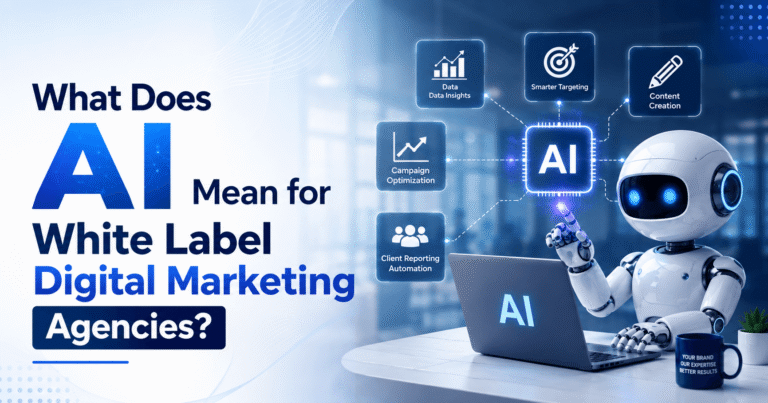
What Does AI Mean for White Label Digital Marketing Agencies?
AI for white label digital marketing agencies refers to using artificial intelligence, machine learning, generative systems, automation, predictive analytics, and related software to improve the research, planning, execution, monitoring, reporting, and optimization of marketing services delivered under another agency’s brand.
A white label agency partner typically works behind the scenes. The reseller or partner agency owns the client relationship and branding, while the fulfillment team handles some or all of the service delivery.
AI can support this model by helping with:
- Data processing and analysis
- Keyword and competitor research
- Content research and planning
- Campaign monitoring
- Advertising optimization
- Reporting
- Lead segmentation
- Customer personalization
- Workflow automation
- Performance tracking
- Repetitive operational tasks
The important point is that AI should function as an assistance and optimization layer, rather than an unsupervised replacement for marketing expertise.
Google’s current guidance also emphasizes that AI itself is not the problem; the focus remains on accuracy, quality, relevance, originality, and value for people. Using automation primarily to manipulate search rankings can violate Google’s spam policies.
Why White Label Agencies Are Exploring AI
White label agencies face a different operational challenge from many traditional marketing businesses.
A direct agency may manage a limited number of clients. A white label partner may support several reseller agencies, each with multiple customers and different requirements.
That creates pressure around:
- Workload
- Delivery speed
- Consistency
- Communication
- Reporting
- Resource allocation
- Quality control
- Scalability
- Profitability
Consider an agency managing SEO, Google Ads, Meta Ads, content, social media, and reporting for several partner agencies.
Without efficient workflows, employees may spend hours collecting information, creating reports, checking campaign data, researching competitors, or preparing repetitive content briefs.
AI and automation can reduce some of this manual work.
The objective, however, should not simply be doing more work faster. The better objective is creating more capacity for strategic work.
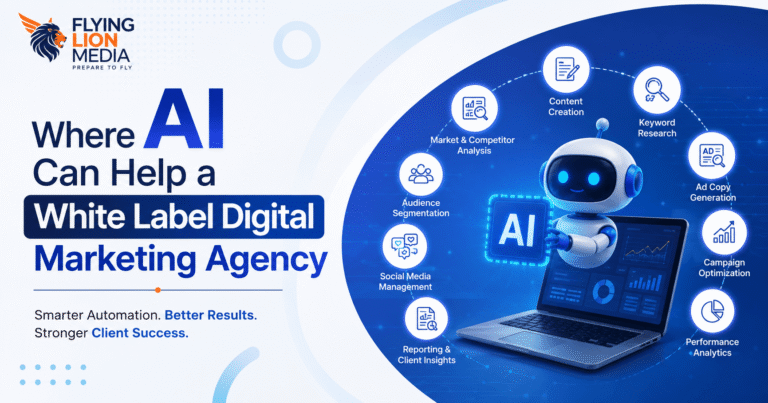
Where AI Can Help a White Label Digital Marketing Agency
1. SEO Research and Analysis
SEO involves large amounts of information.
Marketers may need to examine:
- Search queries
- Keywords
- Search intent
- Competitor pages
- Rankings
- Content gaps
- Backlinks
- Metadata
- Technical issues
- Internal links
- Content topics
- Search trends
AI can help organize this information and identify patterns that deserve human attention.
For example, an SEO team supporting a white label partner could use AI-assisted analysis to group search queries by intent:
Informational → Commercial → Transactional → Local
The strategist can then determine which groups should receive content, service pages, landing pages, or local optimization.
The advantage is not that AI “does SEO.” The advantage is that marketers can spend less time sorting information and more time interpreting it.
2. Content Planning
Generative technology can assist with content research, outlines, topic clustering, briefing, editing, and content repurposing.
For white label agencies, this can improve workflow consistency.
A content team might use AI to turn research into an initial content brief containing:
- Topic
- Audience
- Search intent
- Relevant questions
- Suggested headings
- Supporting entities
- Content gaps
- Internal linking opportunities
A human writer should then validate the information, add original insights, improve the structure, and ensure the content reflects the client’s expertise.
This is especially important because producing large volumes of low-value pages simply through automation is not a sustainable SEO strategy. Google’s documentation specifically warns against scaled content created without adding value.
3. Google Ads Optimization
AI is already deeply integrated into modern advertising platforms, making AI for Digital Marketing Agencies an increasingly important part of campaign management and optimization.
Google Ads Smart Bidding uses Google AI to optimize bids for conversions or conversion value at auction time. For a white label PPC fulfillment team, AI can therefore support areas such as:
Bid optimization
Search query analysis
Audience signals
Campaign performance
Conversion-focused bidding
Creative testing
Budget allocation
Performance monitoring
Google also provides AI-powered features for Search campaigns that can help with search-term matching and creative optimization.
But automation does not eliminate the need for campaign strategy. If tracking is incorrect, the landing page is weak, the offer is unattractive, or the wrong audience is being targeted, automation cannot magically fix the underlying business problem.
4. Lead Generation and Qualification
AI can also support lead management.
For example, incoming leads can be categorized based on:
- Location
- Service requirement
- Company size
- Industry
- Budget indicators
- Purchase intent
- Engagement
- Previous interactions
This can help teams prioritize follow-ups.
For a real estate business, for example, an inquiry asking about property availability, location, budget, and site visits may have different commercial value from a general information request.
AI-assisted segmentation can help the sales team organize those conversations more effectively.
However, lead scoring should be treated as decision support rather than an unquestionable judgment.
Read More:- How To Start White Label Digital Marketing
AI and White Label Workflow Automation
One of the biggest opportunities is workflow automation.
A typical white label workflow may look like:
Client onboarding → Research → Strategy → Production → Review → Delivery → Reporting → Optimization
AI and automation can support several stages.
Before Campaign Launch
AI can assist with:
- Research organization
- Competitor analysis
- Audience segmentation
- Content briefs
- Campaign ideas
- Data summaries
- Initial reporting templates
During Campaign Execution
Systems can help with:
- Performance monitoring
- Anomaly detection
- Reporting
- Task notifications
- Data processing
- Campaign recommendations
- Scheduling
After Campaign Launch
AI can help summarize:
- What changed
- Which campaigns performed differently
- Which audiences responded
- Which pages gained traffic
- Which channels generated conversions
- Where performance requires investigation
This gives marketers a faster starting point for their analysis.
AI Does Not Replace Human Marketing Strategy
This is one of the most important principles for agencies.
Imagine a manufacturer in Gujarat wants more B2B enquiries.
AI may identify thousands of possible keywords. It may produce content ideas and summarize competitor websites.
But someone still needs to understand:
- Which products have the highest margins
- Which markets the manufacturer serves
- Whether buyers search by product, application, or industry
- How long the sales cycle is
- Whether enquiries are handled by sales representatives
- What makes the company different
- Which leads are actually valuable
The same applies to healthcare, finance, education, real estate, and other industries where accuracy, trust, customer behavior, and compliance matter.
AI can process information. Experienced marketers turn information into decisions.
That distinction should remain central to any white label partnership.
A Practical AI Framework for White Label Agencies
A useful implementation model is:
Step 1: Identify Repetitive Work
Start by listing tasks that consume significant time but require limited strategic judgment.
Examples include:
- Data collection
- Report formatting
- Basic categorization
- Scheduling
- Repetitive summaries
- Task management
- Initial research
Step 2: Separate Automation From Strategy
Not every task should be automated.
Good candidates:
- Data processing
- Notifications
- Reporting workflows
- Scheduling
- Initial categorization
Human-led activities:
- Strategy
- Positioning
- Offer development
- Client recommendations
- Final content approval
- Budget decisions
- High-impact campaign changes
Step 3: Create Quality-Control Processes
Every automated workflow needs review.
Check for:
- Accuracy
- Relevance
- Brand consistency
- Data quality
- Privacy
- Compliance
- Incorrect assumptions
- Unusual recommendations
Step 4: Connect Data Sources
AI becomes more useful when it can work with reliable business data.
Depending on the project, this may include:
- Google Analytics
- Google Search Console
- Google Ads
- Meta Ads
- CRM data
- Website analytics
- Lead records
- Sales information
The goal is to connect marketing activity with business outcomes.
Step 5: Measure Business Impact
Do not measure AI implementation simply by counting how many tasks were automated.
Instead, monitor:
- Time saved
- Delivery speed
- Error reduction
- Productivity
- Client satisfaction
- Lead quality
- Conversion rate
- Campaign performance
- Operational costs
- Profitability
AI Across Different Indian Industries
AI applications should change according to the business.
Healthcare
AI can assist with content research, campaign analysis, audience segmentation, and reporting.
However, healthcare content requires stronger accuracy and human review because incorrect information can affect trust and decision-making.
Real Estate
AI can help analyze lead data, segment audiences, organize property-related content, and identify patterns across campaigns.
The priority should remain qualified enquiries, not simply increasing lead volume.
Manufacturing
For manufacturers, AI can help organize technical content, research commercial search behavior, analyze competitors, and support B2B campaign workflows.
Broad traffic is often less valuable than searches connected to specific products, applications, industries, or purchasing needs.
Education
Education businesses can use AI for content planning, campaign analysis, audience segmentation, and admission-season marketing workflows.
Messaging may need to change considerably between Tier 1 cities and smaller Indian markets.
Ecommerce
Ecommerce teams can use AI for product content, customer segmentation, campaign analysis, creative testing, personalization, and repeat-purchase analysis.
But traffic alone is not enough. Conversion rate, average order value, repeat purchases, margins, and customer acquisition costs matter.
Two Practical Business Scenarios
Scenario 1: Local Service Business
Imagine a local service company receiving hundreds of website visits each month but very few phone calls.
An inexperienced team may respond by generating more traffic.
An experienced team would first investigate:
- Search intent
- Landing page relevance
- Mobile experience
- Call-to-action placement
- Local visibility
- Google Business Profile
- Phone tracking
- Form performance
- Lead follow-up
AI can help analyze large amounts of data and identify patterns, but the strategic decision might be that the business needs a better conversion journey—not more traffic.
Scenario 2: Real Estate Lead Generation
Consider a real estate company receiving a high number of enquiries but very few serious prospects.
The problem may not be campaign volume.
The team should investigate:
- Audience targeting
- Property pricing
- Location targeting
- Lead forms
- Qualification questions
- Creative messaging
- Follow-up speed
- CRM stages
- Sales feedback
AI can help classify and analyze leads, but sales and marketing teams must determine what actually defines a qualified buyer.
The lesson: AI should help agencies understand the problem faster, not encourage them to optimize the wrong metric more efficiently.
Common Mistakes When Using AI in White Label Marketing
Myth 1: AI Can Run an Entire Marketing Agency
Fact: AI can automate and assist with many workflows, but strategy, accountability, client communication, quality control, and business judgment still require people.
Myth 2: More AI Content Means Better SEO
Fact: Content needs accuracy, originality, relevance, and genuine value. Google states that using AI does not provide a special ranking advantage.
Myth 3: AI Eliminates the Need for SEO Specialists
Fact: AI can accelerate research and analysis, but specialists still need to interpret search intent, competition, technical issues, and commercial priorities.
Myth 4: Automation Means You Can Stop Monitoring Campaigns
Fact: Automated systems still require monitoring and refinement. Google itself recommends reviewing automated rules and their performance regularly.
Myth 5: The Largest Data Set Always Produces the Best Decision
Fact: Poor or irrelevant data can produce poor recommendations. Data quality and business context matter.
How to Measure AI's Impact on Your Agency
A white label partner should establish a baseline before introducing major automation.
Track:
Area | What to Measure |
Productivity | Hours spent per deliverable |
Delivery | Turnaround time |
Quality | Review errors and revisions |
SEO | Research and reporting efficiency |
PPC | Optimization workload |
Content | Brief-to-publication time |
Reporting | Report preparation time |
Operations | Manual tasks eliminated |
Client Service | Response and communication time |
Profitability | Fulfillment cost per account |
The objective is not to automate everything.
The objective is to build an agency operation where technology handles repetitive work while specialists focus on decisions that create business value.
Conclusion
AI is changing how digital marketing work is researched, executed, analyzed, and optimized. For white label agencies, its biggest opportunity may not be replacing people but increasing the amount of strategic work a skilled team can handle.
The strongest model combines:
AI + Automation + Data + Human Expertise + Quality Control
For Indian agencies, that combination can support more efficient fulfillment across SEO, advertising, content, analytics, lead generation, social media, and marketing automation.
But technology should always serve the business objective.
If a campaign has poor tracking, automation will not fix the measurement problem. If a website fails to convert, generating more traffic may not solve the issue. If lead quality is poor, increasing lead volume can make sales teams busier without making the business healthier.
The right question is therefore not “How much AI can our agency use?”
It is:
“Which parts of our marketing workflow can AI improve without compromising strategy, quality, trust, or client outcomes?”
That is the approach that can turn AI from another marketing tool into a practical operational advantage.