

Many digital marketing agencies in India reach a point where they can generate new clients but struggle to deliver every service efficiently. An SEO project arrives while the team is busy with website development. A Google Ads campaign needs immediate attention, but experienced PPC specialists are unavailable. A client requests social media management, yet hiring a full-time team isn’t financially practical.
These situations are common among startups, freelancers, web design agencies, branding firms, IT companies, and marketing consultants. As client expectations continue to grow, businesses need a way to expand their service offerings without significantly increasing operational costs.
This is where understanding how to start white label digital marketing becomes valuable. Instead of building a large in-house team from day one, businesses can collaborate with an experienced white label partner who delivers digital marketing services under their brand. This approach allows agencies to focus on acquiring clients, strengthening relationships, and growing recurring revenue while experienced specialists handle service fulfillment behind the scenes.
For Indian businesses, especially those operating with limited budgets or lean teams, white label digital marketing provides an efficient path toward business expansion, better resource management, and improved profitability without compromising service quality.
In this guide, we’ll explain how to start a white label digital marketing business, the planning involved, common mistakes to avoid, pricing considerations, partnership strategies, and the practical workflows successful agencies use to scale sustainably.
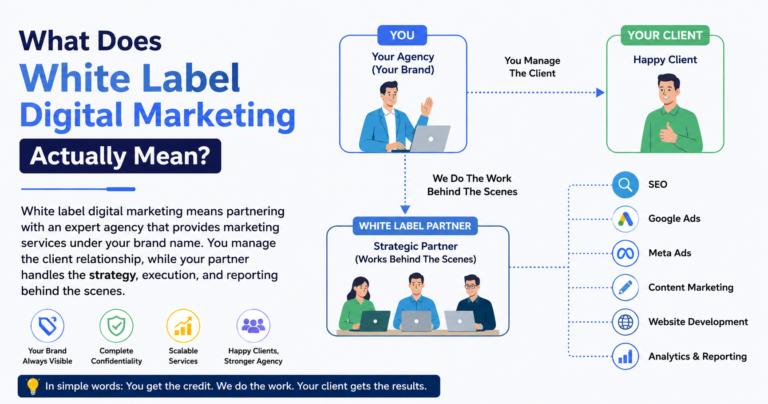
What Does White Label Digital Marketing Actually Mean?
White label digital marketing is a business model where one company performs digital marketing services while another company sells those services under its own brand.
To the client, everything appears to come directly from your agency. Reports, communication, branding, and project management remain under your business identity, while the execution is handled by your trusted fulfillment partner.
This model enables agencies to offer comprehensive digital marketing solutions without recruiting specialists for every service.
Common white label services include:
- Search Engine Optimization (SEO)
- Google Ads Management
- Meta Ads Campaigns
- Local SEO
- Social Media Marketing
- Content Marketing
- Website Development
- Landing Page Optimization
- Marketing Automation
- Conversion Rate Optimization
- Technical SEO
- Email Marketing
Rather than investing heavily in hiring, training, and infrastructure, agencies leverage strategic partnerships and collaboration to deliver professional services efficiently.
Why More Indian Agencies Are Choosing White Label Digital Marketing
India’s digital economy has grown rapidly over the past decade. Businesses from Ahmedabad, Mumbai, Bengaluru, Delhi NCR, Hyderabad, Pune, Chennai, Surat, Jaipur, and many Tier-2 cities increasingly rely on digital channels to generate leads and sales.
At the same time, agency owners face several operational challenges:
- Increasing competition
- Rising employee costs
- Difficulty hiring experienced marketers
- High client expectations
- Multiple service requests
- Pressure to deliver measurable performance
- Limited internal resources
Hiring separate specialists for SEO, PPC, content writing, web development, and social media management can significantly increase monthly expenses before consistent revenue is achieved.
White label digital marketing addresses these challenges by allowing agencies to expand their service offerings through outsourcing while maintaining full control over client relationships.
This model supports scalability, helping agencies grow without proportionally increasing fixed operational costs.
Is White Label Digital Marketing the Right Business Model?
Not every agency requires a white label partner immediately. However, it becomes a practical option when your business experiences one or more of the following situations:
Business Challenge | How White Label Helps |
Limited in-house expertise | Access experienced specialists without hiring full-time staff |
Growing client demand | Increase service capacity through efficient fulfillment |
Budget constraints | Reduce recruitment and infrastructure costs |
Expanding service portfolio | Offer additional marketing services quickly |
Seasonal workload fluctuations | Scale resources up or down as needed |
Focus on sales and client relationships | Delegate technical execution to trusted experts |
For many startups and SMEs, this approach supports sustainable growth, improved efficiency, and greater flexibility while minimizing operational risk.
The Foundation of a Successful White Label Business
Many agencies believe success begins with finding a fulfillment provider. In reality, the first step is building a strong internal strategy.
Before approaching any white label company, consider the following:
Define Your Business Goals
Ask yourself:
- Which industries do you want to serve?
- Will you focus on local businesses, healthcare, real estate, SaaS, manufacturing, or ecommerce?
- What monthly recurring revenue are you aiming for?
- Which services align with your expertise?
Without clear direction, agencies often struggle to create consistent service offerings.
Conduct Thorough Market Research
Effective research and analysis help you understand:
- Customer demand
- Competitor positioning
- Pricing expectations
- Service gaps
- Industry trends
- Local market opportunities
For example, businesses in Ahmedabad may prioritize Local SEO and Google Business Profile optimization, while SaaS companies across India often seek performance marketing and content-driven lead generation.
Understanding your audience enables better planning and more targeted service packages.
Identify Your Ideal Clients
White label digital marketing isn’t limited to traditional agencies.
Potential clients include:
- Website design companies
- Branding agencies
- IT firms
- Software development companies
- Business consultants
- Freelance marketers
- PR agencies
- Creative studios
- Ecommerce consultants
- Startup accelerators
Focusing on a clearly defined audience improves your marketing efforts and simplifies client acquisition.
Build Your Brand Positioning
Strong branding helps differentiate your agency in a competitive marketplace. If you’re Starting a White Label Marketing Agency, establishing a clear brand identity from the beginning can help you attract the right clients and stand out in a crowded digital marketing industry.
Instead of claiming to provide every digital marketing service, position your business around specific strengths such as:
- White Label SEO Solutions
- Performance Marketing for Agencies
- Digital Marketing Fulfillment
- Ecommerce Marketing Support
- Local SEO Partnerships
- Marketing Automation Services
Clear positioning builds credibility, strengthens client trust, and supports long-term business success.
Read More:- White Label Digital Marketing Pricing Guide
Choosing the Right White Label Partner and Building a Scalable Business
Starting a white label digital marketing agency isn’t simply about finding the cheapest service provider. Your white label partner becomes an extension of your business, and their work directly affects your agency’s reputation, client retention, and long-term growth.
Many Indian agencies lose clients because they focus only on pricing rather than evaluating the partner’s expertise, communication, and delivery process. A reliable partnership should help you deliver consistent results while allowing you to concentrate on acquiring new clients and strengthening existing relationships.
How to Choose the Right White Label Digital Marketing Partner
Not every white label provider is the right fit for your business. Before signing an agreement, evaluate them on factors beyond service offerings.
1. Assess Their Industry Expertise
Experience matters because different industries have unique marketing challenges.
For example:
- A healthcare clinic requires compliance-focused content and local visibility.
- A real estate company needs qualified lead generation rather than just website traffic.
- A B2B manufacturer focuses on commercial keywords and longer sales cycles.
- An ecommerce business depends on conversion optimization and repeat purchases.
Ask potential partners about:
- Industries they have worked with
- Types of campaigns they regularly manage
- Their approach to SEO, PPC, and social media
- Reporting and optimisation processes
- Communication structure
Choosing a partner with proven expertise reduces unnecessary trial and error.
2. Review Their Service Fulfillment Process
One of the biggest reasons agencies struggle is poor fulfillment.
Understand how work moves from client approval to project completion.
An ideal process includes:
- Requirement collection
- Strategy discussion
- Task allocation
- Campaign execution
- Internal quality checks
- Client-ready reporting
- Continuous optimization
A structured workflow improves productivity, reduces delays, and creates a better client experience.
3. Evaluate Communication Standards
Successful white label relationships depend on consistent communication.
Ask questions such as:
- Who will be your point of contact?
- How quickly are queries answered?
- Are project updates shared regularly?
- How are urgent issues handled?
- What happens if deadlines change?
Reliable coordination between both teams prevents misunderstandings and builds long-term trust.
4. Understand Confidentiality Policies
White label partnerships require complete confidentiality.
Clients should always see your agency as the service provider.
Ensure your agreement clearly covers:
- Non-disclosure commitments
- Client privacy
- Data protection
- Brand confidentiality
- Intellectual property ownership
Strong confidentiality protects your client relationships and strengthens business credibility.
Selecting the Right White Label Services
Many new agencies try to sell every marketing service immediately.
A better strategy is to begin with services that have consistent demand and manageable delivery requirements.
High-Demand White Label Services
Service | Suitable For |
SEO | Local businesses, manufacturers, healthcare, education |
Google Ads | Ecommerce, SaaS, service businesses |
Meta Ads | D2C brands, ecommerce, local businesses |
Local SEO | Clinics, restaurants, local service providers |
Website Development | SMEs, startups, corporate businesses |
Content Marketing | SEO, brand awareness, lead nurturing |
Marketing Automation | Growing businesses with recurring leads |
Offering focused services improves quality and simplifies management during the early stages of business growth.
Creating a Profitable Pricing Strategy
One of the first business decisions you’ll make is how to price your services.
Avoid copying competitors without understanding your costs.
Your pricing should consider:
- Fulfillment costs
- Marketing expenses
- Sales efforts
- Client support
- Reporting
- Project management
- Business overheads
- Desired profit margin
A thoughtful pricing model supports long-term profitability instead of short-term sales.
Budgeting for Sustainable Growth
New agencies often underestimate operational costs.
Effective budgeting should include:
- Website maintenance
- Sales software
- CRM tools
- Marketing expenses
- Team coordination
- Administrative costs
- Client acquisition
- Professional development
Proper financial planning protects your business during slower months and supports steady expansion.
Think of White Label as an Investment
Rather than viewing outsourcing as an expense, consider it an investment in your agency’s future.
Benefits include:
- Faster service expansion
- Reduced hiring costs
- Access to experienced professionals
- Improved operational efficiency
- Better scalability
- Higher client retention opportunities
When managed well, this investment contributes to recurring revenue and sustainable business growth.
Building an Effective Client Onboarding Process
A smooth onboarding experience creates confidence from the beginning of every project.
Once a client agrees to work with your agency, collect all necessary information before implementation begins.
Typical onboarding includes:
- Business goals
- Website access
- Google Analytics access
- Google Search Console permissions
- Google Ads account access
- Meta Business Manager access
- Brand guidelines
- Existing marketing assets
- Competitor information
- Target audience details
Having a standardized onboarding checklist reduces project delays.
Why Every Project Needs a Consultation
Never begin execution without understanding the client’s objectives.
A structured consultation helps uncover:
- Business priorities
- Current marketing challenges
- Previous campaign performance
- Sales process
- Lead quality
- Customer journey
- Available budget
- Growth expectations
This conversation allows you to recommend strategies that align with the client’s business rather than applying a generic marketing plan.
Writing a Clear Proposal
Before work starts, provide a detailed proposal outlining:
- Scope of work
- Deliverables
- Timelines
- Monthly pricing
- Reporting frequency
- Communication process
- Responsibilities
- Success metrics
A transparent proposal reduces confusion and establishes clear expectations.
Formalising the Agreement
Once the proposal is approved, create a written agreement covering:
- Service duration
- Payment terms
- Revision policy
- Cancellation terms
- Confidentiality clauses
- Ownership of deliverables
- Reporting schedule
- Dispute resolution process
Clear documentation protects both your agency and your clients.
Creating Efficient Workflows
As your client base grows, organised workflows become essential.
An effective workflow may look like this:
Lead Enquiry → Discovery Call → Proposal → Agreement → Onboarding → Strategy → Execution → Reporting → Optimisation → Renewal
Documenting every stage helps maintain consistency across projects and makes it easier to train future team members.
Practical Example
Imagine a web design agency in Ahmedabad receives five requests for SEO services in one month.
Instead of hiring an SEO specialist immediately, the agency partners with a trusted white label provider. The agency manages client meetings, branding, and communication, while the partner handles keyword research, technical SEO, content optimisation, and reporting.
The client experiences seamless service, the agency expands its offerings without increasing payroll, and internal resources remain focused on business development.
This illustrates how a well-planned partnership can improve operational efficiency while supporting long-term scalability.
Campaign Execution, Performance Management
Choosing the right white label partner is only the beginning. The long-term success of your agency depends on how effectively projects are delivered, measured, and improved over time.
Many agencies successfully acquire new clients but lose them because of inconsistent delivery, unclear reporting, or poor communication. Sustainable business growth comes from creating repeatable systems that ensure every client receives a professional experience from onboarding to monthly performance reviews.
Turning Strategy into Successful Execution
Once the proposal is approved and the onboarding process is complete, it’s time for execution.
Execution is where your planning becomes real marketing activity. Every campaign should follow a documented process instead of relying on ad hoc decisions.
Depending on the services you’ve sold, execution may include:
- SEO keyword research
- Competitor analysis
- Technical website audits
- Google Ads campaign setup
- Meta Ads audience creation
- Landing page optimisation
- Content planning
- Local SEO improvements
- Google Business Profile optimisation
- Conversion tracking implementation
For example, if a local dental clinic in Ahmedabad hires your agency, the first priority may not be running advertisements immediately. Instead, the campaign could begin with fixing website issues, improving Google Business Profile information, and ensuring phone call and WhatsApp enquiry tracking are working correctly. This structured approach helps create a stronger foundation before increasing marketing spend.
Why Proper Implementation Matters
Many marketing campaigns fail not because the strategy is poor, but because the implementation is incomplete.
Common implementation issues include:
- Missing conversion tracking
- Incorrect Google Analytics configuration
- Broken contact forms
- Slow website speed
- Poor landing page experience
- Incorrect keyword targeting
- Weak ad copy
- Inconsistent branding across channels
Before launching any campaign, use a quality assurance checklist to confirm that every technical requirement has been completed.
A structured implementation process reduces avoidable errors and improves client confidence.
Using Automation to Improve Efficiency
As your client portfolio grows, manual processes become difficult to manage.
This is where automation can improve operational efficiency without replacing strategic decision-making.
Examples include:
- Automatic lead assignment in your CRM
- Scheduled monthly performance reports
- Lead notification emails
- Form-to-CRM integrations
- Task reminders for recurring activities
- Invoice and payment reminders
- Internal project status updates
Automation allows your team to spend more time on strategy, optimisation, and client relationships instead of repetitive administrative work.
Integrating Your Marketing Tools
Successful agencies don’t work with disconnected platforms. They create seamless integration between their tools so information flows efficiently.
Typical integrations include:
- Google Ads with Google Analytics
- Google Analytics with Google Tag Manager
- CRM systems with website forms
- Meta Ads with CRM platforms
- Google Search Console with SEO reporting tools
- Call tracking software with lead management systems
These integrations help agencies understand the complete customer journey—from the first website visit to the final enquiry—making reporting more accurate and decision-making more informed.
Reporting That Clients Actually Understand
One of the biggest mistakes agencies make is sending complex reports filled with technical metrics but little business context.
Effective reporting should answer the questions clients care about:
- What work was completed?
- What improved this month?
- What challenges remain?
- Which channels generated enquiries?
- What are the next recommended actions?
Instead of overwhelming clients with data, explain how marketing activities support their business goals.
For example:
“Organic traffic increased after technical SEO improvements, but enquiries remained stable. The next priority is improving the landing page and strengthening the call-to-action to increase conversions.”
This type of reporting builds trust because it focuses on business outcomes rather than vanity metrics.
Using Analytics to Make Better Decisions
Good agencies don’t guess—they rely on analytics.
Analytics helps you understand how users interact with a website, where they drop off, and which marketing channels contribute to enquiries.
Key areas to review include:
- Organic traffic trends
- Paid advertising performance
- User behaviour
- Landing page engagement
- Goal completions
- Conversion paths
- Device usage
- Geographic performance
For Indian businesses, analytics can also reveal whether enquiries come from Tier 1 cities like Mumbai and Bengaluru or emerging Tier 2 markets such as Ahmedabad, Surat, or Indore. These insights help refine targeting and budget allocation.
Monitoring Campaign Performance
Marketing is not a one-time activity. Regular monitoring helps identify issues before they affect campaign performance.
Review campaigns weekly or monthly by checking:
- Keyword rankings
- Click-through rates
- Cost per click
- Cost per lead
- Conversion rates
- Landing page performance
- Website health
- Lead quality
- Budget utilisation
Consistent monitoring allows your team to make informed adjustments instead of reacting after results decline.
Measuring the Right Performance Indicators
Not every metric reflects business success. Strong performance measurement focuses on outcomes that matter to the client.
Useful KPIs include:
Marketing Objective | Relevant KPI |
Increase website visibility | Organic traffic, keyword rankings |
Generate enquiries | Qualified leads, phone calls, WhatsApp enquiries |
Improve advertising | Cost per lead, conversion rate, return on ad spend |
Grow local visibility | Google Business Profile actions, map views |
Improve engagement | Time on page, bounce rate, form submissions |
Retain clients | Client satisfaction, renewal rate, campaign consistency |
Focusing on meaningful KPIs helps agencies make better strategic decisions and communicate value more effectively.
Continuous Optimisation Drives Long-Term Results
No marketing campaign is perfect after launch. Continuous optimization is essential because customer behaviour, competition, and search trends change over time.
Optimisation may involve:
- Refining keyword targeting
- Testing new ad creatives
- Improving landing page content
- Updating calls-to-action
- Enhancing website speed
- Expanding local SEO efforts
- Revising audience segments
- Refreshing existing content
Small improvements made consistently often deliver stronger long-term results than frequent major changes.
Practical Business Example
Consider a manufacturer targeting B2B buyers across India.
Initially, the company focused on broad keywords such as “industrial products,” attracting significant traffic but few enquiries.
After reviewing analytics and monitoring user behaviour, the agency discovered that visitors were not reaching product enquiry pages.
The strategy was adjusted by:
- Targeting industry-specific commercial keywords
- Creating dedicated landing pages
- Improving technical SEO
- Installing accurate conversion tracking
- Optimising enquiry forms
The lesson wasn’t that more traffic was needed—it was that better targeting and continuous optimisation were required to attract qualified business enquiries.
Building Reliable Client Relationships
A successful white label agency is built on reliability, not just technical skills.
Clients appreciate agencies that:
- Deliver work on schedule
- Communicate honestly
- Provide consistent updates
- Explain challenges clearly
- Recommend improvements proactively
- Stay accountable for agreed deliverables
Reliable delivery encourages long-term partnerships, recurring revenue, and positive referrals.
Maintaining Transparency Throughout Every Project
Transparency builds confidence and strengthens professional relationships.
Be open about:
- Campaign timelines
- Budget allocation
- Testing phases
- Industry competition
- Algorithm updates
- Expected limitations
- Areas requiring improvement
Avoid making promises such as guaranteed rankings or instant lead generation. Honest communication helps clients make informed decisions and reinforces your agency’s credibility.
Common Mistakes When Starting White Label Digital Marketing
Learning from common mistakes can save months of frustration and unnecessary expenses.
1. Choosing a Partner Based Only on Price
Lower pricing may seem attractive, but it often comes at the cost of inconsistent delivery, delayed communication, or poor-quality work.
Instead of selecting the cheapest provider, evaluate:
- Industry experience
- Technical expertise
- Communication process
- Reporting quality
- Client support
- Service reliability
- Long-term partnership potential
A dependable partner helps protect your agency’s reputation.
2. Selling Every Service Immediately
New agencies often advertise SEO, PPC, website development, social media marketing, branding, email marketing, and automation before they have a structured delivery process.
A better approach is to begin with a few high-demand services, build confidence, document your workflows, and expand gradually.
Controlled expansion is usually more sustainable than rapid diversification.
3. Ignoring Standard Operating Procedures
Without documented processes, every project is handled differently.
Create SOPs for:
- Lead qualification
- Discovery meetings
- Proposal creation
- Client onboarding
- Campaign execution
- Monthly reporting
- Issue escalation
- Client renewals
Standardised processes improve consistency, efficiency, and scalability.
4. Focusing Only on Client Acquisition
Winning new business is important, but retaining existing clients is often more profitable.
Regular communication, transparent reporting, proactive recommendations, and dependable service encourage long-term partnerships and recurring revenue.
5. Overpromising Results
One of the quickest ways to lose trust is making unrealistic promises such as:
- Guaranteed #1 Google rankings
- Hundreds of leads every month
- Instant SEO success
- Fixed ROI guarantees
An experienced agency explains that outcomes depend on factors including:
- Industry competition
- Marketing budget
- Website quality
- Target audience
- Campaign execution
- Sales follow-up
- Customer demand
Setting realistic expectations builds stronger client relationships.
How White Label Strategies Differ Across Industries
Every industry has different buying behaviour, competition levels, and marketing priorities.
Healthcare
Clinics and hospitals generally focus on:
- Local SEO
- Google Business Profile
- Reputation management
- Educational content
- Appointment generation
Trust and compliance are often more important than aggressive advertising.
Real Estate
Real estate businesses usually require:
- High-quality lead generation
- Landing page optimisation
- Meta Ads
- Google Ads
- CRM integration
- Follow-up automation
Lead quality is typically a higher priority than lead quantity.
Ecommerce
Ecommerce brands often benefit from:
- Google Shopping campaigns
- Product page optimisation
- Conversion rate optimisation
- Email marketing
- Retargeting campaigns
Success depends on improving the entire customer journey rather than simply increasing website traffic.
SaaS Companies
Software businesses generally focus on:
- Educational content
- SEO
- Performance marketing
- Free trial campaigns
- Lead nurturing
- Marketing automation
Longer sales cycles make tracking and analytics especially important.
Manufacturing
Manufacturers usually need:
- Technical SEO
- Industry-specific content
- Commercial keyword targeting
- B2B lead generation
- Website improvements
Targeting broad informational keywords often generates traffic without producing qualified enquiries.
Education Institutes
Schools, colleges, and coaching centres often experience seasonal demand.
Their marketing strategy typically includes:
- Local SEO
- Admission campaigns
- Landing pages
- Social media advertising
- WhatsApp enquiry optimisation
Campaign timing plays an important role in overall performance.
Practical Business Example 1
Imagine a website development company in Ahmedabad.
Clients frequently ask whether the agency can also provide SEO and Google Ads services.
Instead of declining these enquiries or hiring an expensive in-house team, the agency partners with an experienced white label provider.
The agency continues managing client communication, proposals, and billing while the partner handles campaign execution and reporting.
As a result:
- Clients receive complete digital marketing solutions.
- The agency increases recurring revenue.
- Recruitment costs remain low.
- Service quality stays consistent.
This approach allows gradual growth without significantly increasing operational complexity.
Practical Business Example 2
Consider an ecommerce startup selling products across India.
Initially, the business focused almost entirely on increasing website traffic.
Despite attracting more visitors, online sales remained disappointing.
After reviewing analytics, the agency discovered several issues:
- Slow product pages
- Weak product descriptions
- Complicated checkout process
- Missing conversion tracking
- Poor remarketing strategy
Rather than increasing advertising spend, the agency improved the website experience, installed proper tracking, and optimised the conversion funnel.
The result was a stronger foundation for future marketing campaigns.
The lesson: better systems often outperform bigger budgets.
Myths vs Facts About White Label Digital Marketing
Myth | Fact |
White label services reduce quality. | Quality depends on selecting an experienced and reliable fulfillment partner. |
Lower pricing always increases profits. | Sustainable profitability comes from balancing pricing, service quality, and client retention. |
More services automatically mean more clients. | Specialised expertise often converts better than offering everything. |
Once a campaign is launched, little work is needed. | Ongoing monitoring, optimisation, and reporting are essential for long-term success. |
More traffic always leads to more business. | Qualified leads, user experience, and conversion rates have a greater impact on revenue. |
White label marketing is only for large agencies. | Freelancers, startups, web design firms, and SMEs also use white label partnerships to scale efficiently. |
Conclusion
Learning how to start white label digital marketing is about much more than outsourcing work. It requires thoughtful planning, selecting the right partnership, creating efficient workflows, maintaining transparent communication, and delivering measurable value to clients.
For agencies, freelancers, web development companies, and marketing consultants in India, the white label model offers an opportunity to expand services, improve operational efficiency, and generate recurring revenue without the overhead of building a large in-house team.
Success doesn’t come from offering every service at the lowest price. It comes from understanding your target market, setting realistic expectations, investing in reliable processes, monitoring campaign performance, and continuously optimizing your services based on client needs and business goals.
Whether you’re just launching your agency or looking to scale an existing business, a structured white label strategy can help you build stronger client relationships, enhance profitability, and support long-term, sustainable growth.

One Response