

Many agencies reach a point where demand starts growing faster than their internal team can handle. New clients arrive, project deadlines become tighter, and hiring specialists for SEO, PPC, web development, content writing, and social media management begins to increase operational cost. While expanding the team may seem like the obvious solution, it often requires a larger investment, long-term contracts, recruitment efforts, training, and additional management overhead.
This is where a White Label Digital Marketing Pricing Guide becomes valuable. Instead of making decisions based solely on assumptions, agencies can evaluate different pricing models, compare packages, understand fees, estimate expected expenses, and choose a solution that aligns with their business goals and client requirements.
Whether you run a startup agency in Ahmedabad, a web development company in Mumbai, or a full-service marketing agency serving clients across India, understanding how white label pricing works can help you improve profit margins, maintain transparent client billing, and scale your operations more efficiently.
In this guide, we’ll explain how white label pricing is structured, the factors that influence rates, common pricing models, and practical considerations before entering a long-term partnership with a white label provider. Rather than focusing only on the lowest quote, we’ll look at the overall value, service quality, scalability, and long-term business growth.
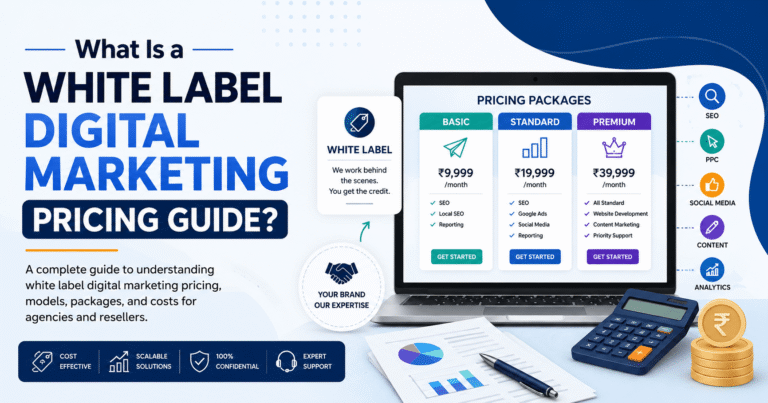
What Is a White Label Digital Marketing Pricing Guide?
A White Label Digital Marketing Pricing Guide is a framework that helps agencies understand how white label providers calculate their service charges, fees, and pricing plans for different digital marketing services.
Instead of maintaining an in-house team for every marketing discipline, agencies can outsource specialized work to an experienced white label partner while continuing to deliver services under their own branding.
A pricing guide generally helps agencies compare:
- Monthly retainer plans
- One-time project packages
- Custom service quotes
- Fixed and flexible pricing structures
- Service-specific pricing tiers
- Enterprise-level marketing solutions
- Performance-based engagement models
- Long-term subscription agreements
The objective isn’t simply to find the cheapest provider. A good pricing guide enables agencies to evaluate the complete business picture, including service quality, turnaround time, reporting standards, technical expertise, client communication processes, and long-term profitability.
Why Indian Agencies Are Choosing White Label Partnerships
India’s digital marketing industry has become increasingly competitive. Agencies are expected to provide a wide range of services, including:
- Search Engine Optimization (SEO)
- Google Ads Management
- Meta Ads
- Local SEO
- Website Development
- Content Marketing
- Social Media Management
- Marketing Automation
- Conversion Tracking
- Analytics & Reporting
Hiring specialists for each department often increases fixed operational expenses. Salaries, software subscriptions, employee benefits, training, and management all contribute to a higher monthly budget.
By working with a trusted white label provider, agencies can:
- Reduce operational costs
- Improve service efficiency
- Scale services without immediate recruitment
- Focus on sales and client relationships
- Deliver professional reporting
- Improve project fulfillment
- Access specialized expertise
- Maintain complete client confidentiality
For many Indian agencies, this model provides greater flexibility while allowing them to grow sustainably.
Key Factors That Affect White Label Digital Marketing Pricing
No two agencies pay exactly the same amount for white label services. The final price depends on several business and operational factors.
1. Scope of Services
The biggest factor influencing pricing is the range of services included. For example, an agency outsourcing only monthly SEO reports will pay significantly less than an agency requiring SEO, Google Ads, Meta Ads, website development, content creation, and marketing automation. Businesses evaluating different White Label Agency Solutions should understand that the broader the service scope, the higher the overall investment. Comparing service inclusions, expertise, and scalability—not just pricing—helps agencies choose a solution that aligns with their long-term growth objectives.
Typical services include:
- SEO
- PPC
- Social Media Marketing
- Website Design
- Website Development
- Content Writing
- Graphic Design
- Email Marketing
- Marketing Automation
- Local SEO
- Ecommerce Marketing
2. Service Package Selection
Most providers offer multiple packages based on agency requirements.
Common examples include:
Basic Package
Suitable for startups and smaller agencies handling a limited number of client accounts.
Typically includes:
- Monthly reporting
- Basic SEO
- Limited content support
- Email support
Standard Package
Designed for growing agencies requiring broader digital marketing support.
May include:
- SEO
- PPC
- Content Marketing
- Monthly consultations
- Performance tracking
- Campaign optimization
Premium Package
Suitable for established agencies managing multiple client campaigns.
Often includes:
- Dedicated account manager
- Advanced analytics
- Marketing automation
- Conversion tracking
- Multi-channel campaign management
- Priority support
- Custom reporting
- Strategic consultation
Higher-tier plans naturally involve higher fees, but they often provide better operational support and improved scalability.
3. Custom vs Standard Pricing
Some agencies prefer fixed monthly pricing, while others require customized solutions.
Standard Pricing
Standard plans are usually ideal when:
- Services are predefined
- Client requirements remain consistent
- Campaign complexity is relatively low
These plans provide predictable monthly charges, making budget planning easier.
Custom Pricing
Custom pricing is more appropriate when:
- Multiple services are combined
- Large client portfolios are involved
- Enterprise campaigns require unique workflows
- Dedicated teams are needed
A custom proposal generally includes a detailed estimate, project scope, deliverables, service timelines, and pricing based on the agency’s specific requirements.
4. Agency Size and Client Volume
Pricing also depends on the number of active client accounts.
For example:
Agency Type | Typical Pricing Consideration |
Freelancer | Lower monthly investment |
Startup Agency | Flexible pricing plans |
Growing Agency | Scalable service packages |
Mid-Sized Agency | Dedicated resources |
Enterprise Agency | Custom pricing agreement |
As client volume increases, providers may offer discounted pricing or more flexible subscription models, helping agencies improve long-term revenue while maintaining healthy margins.
5. Reporting and Performance Management
Transparent reporting is a critical part of any white label partnership. While detailed dashboards, performance insights, and advanced analytics may increase the monthly fee, they also enable agencies to make informed decisions and demonstrate measurable performance to their clients.
Experienced providers often include:
- Monthly performance reports
- Campaign analytics
- Lead tracking
- Conversion analysis
- SEO ranking updates
- Advertising performance reviews
- Actionable recommendations
- Clearly defined deliverables
These insights support better strategy, ongoing optimization, and stronger client relationships.
Common White Label Digital Marketing Pricing Models
Selecting the right pricing model is just as important as choosing the right white label partner. Every agency has different client expectations, service offerings, and growth goals. A pricing structure that works well for a boutique SEO agency may not suit a full-service digital marketing agency managing dozens of campaigns.
Below are the most common pricing models used by white label digital marketing providers in India.
1. Monthly Retainer Model
The monthly retainer is the most widely used pricing model because it offers predictable costs for agencies and consistent service delivery.
With this model, agencies pay a fixed monthly fee for an agreed scope of work.
Typical services include:
- SEO
- Google Ads management
- Meta Ads management
- Content writing
- Social media management
- Monthly reporting
- Technical support
Best For
- Growing agencies
- Long-term client relationships
- Businesses requiring ongoing campaign management
Advantages
- Predictable monthly budget
- Easy financial planning
- Consistent campaign optimization
- Continuous support
- Better long-term performance
2. Project-Based Pricing
Some agencies only require assistance with specific projects.
Examples include:
- Website development
- Website redesign
- Landing page creation
- Technical SEO audit
- Local SEO setup
- Marketing automation implementation
Instead of paying a recurring subscription, agencies receive a one-time quote based on project requirements.
Best For
- Freelancers
- Web design agencies
- Startup agencies
- Seasonal marketing campaigns
Advantages
- No long-term contract
- Flexible investment
- Clear project deliverables
- Defined completion timeline
3. Per-Service Pricing
Many white label providers price each service separately.
For example:
- SEO pricing
- PPC pricing
- Content writing pricing
- Social media pricing
- Graphic design pricing
This model gives agencies the flexibility to purchase only the services they need.
Best For
- Agencies with in-house specialists
- Businesses filling skill gaps
- Custom marketing solutions
Advantages
- Greater flexibility
- Better cost control
- Easier service expansion
- Scalable outsourcing
4. Custom Enterprise Pricing
Larger agencies usually require customized workflows.
Their requirements often include:
- Dedicated account managers
- Multiple client accounts
- Custom reporting dashboards
- CRM integration
- Marketing automation
- Advanced analytics
- Priority support
Instead of predefined packages, providers prepare a detailed proposal with a customized estimate.
Best For
- Enterprise agencies
- National brands
- Multi-location businesses
- High-volume client management
Advantages
- Tailored workflow
- Flexible pricing
- Dedicated resources
- Long-term partnership
Typical White Label Digital Marketing Pricing in India
While every provider follows a different pricing strategy, the table below offers a general idea of typical pricing ranges in India. Actual pricing depends on project complexity, competition, service scope, and agency requirements.
Service | Typical Monthly Price (INR) | Suitable For |
White Label SEO | ₹8,000 – ₹35,000 | Small to enterprise businesses |
Google Ads Management | ₹10,000 – ₹40,000 | Lead generation campaigns |
Meta Ads Management | ₹8,000 – ₹30,000 | Ecommerce & brand awareness |
Local SEO | ₹7,000 – ₹25,000 | Local businesses |
Content Writing | ₹2 – ₹8 per word or package-based | SEO & blogs |
Social Media Management | ₹10,000 – ₹40,000 | Brand engagement |
Website Maintenance | ₹5,000 – ₹20,000 | Existing business websites |
Website Development | Project-based | Business & ecommerce websites |
Marketing Automation | Custom Pricing | Growing businesses |
Complete White Label Package | ₹35,000 – ₹2,00,000+ | Agencies managing multiple clients |
Note: These are indicative market ranges. Final pricing varies based on campaign scope, competition, timelines, service quality, tools used, reporting requirements, and customization.
Market Context: What Buyers Should Know Today
The Gandhinagar luxury real estate market has evolved significantly over the past decade.
Demand is increasingly driven by:
- Gift City growth
- Improved connectivity
- Expanding commercial activity
- Better urban infrastructure
- Migration of high-income professionals
However, buyers should remember:
Luxury real estate moves in cycles.Short-term market fluctuations are normal.Property decisions should align with a 7–10 year perspective rather than immediate gains.
What Influences White Label Pricing?
Even agencies purchasing the same service may receive different pricing.
Here are some of the biggest pricing factors.
Number of Client Accounts
Managing five client campaigns is very different from managing fifty.
Larger agencies often negotiate volume-based pricing because providers can streamline processes and improve operational efficiency.
Campaign Complexity
A local dentist’s SEO campaign usually requires less work than a national ecommerce brand competing across hundreds of product categories.
Higher complexity generally means:
- More keyword research
- Additional competitor analysis
- Larger content requirements
- Frequent campaign optimization
- Advanced conversion tracking
This naturally affects the final rate.
Reporting Requirements
Basic monthly reports cost less than fully customized dashboards.
Some agencies require:
- Weekly reports
- White label dashboards
- Live campaign tracking
- CRM integration
- Lead attribution
- ROI reporting
Enhanced reporting and analytics require additional effort, which may increase pricing.
Turnaround Time
Urgent projects often require additional resources.
Examples include:
- Website launch within one week
- Emergency PPC campaign setup
- Fast content production
- Immediate SEO fixes
Expedited delivery can lead to higher charges due to resource allocation and scheduling.
Technology and Tools
Professional agencies invest in premium software for:
- SEO audits
- Keyword research
- Rank tracking
- Competitor analysis
- Call tracking
- CRM systems
- Marketing automation
- Performance monitoring
While these tools contribute to the provider’s expense, they often improve campaign quality and decision-making.
Practical Business Example 1
A Growing Web Design Agency
Imagine a web design agency in Ahmedabad that builds excellent websites but doesn’t offer SEO or paid advertising.
As client demand grows, many customers begin asking for ongoing digital marketing services. Hiring an in-house SEO specialist, PPC manager, content writer, and designer would significantly increase the agency’s monthly budget, recruitment efforts, and operational expenses.
Instead, the agency partners with a white label provider offering SEO, Google Ads, and content marketing under a transparent retainer model. The agency continues managing client relationships while the white label team handles campaign fulfillment, monthly reporting, and ongoing optimization.
Key takeaway: The agency expands its service portfolio without immediately increasing fixed overheads, helping improve operational flexibility and long-term growth.
Practical Business Example 2
Consider a performance marketing agency handling Google Ads for several real estate developers across India.
As new projects come in, the internal team struggles to maintain campaign quality, prepare detailed reports, and optimize every account.
Rather than rushing to hire multiple specialists, the agency evaluates a white label partner that offers dedicated campaign management, advanced analytics, transparent pricing, and scalable support.
The agency selects a custom pricing plan tailored to its client volume and reporting needs. This allows the team to maintain service quality while focusing on strategy, client communication, and business development.
Key takeaway: Choosing the right pricing model isn’t only about finding the lowest cost—it’s about balancing value, operational efficiency, and the ability to scale responsibly.
Practical Business Example 2
Pricing Model | Best For | Flexibility | Scalability | Cost Predictability |
Monthly Retainer | Agencies with recurring clients | Medium | High | High |
Project-Based | One-time projects | High | Low | High |
Per-Service | Agencies needing specific expertise | High | Medium | Medium |
Custom Enterprise | Large agencies & multi-service operations | Very High | Very High | Medium |
How to Choose the Right White Label Digital Marketing Pricing Plan
Choosing the lowest-priced provider doesn’t always result in the best business outcome. Similarly, paying for a premium package doesn’t automatically guarantee better service. The right pricing plan depends on your agency’s business model, client expectations, internal capabilities, and long-term goals.
Before comparing providers, evaluate what your agency genuinely needs today and where you expect it to be in the next 12–24 months.
1. Understand Your Agency's Service Requirements
Start by listing the services you currently offer and those you plan to introduce.
For example:
- Search Engine Optimization (SEO)
- Google Ads Management
- Meta Ads
- Local SEO
- Website Development
- Content Marketing
- Social Media Management
- Marketing Automation
If your agency only needs SEO support, paying for a complete digital marketing package may increase your monthly expense unnecessarily. On the other hand, if your clients expect multiple services, a bundled package may provide better overall value than purchasing individual services separately.
2. Compare More Than Just Pricing
Many agencies make the mistake of comparing only the monthly fee or rate.
Instead, compare:
- Scope of services
- Experience with similar industries
- Turnaround time
- Reporting quality
- Communication process
- Technical expertise
- Dedicated account management
- Quality assurance
- Service-level commitments
- Scalability
A transparent proposal should clearly define the scope of work, timelines, responsibilities, deliverables, and pricing structure.
3. Evaluate Reporting and Transparency
Professional white label providers don’t just complete tasks—they help agencies understand campaign performance through regular reporting and analytics.
Ask questions such as:
- How often will reports be shared?
- Are dashboards white-labelled?
- How is campaign performance measured?
- Which KPIs are included?
- Is ROI discussed realistically?
- Are recommendations included?
Transparent reporting builds trust between your agency and its clients while making future decision-making easier.
4. Check Scalability Before Signing
Your current requirements may be modest, but successful agencies grow quickly.
Consider whether the provider can support:
- Additional client accounts
- New service offerings
- Multi-location campaigns
- Larger advertising budgets
- Dedicated resources
- Enterprise-level workflows
A scalable pricing model allows you to expand without changing partners every time your agency grows.
5. Understand the Contract Terms
Before entering a long-term agreement, carefully review:
- Contract duration
- Cancellation policy
- Payment terms
- Confidentiality clauses
- Service limitations
- Revision policy
- Ownership of creative assets
- Communication expectations
A clear contract protects both parties and reduces misunderstandings later.
Common White Label Digital Marketing Pricing Mistakes
Even experienced agencies occasionally choose pricing models that don’t match their operational needs. Below are some of the most common mistakes and how to avoid them.
Choosing the Cheapest Option
Low pricing may look attractive initially, but it can lead to:
- Limited support
- Poor communication
- Delayed project delivery
- Generic strategies
- Lower campaign quality
Focus on long-term value, not just the lowest cost.
Ignoring Hidden Charges
Some providers advertise attractive monthly pricing but charge extra for:
- Additional revisions
- Extra content
- Technical fixes
- Landing pages
- Advanced reports
- Strategy meetings
Always request a detailed quote that outlines every potential charge.
Overpaying for Unused Services
Buying a premium plan doesn’t always make sense.
If your agency only needs SEO and content writing, paying for services like marketing automation or paid advertising management may unnecessarily increase your budget.
Choose a custom solution whenever possible.
Not Planning for Growth
Some agencies choose providers based only on today’s workload.
Six months later, they acquire more clients and discover that the provider cannot scale.
A good white label partnership should support long-term growth without major operational disruptions.
Myths vs Facts About White Label Digital Marketing Pricing
Myth | Fact |
The cheapest provider offers the best value. | Lower pricing may come with limited expertise, slower turnaround, or fewer deliverables. Evaluate quality alongside cost. |
Premium pricing guarantees better results. | Higher fees may include additional resources, but campaign success also depends on strategy, execution, competition, website quality, and follow-up. |
Every agency should choose the same pricing model. | Different agencies have different client volumes, services, and operational goals. The best pricing model depends on your business needs. |
White label services reduce quality. | Experienced providers often have specialized teams and established workflows that help agencies maintain consistent quality. |
Fixed pricing is always better than custom pricing. | Fixed pricing works well for standard services, while custom pricing is often more suitable for agencies with unique requirements. |
White label pricing never changes. | Pricing can vary due to campaign complexity, service scope, competition, timelines, and technology requirements. |
How to Measure Whether Your White Label Investment Is Working
Evaluating a white label partnership shouldn’t focus only on monthly spending. Instead, measure how effectively the partnership supports your agency’s operations, client satisfaction, and sustainable growth.
Key performance indicators (KPIs) to monitor include:
- Client retention rate
- Project delivery timelines
- Campaign performance improvements
- Lead quality
- Conversion rates
- Client satisfaction
- Report accuracy
- Response times
- Revenue growth
- Operational efficiency
- Profit margin
A successful partnership should help your agency improve service quality while allowing your internal team to focus on sales, account management, and business development.
How to Measure Whether Your White Label Investment Is Working
The right pricing structure depends not only on the services you need but also on the industries your agency serves. Different sectors have unique customer journeys, competition levels, campaign objectives, and reporting expectations. A pricing model that works for a local business may not be suitable for an ecommerce brand or a B2B manufacturer.
Below are some common industry scenarios.
Healthcare Businesses
Healthcare providers such as clinics, hospitals, and diagnostic centres often require:
- Local SEO
- Google Ads
- Reputation management
- Website maintenance
- Content marketing
- Conversion tracking
Since healthcare is a competitive industry with strict advertising considerations, campaigns usually require continuous optimization, regular reporting, and close consultation.
A monthly retainer model is often more suitable than project-based pricing.
Real Estate Companies
Real estate businesses usually focus on qualified lead generation rather than high website traffic.
Typical services include:
- Google Ads
- Meta Ads
- Landing page optimization
- CRM integration
- Lead tracking
- Marketing automation
Pricing generally depends on:
- Number of active projects
- Advertising budget
- Campaign complexity
- Reporting frequency
Ecommerce Brands
Ecommerce marketing often requires multiple services working together.
Examples include:
- SEO
- Product page optimization
- Google Shopping Ads
- Meta Ads
- Email marketing
- Conversion rate optimization
- Analytics
- Performance reporting
These businesses usually benefit from custom pricing because campaign requirements change throughout the year during festive seasons, sales events, and product launches.
Manufacturers and B2B Companies
Manufacturers usually have longer buying cycles.
Instead of generating thousands of enquiries, the focus is often on generating qualified B2B leads.
Typical services include:
- SEO
- LinkedIn marketing
- Google Ads
- Technical content
- Website optimization
Campaign success depends on targeting the right audience rather than simply increasing traffic.
Local Service Businesses
Businesses such as:
- Interior designers
- Chartered accountants
- Law firms
- Home service providers
- Coaching institutes
usually require:
- Local SEO
- Google Business Profile optimization
- Review management
- Location-based Google Ads
These campaigns generally have lower budgets than enterprise businesses, making flexible packages an attractive option.
When Should an Agency Invest in White Label Digital Marketing?
Not every agency needs a white label partner immediately. However, there are clear signs that outsourcing may become the smarter business decision.
Consider professional white label support if:
- Your internal team is overloaded.
- Client projects are being delayed.
- You are turning down new business due to limited capacity.
- Hiring full-time specialists isn’t financially practical.
- You want to expand services without increasing fixed operational expenses.
- Your agency wants predictable pricing and scalable support.
The goal isn’t to replace your internal team but to strengthen your service delivery while maintaining quality and client satisfaction.
Conclusion
Choosing the right White Label Digital Marketing Pricing Guide isn’t about finding the cheapest provider—it’s about identifying a partner that offers the right balance of cost, value, transparency, support, and long-term scalability.
A reliable white label partnership allows agencies to expand services, improve operational efficiency, manage budgets more effectively, and deliver consistent results without the overhead of building a large in-house team. Whether you’re a startup agency or an established digital marketing company, understanding pricing structures, service packages, reporting standards, and contractual terms will help you make informed business decisions.
If your agency is planning to scale while maintaining quality and profitability, take the time to evaluate providers based on their expertise, communication, flexibility, and commitment to your growth—not just their pricing.