

Winning an SEO client is only the beginning. The real test starts after the agreement is signed.
An agency can have a strong sales process and still create problems later if the onboarding is incomplete. Missing website access, unclear goals, incorrect target locations, incomplete business information, or poorly defined reporting responsibilities can delay the SEO campaign before meaningful work even starts.
This is particularly important for agencies using a white label SEO model. Your client expects your agency to remain the visible service provider, while your fulfillment partner works behind the scenes. That means the onboarding process has to be organised enough for information to move from your sales team to your SEO partner without confusion.
A structured White Label SEO Client Onboarding Checklist helps agencies collect the right information, establish responsibilities, reduce delays, and create a repeatable workflow.
This guide explains what should be included, how to structure the process, what agencies commonly miss, and how to build an onboarding system that works across multiple SEO clients.
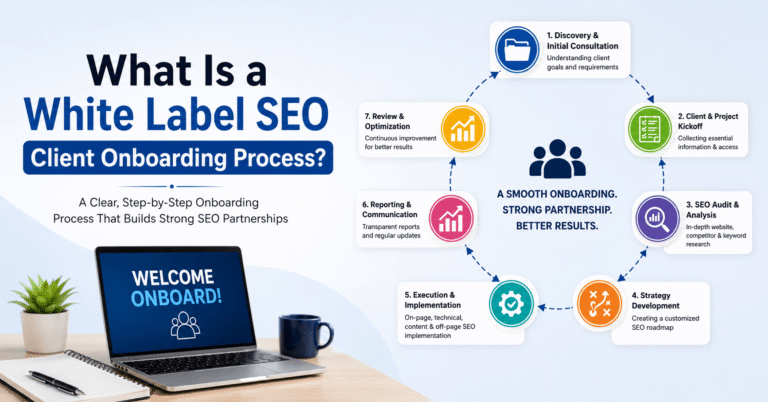
What Is a White Label SEO Client Onboarding Process?
A white label SEO client onboarding process is the structured system an agency uses to collect client information, access credentials, business objectives, SEO requirements, brand information, and reporting preferences before SEO execution begins.
The process typically connects three parties:
Client → Your Agency → White Label SEO Partner
Your agency remains responsible for the client relationship and communication. The white-label partner handles the agreed SEO fulfillment under your agency’s branding or internal workflow.
A good onboarding process should answer five basic questions:
- What does the client want to achieve?
- Who is the client’s target customer?
- Which products, services, and locations matter most?
- What access and information does the SEO team need?
- How will progress and responsibilities be communicated?
Without these answers, SEO work can become task-driven rather than business-driven.
Why White Label SEO Client Onboarding Matters
SEO involves many connected activities: technical analysis, keyword research, competitor analysis, content planning, on-page optimisation, local SEO, link acquisition, reporting, and ongoing strategy.
If the information collected at the beginning is incomplete, the fulfillment team may have to make assumptions.
For example, imagine an Ahmedabad-based manufacturer wants more enquiries from industrial buyers across Gujarat and Maharashtra.
If the onboarding form only says:
“Need SEO for manufacturing website.”
the SEO team still does not know:
- Which products have the highest commercial value
- Which industries the company serves
- Whether the priority is Gujarat or all of India
- Which cities or states matter
- Who the decision-maker is
- Which competitors the client considers important
- Which products have healthy margins
- Whether enquiries or traffic are the main objective
The campaign can technically be executed while still missing the commercial objective.
That is why onboarding should collect business context before SEO tasks.
White Label SEO Client Onboarding Checklist
A practical onboarding system should cover the following areas. For agencies looking to manage growing client requirements efficiently, Scalable White Label SEO Solutions can provide a structured foundation for handling keyword research, technical SEO, content optimisation, link building, reporting, and ongoing campaign management without creating unnecessary pressure on the internal team.
1. Client and Business Information
Start with the fundamentals.
Collect:
- Business name
- Website URL
- Business address
- Primary contact person
- Email address
- Phone number
- Industry
- Years in business
- Main products or services
- Primary target markets
- Service locations
- Business model
- Main competitors
- Current marketing channels
Do not treat this information as administrative paperwork.
It gives the SEO team the context needed to understand the business before analysing keywords and competitors.
2. Business Goals and SEO Objectives
Ask the client what they actually want from SEO.
Possible objectives include:
- More qualified enquiries
- More phone calls
- More WhatsApp enquiries
- Increased organic visibility
- Better local visibility
- More ecommerce sales
- Improved visibility for specific services
- Expansion into new cities
- Growth in non-branded search traffic
- Support for a new product or service
Avoid accepting vague goals such as “increase traffic” without asking why.
Traffic is a means, not necessarily the business objective.
For example, a B2B manufacturer may prefer 20 highly relevant enquiries over thousands of visitors who have no purchasing intent.
3. Target Audience and Customer Discovery
Your SEO client intake checklist should include questions about customers.
Identify:
- Ideal customer
- Customer location
- Buyer type
- Industry
- Job role
- Common customer problems
- Buying considerations
- Frequently asked questions
- High-value products or services
- Typical sales cycle
- Common objections
- Reasons customers choose the business
This information helps connect search intent with commercial priorities.
A healthcare business, SaaS company, manufacturer and local home-service provider may all need SEO, but their customer journeys are completely different.
4. Target Location
Location needs special attention for Indian businesses.
Ask whether the client wants to target:
- One neighbourhood
- One city
- Multiple cities
- Gujarat
- A specific state
- Multiple states
- India
- International markets
For local SEO, identify the actual service areas rather than simply adding city names to pages.
A business serving Ahmedabad, Gandhinagar and nearby areas may need a different local strategy from a company selling products throughout India.
Also record whether customers search primarily in English, Hindi, Gujarati, or another regional language where relevant.
5. Website and Technical Access
Your white label SEO setup should have a defined access process.
Depending on the project, the SEO team may require access to:
- Google Search Console
- Google Analytics
- Google Business Profile
- Website CMS
- Google Tag Manager
- Hosting or technical environment
- Ecommerce platform
- Relevant SEO tools
- Business listing platforms
Do not collect passwords unnecessarily.
Whenever possible, use appropriate user permissions rather than sharing personal login credentials.
Google Search Console provides performance information such as impressions, clicks, CTR and search queries, making it an important source of baseline SEO information.
6. Existing SEO Information
Ask what has already been done.
Important questions include:
- Has another SEO agency worked on the website?
- When did SEO begin?
- What pages were previously optimised?
- Has the website recently migrated?
- Has the domain changed?
- Are there existing backlinks?
- Has organic traffic recently declined?
- Are there known technical issues?
- Has the site received a manual action?
- Are there previous SEO reports?
- Which keywords were previously targeted?
This can prevent the new SEO team from repeating ineffective work.
7. Competitor Information
Do not rely only on tools to identify competitors.
Ask the client:
“Which businesses do you compete with for customers?”
The answer may be different from the websites ranking for a particular keyword.
Create two competitor categories:
Business competitors: Companies the client competes with commercially.
Search competitors: Websites competing for the same search visibility.
Both are useful.
A manufacturer may compete commercially with five local companies but find national directories and international suppliers ranking for its target searches.
8. Keyword and Service Priorities
The onboarding process should identify commercial priorities before detailed keyword research begins.
Ask:
- Which services generate the most revenue?
- Which products have the strongest margins?
- Which services are easiest to sell?
- Which services does the company want to promote?
- Which locations are strategically important?
- Are there new services to launch?
- Are there seasonal products?
- Are there keywords the business already considers important?
The SEO team can then validate these priorities through search intent, competition and search data.
9. Content and Brand Guidelines
If content is part of the white-label SEO workflow, collect brand information early.
Include:
- Brand tone
- Preferred terminology
- Words to avoid
- Writing style
- Brand positioning
- Product specifications
- Service details
- Approved claims
- Author information
- Industry compliance requirements
- Existing brochures or sales material
- Frequently used customer questions
This is particularly important for healthcare, finance, legal, education and other regulated or trust-sensitive industries.
The SEO team should not have to guess how a business describes its services.
10. Conversion and Lead Tracking
One of the most overlooked parts of SEO onboarding is conversion measurement.
Define what counts as a meaningful conversion.
Examples include:
- Contact form submission
- Phone call
- WhatsApp enquiry
- Appointment request
- Demo request
- Quote request
- Product purchase
- Application submission
- Store visit enquiry
Google Analytics can use important events as conversions and share conversion data with Google Ads, helping businesses evaluate important actions across channels.
Read More:- How To Handle More SEO Clients Without Hiring
Step-by-Step White Label SEO Onboarding Process
A repeatable workflow makes onboarding easier as your agency grows.
Step 1: Close the Scope Before Fulfillment Begins
Document:
- Services included
- Number of pages or websites
- Target locations
- Reporting frequency
- Content responsibilities
- Technical SEO responsibilities
- Link-building scope
- Client approval requirements
- Communication process
- Expected deliverables
Avoid starting work based only on a sales conversation.
The signed scope should become the operational reference.
Step 2: Send the SEO Client Intake Form
Use one structured form instead of scattered WhatsApp messages and emails.
Collect business information, goals, audience, competitors, services, locations, access requirements and brand guidelines.
This creates a consistent SEO project onboarding experience.
Step 3: Verify Access
Create an internal access checklist.
For each platform, record:
- Required
- Requested
- Received
- Verified
- Not applicable
Do not mark an account as complete merely because the client says access has been provided.
The team should verify that the correct permission level is available.
Step 4: Complete Initial SEO Discovery
Before implementation, review:
- Website structure
- Indexation
- Existing rankings
- Organic traffic
- Search queries
- Key landing pages
- Technical issues
- Competitor visibility
- Existing content
- Backlink profile
- Local search presence
Search Console’s Performance reports can be filtered by queries, pages, countries and other dimensions, which makes the baseline analysis more useful than simply recording one overall traffic number.
Step 5: Create the SEO Strategy
Translate business priorities into an SEO plan.
A useful strategy document should clarify:
Business objective → Audience → Search intent → Keywords → Pages → Content → Technical work → Measurement
This prevents keyword research from becoming disconnected from revenue priorities.
Step 6: Establish the Reporting Workflow
Define:
- Reporting date
- Report format
- Key metrics
- Deliverables
- Client communication channel
- Monthly review process
- Approval workflow
For white-label agencies, reporting deserves extra attention because the final report may need to be presented entirely under the agency’s brand.
Step 7: Hold an Internal Handoff
Before the fulfillment team starts, your agency should conduct an internal handoff.
Share:
- Client goals
- Scope
- Target locations
- Priority services
- Audience
- Competitors
- Access status
- Technical constraints
- Content requirements
- Reporting requirements
- Important client preferences
This is where a good onboarding system becomes a genuine white label SEO workflow rather than a collection of forms.
What Agencies Commonly Get Wrong
Starting SEO Before Understanding the Business
Keyword research should not be the first and only discovery exercise.
If you do not understand the commercial priorities, you may optimise pages that generate visibility without meaningful business value.
Collecting Too Much Information
A long form is not automatically a better form.
Ask questions that influence strategy.
If a question will never affect targeting, content, technical work, reporting or client communication, consider removing it.
Relying Entirely on Client-Provided Keywords
Clients know their products and customers. SEO specialists understand search behaviour.
You need both perspectives.
Client keywords are useful inputs, not the finished keyword strategy.
Treating All Leads as Equal
For a real estate agency, one enquiry could be a serious buyer while another may simply ask for property information.
For a B2B manufacturer, a request from the right procurement team can be much more valuable than several irrelevant enquiries.
Your onboarding process should therefore capture lead-quality considerations.
Keeping Everything in WhatsApp
WhatsApp is useful for quick communication, but it should not become the agency’s only project-management system.
Important approvals, credentials, scope decisions and strategy changes should be documented in the appropriate system.
Practical Examples
Example 1: Local Service Business
Imagine a home-service company serving Ahmedabad.
The owner says:
“We need more traffic from Google.”
During onboarding, the agency discovers that the real priority is phone enquiries for three high-margin services.
The strategy changes.
Instead of measuring only overall traffic, the team can focus on:
- Service-specific landing pages
- Local search visibility
- Google Business Profile optimisation
- Call tracking
- Location relevance
- Conversion-focused website improvements
The lesson is simple: the onboarding conversation can change the SEO strategy.
Example 2: Real Estate Business
Consider a real estate company receiving a high number of online enquiries.
At first glance, this appears positive.
But the sales team reports that many enquiries are from people outside the target budget or location.
During onboarding, the agency should capture:
- Preferred property types
- Target locations
- Buyer profile
- Price ranges
- Project priorities
- Qualification criteria
- Lead handoff process
The objective becomes improving lead relevance, not simply increasing enquiry volume.
How White Label SEO Onboarding Differs by Industry
Healthcare
Prioritise service information, locations, trust signals, accurate content and enquiry/appointment journeys.
Real Estate
Focus on project/location intent, buyer segments, property types and lead qualification.
Manufacturing
Give greater attention to technical products, B2B search intent, applications, industries served and procurement-related queries.
Education
Consider course intent, admission periods, locations, eligibility and seasonal demand.
Ecommerce
Connect SEO with product categories, product discovery, commercial intent, technical ecommerce issues and conversion behaviour.
SaaS
Focus on product use cases, problem-based searches, comparison intent, integrations and demo/signup journeys.
Local Services
Prioritise service areas, Google Business Profile, local landing pages, calls, directions and enquiry actions.
How to Measure Whether Onboarding Is Working
Onboarding itself should be measurable.
Useful operational indicators include:
- Percentage of required access received
- Time from sale to project kickoff
- Number of unresolved client questions
- Number of missing business details
- Strategy approval time
- Number of scope clarifications after kickoff
- Reporting setup completion
- Tracking implementation status
For SEO performance, establish a baseline before major changes are made.
Track relevant metrics such as:
- Organic clicks
- Impressions
- Search queries
- CTR
- Relevant keyword visibility
- Organic landing-page performance
- Qualified enquiries
- Conversion actions
Google specifically recommends looking at trends in impressions and clicks rather than relying on average position alone when assessing Search performance.
White Label SEO Client Onboarding Checklist
Before moving a new client into active SEO fulfillment, review this checklist:
- Client business information completed
- Primary contact confirmed
- Business objectives documented
- Target audience defined
- Priority services/products identified
- Target locations confirmed
- Competitors identified
- Existing SEO history collected
- Website access verified
- Google Search Console access verified
- Google Analytics access verified where applicable
- Google Business Profile access checked for local SEO
- Conversion actions defined
- Brand guidelines collected
- Content requirements documented
- SEO scope approved
- Reporting requirements confirmed
- Communication process established
- Initial SEO audit completed
- Keyword research requirements documented
- Internal fulfillment handoff completed
- Project kickoff approved
Myths vs Facts About SEO Client Onboarding
Myth 1: Onboarding is just collecting passwords.
Fact: Access is only one part of onboarding. Business objectives, audience, priorities, scope, tracking and communication are equally important.
Myth 2: The client already knows their keywords.
Fact: Clients provide valuable market knowledge, but search data and intent analysis should validate which terms deserve strategic attention.
Myth 3: More onboarding questions always produce better SEO.
Fact: The best onboarding forms collect information that can actually influence the campaign.
Myth 4: SEO can start before tracking is ready.
Fact: SEO work can technically begin, but without appropriate measurement, it becomes harder to evaluate meaningful business outcomes.
Myth 5: More leads automatically mean better SEO.
Fact: Lead quality matters. A smaller number of relevant enquiries may be more valuable than a large volume of poorly qualified leads.
Myth 6: White-label SEO removes the need for agency involvement.
Fact: A fulfillment partner can handle execution, but the agency still needs to own client communication, expectations, positioning and account strategy.
Conclusion
A strong White Label SEO Client Onboarding Checklist is not just an administrative document. It is the foundation connecting sales, strategy, fulfillment, reporting and client communication.
For Indian agencies, this becomes even more important as client requirements vary widely across cities, industries, budgets and business models.
A manufacturer may need qualified B2B enquiries. A clinic may care about appointment requests. A local service company may depend on phone calls and WhatsApp. An ecommerce brand may care about product discovery and sales.
The onboarding process should capture those differences before the SEO workflow begins.
If your agency is handling white-label SEO manually through scattered emails, WhatsApp messages and spreadsheets, the next improvement may not be hiring more people. It may be creating a better onboarding system.
Flying Lion Media works with agencies and business partners that need structured white-label SEO fulfillment, transparent workflows and agency-focused delivery. If you are evaluating your current SEO fulfillment process, a strategy discussion can help identify where onboarding, execution or reporting could be improved—without assuming that the same workflow will work for every agency.