

For a growing digital marketing agency, winning new SEO clients can eventually create a problem of its own.
Sales may be bringing in more enquiries, but the delivery team is already managing keyword research, technical audits, content briefs, on-page optimisation, link building, reporting and client communication for existing accounts. Hiring another full-time SEO specialist every time the client list grows can quickly increase fixed costs and management overhead.
The better question is not always “How do we hire more people?” It is:
“How can we handle more SEO clients using better processes, technology, specialisation and reliable delivery support?”
This is where SEO client management, process standardisation and SEO outsourcing for agencies become important.
For Indian digital marketing agencies, particularly smaller agencies and growing teams in Ahmedabad, Mumbai, Bengaluru, Delhi NCR and other competitive markets, scalability often depends on how efficiently work is delivered rather than simply how many employees are on payroll.
This guide explains how to handle more SEO clients without hiring, where agencies commonly become overloaded, and when outsourcing or white-label SEO services can make operational sense.
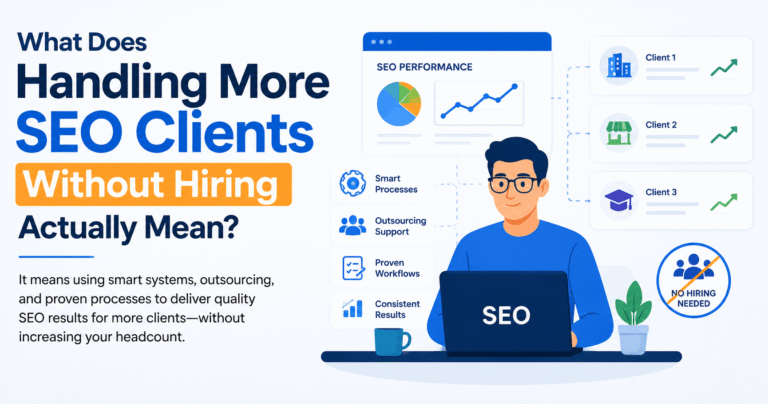
What Does Handling More SEO Clients Without Hiring Actually Mean?
Handling more SEO clients without hiring does not mean forcing your existing team to work longer hours.
It means increasing your agency’s delivery capacity by improving how SEO work is planned, assigned, documented, automated and fulfilled.
A scalable SEO operation typically combines:
- Standardised SEO workflows
- Repeatable onboarding processes
- Clear client communication
- Automated reporting
- Specialised freelancers or outsourcing partners where appropriate
- White label SEO services
- Documented quality-control procedures
- Better project management
- Reusable templates and frameworks
- Clear service packages
The objective is to reduce unnecessary manual work while protecting the quality of strategic SEO work.
Google itself explains that SEO involves areas such as content development, technical recommendations, keyword research and expertise in specific markets or geographies.
That makes process design especially important when an agency is managing clients across different industries and Indian locations.
Why Do Agencies Struggle to Manage Multiple SEO Clients?
An agency may be able to manage five SEO accounts comfortably but struggle when it reaches 15 or 20.
The problem is often not simply the number of clients. It is how much custom work is being performed for every account.
1. Every client follows a different process
One client wants weekly calls.
Another wants WhatsApp updates.
Another expects a detailed monthly presentation.
Another needs reports sent to three different stakeholders.
If every account follows a completely different workflow, account management becomes expensive.
2. SEO tasks are not documented
When keyword research, content planning, audits and reporting depend on individual employees remembering what to do, scaling becomes difficult.
A documented workflow creates consistency.
3. Senior SEO staff handle routine tasks
Experienced SEO specialists should spend their time solving strategic problems, analysing performance and making decisions.
If they are spending hours preparing repetitive reports or manually completing basic tasks, the agency is using expensive expertise inefficiently.
4. Client communication consumes delivery time
Client questions can interrupt SEO work throughout the day.
A structured communication process can reduce this problem.
For example:
- Weekly internal updates
- Monthly client reports
- Defined response windows
- Scheduled strategy calls
- Centralised task management
5. Sales grows faster than fulfilment
This is one of the most common agency bottlenecks.
Sales may successfully close new clients while the delivery team has no remaining capacity.
At this stage, SEO agency scalability becomes a business issue, not simply an SEO issue.
7 Practical Ways to Handle More SEO Clients Without Hiring
1. Standardise Your SEO Delivery Process
The first step toward scalability is creating a repeatable SEO workflow.
Instead of developing a completely new process for every client, create a core framework that can be customised where necessary.
For example:
SEO onboarding
- Website access
- Google Search Console access
- Google Analytics access
- Business information
- Target locations
- Target products or services
- Competitor information
- Existing keyword data
- Previous SEO work
Initial strategy
- Website audit
- Competitor analysis
- Keyword research
- Search intent analysis
- Technical SEO review
- Content gap analysis
- Conversion review
Monthly execution
- Keyword tracking
- Technical improvements
- Content optimisation
- New content planning
- Internal linking
- Local SEO activities where applicable
- Authority-building activities
- Performance analysis
- Client reporting
The exact work will vary by account, but the process should remain predictable.
2. Create SEO Packages With Defined Deliverables
Another common scalability problem is selling vague SEO services. If a client expects “complete SEO,” your team may end up handling unlimited tasks, making it difficult to control workload and delivery costs. A clear package structure can help agencies scale your SEO agency without hiring by defining exactly what each service includes.
For example:
Starter SEO
- Keyword research
- Basic technical review
- On-page optimisation
- Content recommendations
- Monthly reporting
Growth SEO
- Technical SEO
- Keyword strategy
- Content planning
- On-page optimisation
- Internal linking
- Local SEO where required
- Monthly reporting
Advanced SEO
- Technical SEO
- Extensive content strategy
- Competitor analysis
- Conversion optimisation recommendations
- Local or ecommerce SEO
- Digital PR or link acquisition strategy
- Advanced reporting
This makes SEO client management easier because your team knows what has been sold.
It also helps sales teams avoid promising work that the delivery team cannot realistically support.
3. Automate Repetitive SEO Work
Automation should remove repetitive administration—not replace strategic decision-making.
Consider automating:
- Report generation
- Rank tracking updates
- Client notifications
- Task reminders
- Lead notifications
- Data collection
- Website monitoring
- Recurring project tasks
Google Search Console can provide useful performance data including clicks, impressions, CTR and average position. It can also be filtered by queries, pages and countries.
Instead of manually collecting this information for every client, build a reporting system that pulls the required information into a consistent report.
Your SEO specialist should then interpret the data, rather than spend most of the reporting time copying it.
4. Build Templates for Repeated SEO Tasks
Templates can dramatically reduce unnecessary production time.
Create reusable frameworks for:
- SEO audit reports
- Keyword research
- Content briefs
- Meta title recommendations
- Meta descriptions
- On-page optimisation
- Monthly reports
- Client onboarding
- Competitor analysis
- Technical SEO checklists
- Local SEO audits
However, templates should provide a starting structure rather than become copy-and-paste SEO.
For example, a healthcare website and an industrial manufacturer should not receive identical keyword strategies simply because they use the same report template.
Standardise the workflow, not the strategy.
5. Separate Strategy From Production
One of the strongest ways to improve SEO agency scalability is to divide strategic and production responsibilities.
Your senior SEO team can focus on:
- Search intent
- Strategy
- Competitor analysis
- Technical priorities
- Keyword mapping
- Content direction
- Performance analysis
- Client strategy
Production work can then be handled through internal specialists, freelancers or a trusted SEO outsourcing for agencies partner.
Depending on the agency, outsourced production may include:
- Keyword research
- SEO content writing
- On-page optimisation
- Technical implementation
- Link-building activities
- Local SEO support
- Reporting preparation
This allows the core team to remain focused on decisions that require experience.
6. Use White Label SEO Services When Delivery Capacity Becomes the Bottleneck
For agencies that already have strong sales and account-management capabilities, white label SEO services can be an efficient way to expand fulfilment capacity.
The basic model is straightforward.
Your agency owns the client relationship.
A specialised SEO partner supports the delivery.
You then present the completed work under your own brand, where the commercial arrangement and service structure allow it.
This can help agencies avoid immediately building a large internal SEO department.
Potentially outsourced activities include:
- SEO audits
- Keyword research
- Content briefs
- Technical SEO
- On-page optimisation
- Content production
- Local SEO
- Link-building support
- SEO reporting
- Campaign execution
The important point is that outsourcing should not mean giving up strategic control.
Your agency should still decide:
Who is the client? What are their business objectives? What should be prioritised? What does success look like?
A good white label SEO outsourcing model supports your delivery system rather than replacing your agency’s relationship with the client.
7. Build a Quality-Control Layer Before Scaling
More clients mean more opportunities for small mistakes.
A missed redirect, incorrect keyword mapping, weak content brief or reporting error can damage client trust.
Before increasing your SEO workload, create quality-control checkpoints.
For example:
Before strategy approval
- Are business goals documented?
- Are commercial keywords identified?
- Is search intent understood?
- Are competitors relevant?
- Are target locations correct?
Before content publication
- Does the page satisfy search intent?
- Is the primary keyword naturally used?
- Are supporting topics covered?
- Are internal links relevant?
- Is the content useful to the intended customer?
Before monthly reporting
- Are the reporting dates correct?
- Are traffic sources properly interpreted?
- Are conversions being measured?
- Are important wins and problems explained?
- Are next month’s priorities clear?
Google’s SEO documentation also stresses that SEO changes can take varying amounts of time to show an impact, so client reporting should avoid presenting short-term movement as a guaranteed outcome.
A Simple SEO Scaling Framework
If you want to grow an SEO agency without hiring, use this framework:
Standardise → Automate → Delegate → Outsource → Quality Check → Scale
Standardise
Create repeatable workflows.
Automate
Remove repetitive administrative work.
Delegate
Move suitable production tasks away from senior specialists.
Outsource
Use specialist SEO fulfillment when internal capacity becomes constrained.
Quality Check
Review important deliverables before they reach the client.
Scale
Increase your client capacity only after the delivery system is stable.
The sequence matters.
Adding 20 clients to a broken process does not create a scalable agency. It creates a larger operational problem.
Two Practical Examples
Example 1: Local Service Business SEO
Imagine your agency manages SEO for a local home-services company.
The website receives organic visitors, but enquiries are inconsistent.
Instead of simply producing more blog posts, the SEO team should examine:
- Which service pages receive impressions?
- Which local searches generate visibility?
- Are important service pages ranking?
- Is the Google Business Profile properly managed?
- Are phone calls and WhatsApp enquiries being tracked?
- Does the landing page make the next step obvious?
Google Search Console can show queries, pages, clicks, impressions and CTR, helping the agency understand whether visibility is coming from relevant searches.
The lesson is important:
Scaling SEO delivery does not mean producing more tasks. It means making the workflow better at identifying and solving the right problems.
Example 2: Real Estate SEO
Consider a real estate agency serving multiple Indian cities.
It may generate substantial enquiry volume but still have a lead-quality problem.
If the SEO team only reports traffic and keyword rankings, management may miss the bigger issue.
A better process connects SEO activity with:
- Location
- Property type
- Search intent
- Landing page
- Lead source
- Enquiry quality
- Sales follow-up
For example, ranking for broad informational searches may generate visitors without generating serious property enquiries.
The agency therefore needs to prioritise commercial and location-specific search intent, not simply increase organic traffic.
Myths vs Facts About Scaling SEO Clients
Myth | Fact |
More clients always require more employees. | Better processes, automation and specialist outsourcing can increase capacity without immediately increasing permanent headcount. |
Every SEO client needs a completely unique workflow. | Strategy should be customised, but operational processes can be standardised. |
More SEO tasks mean better results. | Prioritising high-impact work is usually more useful than maximising task volume. |
Outsourcing means losing control. | With clear SOPs, approvals and quality checks, outsourcing can extend delivery capacity while the agency retains strategic control. |
More traffic means better SEO performance. | Relevant traffic and qualified enquiries matter more than traffic volume alone. |
SEO results should appear immediately. | Google notes that changes can take anywhere from hours to months to be reflected, and some changes may not produce noticeable impact. |
How to Measure Whether Your SEO Operation Is Actually Scaling
Client count alone is not a useful measure of scalability.
Track operational metrics such as:
Client capacity per SEO specialist
How many accounts can a specialist manage while maintaining acceptable quality?
Delivery time per client
How many hours are required each month?
Task completion rate
Are recurring SEO tasks being completed on schedule?
Client retention
Are clients staying because they see meaningful value?
Reporting time
How much staff time is spent creating reports?
Revision rate
How often do deliverables need major rework?
Qualified enquiry contribution
Are SEO activities supporting business-relevant enquiries?
Gross margin per account
Does the account remain commercially viable after delivery costs?
This last metric is particularly important.
An agency can grow its client list while becoming less profitable if delivery costs increase faster than revenue.
When Should an Agency Consider SEO Outsourcing?
Outsourcing becomes worth evaluating when:
- Sales is consistently generating more SEO work than the team can fulfil.
- Senior employees are overloaded with production tasks.
- Hiring full-time specialists would create too much fixed overhead.
- You need expertise in a specific SEO discipline.
- You want to expand your SEO service portfolio.
- Client demand fluctuates from month to month.
- You need white-label delivery under your agency brand.
- You want to test a new service before building an internal department.
Google recommends researching SEO providers carefully and considering their experience, expected timeframe, methods and relevant market or geographic experience.
That principle is equally important when selecting an SEO outsourcing partner for an agency.
Do not evaluate a partner only on price.
Look at:
- Communication
- SEO expertise
- Reporting quality
- Turnaround time
- Quality-control process
- Industry experience
- Scalability
- Transparency
- Ability to follow your SOPs
A Practical Checklist Before Taking on More SEO Clients
- Is your SEO onboarding process documented?
- Are your service packages clearly defined?
- Do you have standard SEO SOPs?
- Are recurring tasks automated where practical?
- Are senior SEO specialists focused on strategy?
- Do you have reusable reporting templates?
- Is client communication structured?
- Are conversion actions being tracked?
- Do you have a quality-control process?
- Can you outsource specialist or production work when required?
- Can your current team handle additional accounts without compromising quality?
- Do you know the delivery cost and margin for each SEO package?
If several answers are “no,” adding more clients may create operational pressure before it creates profitable growth.
How SEO Scaling Differs Across Indian Industries
There is no universal model for managing SEO clients.
Healthcare
SEO workflows need strong attention to service pages, location targeting, trust signals and enquiry journeys.
Real Estate
Location, property type, project intent and lead quality can be more important than raw traffic.
Manufacturing
B2B SEO often requires detailed product, application and industry-specific content rather than broad consumer keywords.
Education
Seasonality can influence demand, so content and campaign priorities may need to change around admission cycles.
Ecommerce
SEO scalability often involves category pages, product pages, technical SEO, internal linking and large content inventories.
Local Businesses
Google Business Profile, location pages, reviews, service pages and phone/WhatsApp enquiries may be particularly important.
The underlying lesson is the same:
Standardise the delivery process while customising the marketing strategy.
Conclusion:
If your digital marketing agency is struggling to handle more SEO clients without hiring, the answer may not be another full-time employee.
First examine the delivery system.
Can you standardise onboarding? Can repetitive reporting be automated? Are senior specialists spending too much time on production? Are your SEO packages clearly defined? Can selected tasks be delegated? Can a reliable SEO fulfillment service extend your capacity while your agency retains strategic control?
These questions matter because sustainable agency growth is not simply about acquiring more clients. It is about delivering consistent value without allowing operational costs and complexity to grow at the same rate.
For Indian agencies, especially those serving clients across multiple cities and industries, a combination of SEO client management, process standardisation, automation and carefully selected SEO outsourcing can create a more flexible operating model.
Flying Lion Media works with businesses and agencies across India on SEO, digital marketing and white-label fulfilment. If your agency is reaching a point where client demand is exceeding your current SEO delivery capacity, a practical next step is to review your current workflow, identify the bottlenecks and determine which activities should remain in-house and which can be supported externally.