

A digital marketing agency can publish dozens of articles, build backlinks, optimize pages, and still struggle to make a client’s website clearly understood by search engines.
The problem is often not a lack of keywords. It is a lack of context.
A search engine needs to understand what a business is, what it offers, who it serves, where it operates, which topics it has expertise in, and how its products, services, people, locations, and content relate to one another.
That is where a White Label Entity-Based SEO Strategy becomes useful.
For agencies, the challenge is even bigger. You may sell SEO under your own brand while relying on an external fulfillment team to handle technical SEO, content, entity optimisation, structured data, internal linking, local SEO, and reporting. If these activities are disconnected, the client may receive a collection of SEO tasks rather than a coherent search strategy.
This guide explains how entity-based SEO can be incorporated into a white label SEO workflow, what agencies should actually optimise, common mistakes to avoid, and how to evaluate whether the strategy is improving a client’s search presence.
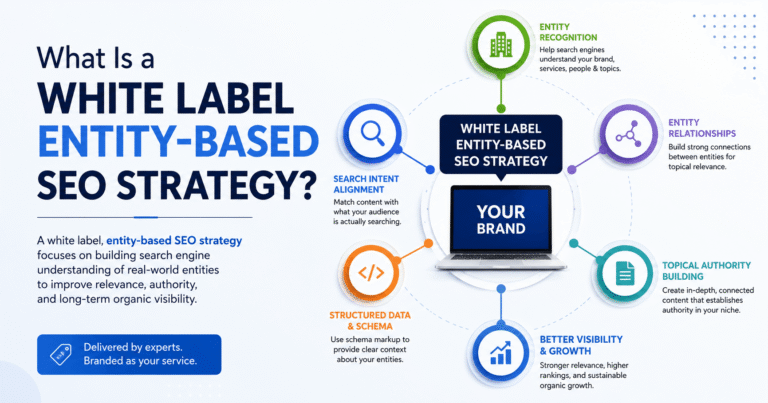
What Is a White Label Entity-Based SEO Strategy?
A White Label Entity-Based SEO Strategy is an SEO delivery approach where a white label provider helps an agency optimise a client’s online presence around clearly defined entities, their attributes, relationships, topics, services, products, locations, and audience needs.
Instead of treating SEO as a list of keywords, the strategy builds a connected understanding of the business.
For example, imagine a hypothetical Ahmedabad-based manufacturer.
Its website might target:
- industrial equipment
- manufacturing machinery
- CNC machines
- industrial automation
- machine components
A traditional keyword approach might create separate pages for each phrase.
An entity-based approach asks broader questions:
- What is the company?
- What products does it manufacture?
- Which industries use those products?
- Which locations does it serve?
- What problems do those products solve?
- Which related technical concepts should the website explain?
- Which services belong to which products?
- Which people or organisations are associated with the business?
- How should these relationships be represented throughout the website?
This creates a more coherent semantic SEO strategy.
Google explains that structured data can help it understand page content, while its people-first guidance emphasises useful, reliable content created for users rather than content created primarily to manipulate rankings.
Why Entity-Based SEO Matters for White Label Agencies
Your client may never know who performed the technical audit, prepared the content brief, mapped entities, or analysed competitors. What the client sees is your agency’s brand and the quality of the outcome.
That makes consistency important.
A keyword-only fulfillment model can create problems when:
- Content writers target keywords without understanding the business
- Service pages overlap
- Similar topics compete with each other
- Internal links are added without a clear structure
- Schema is implemented without accurate business information
- Local pages contain repetitive content
- Content covers search terms but not customer questions
- Different writers use inconsistent terminology
An entity-first SEO workflow gives the delivery team a shared understanding of the client. A well-planned entity-based SEO strategy provides a structured framework for connecting keyword research, content, technical SEO, local SEO, website architecture, structured data, and authority building.
Entity-Based SEO vs Keyword-Based SEO
Keywords still matter. Entity-based SEO does not mean abandoning keyword research.
The difference is how the information is organised.
Keyword-focused approach | Entity-focused approach |
Targets individual phrases | Understands topics and entities |
Focuses heavily on keyword variations | Connects related concepts |
Creates pages around search terms | Creates pages around user needs |
Measures rankings and traffic | Also considers relevance and business outcomes |
Can encourage repetitive content | Encourages broader topical coverage |
Often starts with keywords | Starts with business, audience and search intent |
Consider a healthcare clinic.
A keyword-focused plan might target:
- dental clinic Ahmedabad
- dentist Ahmedabad
- best dentist Ahmedabad
- dental treatment Ahmedabad
An entity-based content strategy would also consider:
- dental clinic
- dentist
- dental treatments
- patients
- preventive dentistry
- root canal treatment
- dental implants
- oral health
- appointment
- Ahmedabad
- clinic location
- treatment costs
- common patient concerns
The objective is not to force all these terms into one page.
The objective is to build a website where the relationships between these subjects make sense.
The Core Components of a White Label Entity-Based SEO Strategy
1. Define the Business Entity
Start with the business itself.
Document:
- Business name
- Business type
- Products
- Services
- Locations
- Target customers
- Industries served
- Brand variations
- Contact information
- Key people
- Important online profiles
- Main competitors
This becomes the foundation for SEO entity mapping.
For a white label agency, this information should be included in the onboarding process rather than discovered randomly after content production has already started.
2. Map Products, Services and Topics
Next, identify the relationships between the business’s offerings and the subjects customers search for.
For example:
Manufacturer → Industrial Equipment → CNC Machines → Components → Maintenance → Industries Served
Or:
Digital Agency → SEO Services → Technical SEO → Content Strategy → Local SEO → Ecommerce SEO
This is entity relationship mapping.
It helps content strategists understand which pages should exist and how those pages should connect.
Why this matters
Without a relationship map, agencies often create isolated blog posts.
One article may discuss technical SEO.
Another discusses crawling.
Another discusses indexing.
Another discusses website audits.
But none of them may connect logically to the client’s primary SEO service.
A semantic website structure fixes this by organising related information into useful clusters.
3. Build Topical Authority Around Real Customer Needs
Topical authority SEO is not simply publishing hundreds of articles.
It means demonstrating useful coverage of a subject.
For example, an Indian SaaS company selling accounting software may need content around:
- accounting software
- invoicing
- GST invoicing
- expense management
- financial reporting
- business accounting
- integrations
- automation
- small-business accounting
- compliance-related workflows
The exact structure depends on the product and audience.
The important point is that content should answer genuine customer questions rather than being created only because a keyword has search volume.
Google’s current guidance explicitly encourages content that provides original value, demonstrates first-hand expertise, and leaves readers satisfied rather than requiring them to search again.
4. Connect Search Intent With Entities
Search intent tells you why someone is searching.
Entity optimization helps you understand what the search is about.
Both are necessary.
Consider the query:
“best CRM software for small business India”
The searcher may be evaluating products.
Relevant entities could include:
- CRM software
- sales management
- lead management
- small businesses
- customer data
- India
- pricing
- integrations
- reporting
The page should therefore do more than repeat the keyword.
It should help the user compare relevant options and make a decision.
This is where search intent optimisation becomes more important than artificial keyword density.
5. Use Structured Data Carefully
Structured data is one part of an entity-based SEO strategy.
It gives search engines machine-readable information about content on a page.
Google says structured data is a standardized format for providing information about a page and classifying its content. It also recommends validating structured data and maintaining accurate, complete information.
Depending on the business, an agency may evaluate:
- Organization
- LocalBusiness
- Product
- Service-related structured data where applicable
- Article
- Breadcrumb
- Profile-related markup where supported
For example, Google recommends using Organization structured data on a homepage or a page describing the organisation, with relevant details such as name, URL, logo, address and telephone where applicable.
Important warning
Schema markup does not automatically create rankings.
Google also states that valid structured data does not guarantee that a page will receive a rich result.
So don’t sell “schema implementation” to a client as a shortcut to higher rankings.
Treat it as part of a larger structured data SEO and website-understanding strategy.
Read More:- White Label SEO Client Reporting Workflow
6. Strengthen Brand and Business Entity Signals
A brand should be consistently represented across its website and important online properties.
Review:
- Business name
- Logo
- Website
- About page
- Contact information
- Social profiles
- Google Business Profile
- Business directories where relevant
- Author information
- Organisation details
- Location information
For local businesses, this becomes especially important.
A clinic in Ahmedabad, for example, should make it easy for users to understand:
- who operates the clinic
- where it is located
- what treatments it provides
- when it is open
- how to contact it
- which areas it serves
This is business entity optimisation, not merely local keyword insertion.
Google’s documentation notes that organisation structured data can help Google understand administrative details and disambiguate an organisation in search results.
7. Build an Entity-Based Website Architecture
Website structure is often overlooked in white label SEO fulfillment.
A strong structure might look like:
Homepage
↓
Core Services
↓
Specific Services
↓
Industry Solutions
↓
Supporting Educational Content
For an SEO agency, for example:
SEO Services
→ Technical SEO
→ Local SEO
→ Ecommerce SEO
→ SaaS SEO
→ Enterprise SEO
Supporting articles can then explain:
- crawlability
- internal linking
- search intent
- content optimisation
- local search
- ecommerce category optimisation
- technical audits
This creates a logical relationship between commercial and informational content.
Step-by-Step White Label Entity SEO Workflow
Step 1: Understand the Client
Before keyword research, collect:
- Business objectives
- Products and services
- Target customers
- Target locations
- Sales process
- Average customer value
- Competitors
- Existing marketing channels
- Website limitations
A manufacturer and a local dentist should never receive the same entity strategy.
Step 2: Perform a Website Audit
Review:
- Indexing
- Crawlability
- Internal links
- Page hierarchy
- Existing content
- Duplicate pages
- Metadata
- URLs
- Mobile experience
- Conversion paths
- Local signals
- Structured data
- Existing organic visibility
Google Search Essentials recommends focusing on helpful content and using words people actually use to find content, alongside core technical practices.
Step 3: Conduct Entity and Competitor Research
Study competing websites to understand:
- Their core entities
- Service categories
- Content depth
- Industry terminology
- Location coverage
- Author information
- Internal linking
- Structured data
- Commercial pages
- Supporting content
Don’t copy competitors.
Identify what they explain well and where the client can provide a more useful resource.
Step 4: Create the Entity Map
Build a simple internal document containing:
Primary entity: Client business
Products: Main products
Services: Main services
Locations: Target locations
Audience: Customer groups
Topics: Major knowledge areas
Relationships: How products, services, audiences and topics connect
Supporting content: Articles required to explain those relationships
This becomes the foundation for content production.
Step 5: Create Topic Clusters
A topic cluster groups related pages around a central subject.
For example:
Pillar: Ecommerce SEO
Supporting content:
- Ecommerce keyword research
- Product page SEO
- Category page optimisation
- Ecommerce technical SEO
- Internal linking
- Product structured data
- Ecommerce conversion optimisation
The exact cluster should reflect the client’s business and audience.
Step 6: Optimise Existing Pages Before Creating Hundreds of New Ones
This is one of the most useful lessons for agencies.
A website may already contain valuable pages that are poorly structured.
Before creating 50 new articles, check whether existing pages need:
- Better headings
- Clearer search intent
- Stronger internal links
- Improved entity relationships
- More useful explanations
- Better conversion paths
- Updated business information
- Better structured data
- Content consolidation
More pages are not automatically better.
Two Practical Business Scenarios
Example 1: Local Healthcare Business
Imagine a hypothetical dental clinic in Ahmedabad receiving website traffic but very few appointment enquiries.
The agency initially finds that the site has articles attracting informational searches, but its commercial pages are weak.
An entity-based review identifies:
Business: Dental clinic
Location: Ahmedabad
Services: Dental implants, root canal treatment, preventive dentistry
Audience: Local patients
Conversion: Appointment request or phone call
The strategy could then connect educational content to appropriate treatment pages, strengthen location relevance, clarify services and improve conversion paths.
The lesson is simple:
More informational traffic would not necessarily solve the clinic’s business problem. Better alignment between search intent, service entities and conversion paths may matter more.
Example 2: Real Estate Lead Quality
Consider a hypothetical real estate company targeting property buyers in a competitive Indian city.
The company generates leads through organic search, but many enquiries are irrelevant.
An agency should investigate:
- Which pages generate leads?
- Which queries attract those visitors?
- Are informational and transactional searches being mixed?
- Are location pages specific enough?
- Are property types clearly defined?
- Are pricing expectations communicated?
- Is the lead form attracting the right audience?
- How quickly are sales teams following up?
This demonstrates why entity-based content optimisation should not operate separately from conversion analysis.
SEO can influence who discovers the business, but the website and sales process influence what happens next.
How Entity-Based SEO Differs Across Indian Industries
Branding firms often work closely with businesses during repositioning or expansion.
SEO can become part of the digital visibility strategy when the new brand launches.
Healthcare
Focus on:
- Services
- Treatments
- Conditions where appropriate
- Medical professionals
- Locations
- Patient questions
- Trust and expertise
Healthcare content requires particularly careful sourcing and responsible communication.
Real Estate
Important entities may include:
- Property type
- Location
- Project
- Builder
- Amenities
- Price range
- Local infrastructure
- Buyer intent
Manufacturing
B2B manufacturers should consider:
- Product specifications
- Applications
- Industries served
- Materials
- Technical terminology
- Certifications
- Manufacturing capabilities
- Service areas
Ecommerce
Entity optimisation can involve:
- Products
- Categories
- Brands
- Attributes
- Variants
- Use cases
- Reviews
- Availability
- Product information
Education
Relevant entities may include:
- Courses
- Institutions
- Programs
- Subjects
- Admissions
- Locations
- Eligibility
- Career outcomes
The strategy should change according to how customers research and purchase in each industry.
Common White Label Entity SEO Mistakes
Myth 1: Entity SEO means adding more keywords
Fact: Entity-based optimisation is about relationships, context and understanding—not simply increasing keyword frequency.
Myth 2: Schema automatically improves rankings
Fact: Structured data can help search engines understand content and may support eligible search features, but Google does not guarantee enhanced search appearances.
Myth 3: More content always creates more authority
Fact: Poorly planned content can create overlap, maintenance problems and weak user experiences. Content should solve genuine customer needs.
Myth 4: Entity SEO replaces keyword research
Fact: Keywords remain useful for understanding how people search. Entity research adds context around those searches.
Myth 5: A knowledge panel means a company has "won SEO"
Fact: Search visibility is broader than a single search feature. Businesses should evaluate relevant visibility, qualified traffic, enquiries and other business outcomes.
How to Measure Whether the Strategy Is Working
Don’t evaluate an entity-based SEO strategy using rankings alone.
Track a combination of:
Search visibility
- Relevant keyword movement
- Organic impressions
- Search visibility for priority topics
- Local search presence
Website engagement
- Organic landing pages
- Engaged sessions
- Important page interactions
- Navigation between related pages
Conversion performance
- Enquiries
- Phone calls
- Form submissions
- WhatsApp enquiries
- Appointment requests
- Product enquiries
Business quality
- Qualified leads
- Sales opportunities
- Lead-to-customer rate
- Revenue influenced by organic search where measurable
A website can increase traffic while generating fewer qualified enquiries.
That is why experienced SEO teams connect Google Search Console, analytics, conversion tracking and CRM information wherever the client’s setup allows.
White Label Entity-Based SEO Checklist
Before delivering an entity-focused SEO campaign, check:
- Is the primary business entity clearly defined?
- Are products and services mapped?
- Are target locations documented?
- Is the target audience understood?
- Has search intent been analysed?
- Are important entity relationships documented?
- Is the website architecture logical?
- Are commercial and informational pages connected?
- Are topic clusters based on genuine customer needs?
- Are existing pages being improved before creating unnecessary pages?
- Is structured data accurate and relevant?
- Are internal links purposeful?
- Are local business signals consistent?
- Is conversion tracking working?
- Are qualified leads being measured?
- Can the white label partner explain why each optimisation is being made?
When Should an Agency Outsource Entity-Based SEO?
A white label arrangement can make sense when an agency:
- Has growing SEO demand
- Does not have enough internal SEO specialists
- Wants to expand its SEO offering
- Has strong sales but limited delivery capacity
- Needs technical SEO expertise
- Needs scalable content operations
- Wants support with local or ecommerce SEO
- Needs a structured SEO fulfillment workflow
It may not be necessary for an agency that already has a mature internal SEO team with the expertise and capacity to manage entity research, technical SEO, content, analytics and strategy internally.
The right decision depends on capacity, quality requirements, client expectations, margins and long-term agency positioning.
Conclusion
A strong White Label Entity-Based SEO Strategy is not another way of saying “use more semantic keywords.”
It is a more organised way to deliver SEO.
The agency first understands the business, then maps its entities, products, services, locations, audiences and relationships. From there, the SEO team can build relevant topic clusters, improve website architecture, connect internal pages, optimise existing content, implement accurate structured data where appropriate, and measure whether organic visibility is attracting meaningful business opportunities.
For Indian agencies, this approach can be particularly useful when clients operate across multiple cities, industries or service categories.
The goal should not be to create the largest website.
It should be to create a website that clearly explains what the business does, who it serves, why its offerings matter, and how its information fits together.
If your agency is struggling to scale SEO fulfillment or your clients have websites full of disconnected keyword-targeted pages, an entity-focused audit can be a practical starting point.