

For many digital marketing agencies, winning an SEO client is easier than delivering a reporting experience that keeps the client confident month after month.
The problem usually starts when reports become a collection of screenshots, ranking tables, traffic graphs and automated metrics with little explanation of what they mean for the business. A client may see that organic traffic increased, but still ask: “Are we getting better leads?”
That is why a well-designed White Label SEO Client Reporting Workflow matters.
A good workflow does more than generate branded reports. It connects SEO activity with business objectives, explains performance in language clients understand, identifies problems early and gives the agency a repeatable process it can use across multiple accounts.
For Indian agencies serving local businesses, healthcare companies, real estate firms, manufacturers, ecommerce brands and SaaS businesses, this becomes especially important as client expectations grow.
This guide explains how to build an effective white label SEO reporting process, what should appear in a monthly report, which metrics actually matter, common mistakes to avoid and how agencies can make reporting scalable.
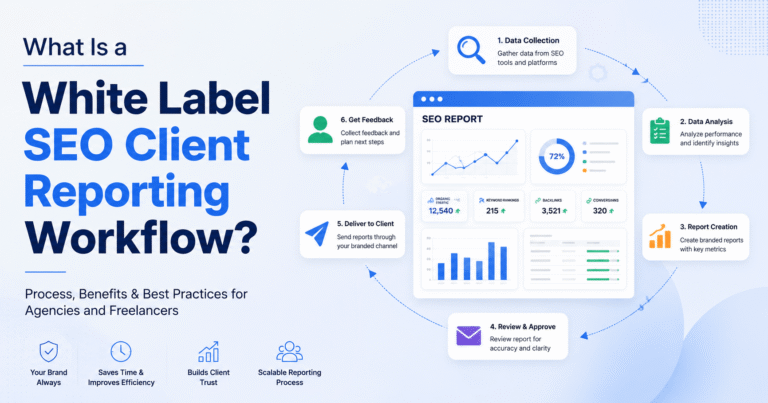
What Is a White Label SEO Client Reporting Workflow?
A White Label SEO Client Reporting Workflow is a structured process used by an agency or SEO fulfillment partner to collect SEO data, analyse performance, prepare a branded report and deliver clear recommendations to the agency’s client.
In a white label arrangement, the underlying SEO work may be completed by an external specialist, while the client-facing report carries the agency’s branding.
A practical workflow usually looks like this:
- Collect data from SEO and analytics platforms.
- Validate the data.
- Compare current performance with previous periods.
- Analyse rankings, organic traffic and conversions.
- Identify wins, losses and opportunities.
- Connect SEO activity with business objectives.
- Prepare the branded report.
- Add recommendations and next-month priorities.
- Review internally.
- Deliver the report and discuss important findings with the client.
The important point is that report generation is only one part of reporting.
The real value comes from interpreting the numbers.
Google says Search Console’s Performance report can show search performance through metrics such as clicks and impressions and can break the information down by queries, pages and countries.
For an agency, that information becomes useful when it is connected to questions such as:
- Which pages are attracting commercial searchers?
- Which keywords are improving?
- Which pages lost visibility?
- Are organic visitors completing important actions?
- What should the SEO team do next?
Why SEO Client Reporting Is Difficult for Agencies
SEO reporting sounds straightforward until an agency manages 20, 50 or 100 client accounts.
The difficulty is not simply collecting data. It is producing consistent, accurate and understandable reporting at scale.
1. Clients care about business outcomes
An SEO specialist may be interested in:
- Impressions
- Average position
- Crawl issues
- Indexed pages
- Backlinks
- Keyword movements
For agencies providing SEO services for agencies, these technical metrics are important for evaluating campaign performance and identifying optimisation opportunities. However, a business owner is more likely to ask:
- Are more people finding us?
- Are enquiries increasing?
- Which services are generating demand?
- Are the right customers visiting?
- What are we doing next month?
Both perspectives matter, but they should not be presented in the same way. A good client reporting workflow translates technical SEO data into clear business insights so clients can understand how the work relates to their goals.
2. Different clients need different KPIs
A real estate company and an ecommerce business should not receive identical SEO performance reports.
A real estate client may care about:
- Property-related organic traffic
- Location keywords
- Enquiry form submissions
- Phone calls
- High-value landing pages
An ecommerce business may care about:
- Category traffic
- Product visibility
- Organic revenue
- Product conversions
- Non-brand search growth
The reporting system should therefore be standardised without becoming generic.
3. Data from different platforms does not always match
Search Console and Google Analytics measure different things. Google specifically notes that Search Console is the source of truth for Search performance, while Analytics is used to understand behaviour on the website. Their metrics may not match exactly.
That means agencies should not spend every reporting call trying to explain why two platforms show slightly different numbers.
Instead, define what each platform is being used to measure.
The Ideal White Label SEO Reporting Workflow
A reliable SEO reporting process should be repeatable enough for a fulfilment team to follow and flexible enough to accommodate different clients.
Step 1: Define the Client's Business KPIs
Before building the report, identify what success means for that specific client.
For example:
Local clinic
- Appointment enquiries
- Calls
- Location visibility
- Service-page traffic
Manufacturer
- B2B enquiry submissions
- Product/service page visibility
- High-intent commercial keywords
- Organic leads
Education institute
- Course-page traffic
- Admission enquiries
- Location-based searches
- Application-related conversions
Ecommerce brand
- Organic revenue
- Product traffic
- Category visibility
- Organic transactions
This prevents the report from becoming a generic ranking document.
Step 2: Establish a Baseline
Every SEO campaign needs a starting point.
Record important baseline information such as:
- Organic sessions
- Search clicks
- Search impressions
- Average position
- Important keyword rankings
- Organic conversions
- Top landing pages
- Indexed pages
- Technical SEO issues
- Backlink profile where relevant
The baseline allows the agency to evaluate progress against something meaningful rather than saying that a metric “looks good.”
Step 3: Collect Data From the Right Sources
A typical white label SEO dashboard may combine information from:
- Google Search Console
- Google Analytics 4
- Keyword tracking software
- Website analytics
- Google Business Profile for local SEO
- CRM data where available
- SEO crawling tools
- Backlink monitoring platforms
Google Analytics provides reports that can help businesses understand traffic and user activity, while customised reports can be built around the information most relevant to the business.
The goal is not to put every available metric into the dashboard.
The goal is to put the right metrics in front of the right decision-maker.
Step 4: Validate the Data Before Reporting
This step is often skipped.
Before sending white label SEO reports, check:
- Is the reporting period correct?
- Is tracking working?
- Did a website migration affect the data?
- Are conversions being recorded?
- Are duplicate conversions inflating numbers?
- Are filters configured correctly?
- Did the client change the website?
- Are rankings being compared using the same location and device settings?
A beautiful dashboard with incorrect data is worse than a simple spreadsheet with accurate information.
Step 5: Analyse Performance, Not Just Numbers
Suppose organic clicks increased from one month to the next.
That is useful, but it is not the end of the analysis.
Ask:
Why did clicks increase?
Perhaps:
- A service page started ranking for more commercial searches.
- A new content cluster gained visibility.
- A seasonal demand period began.
- Existing rankings moved higher.
- A technical issue was resolved.
Then ask:
Did the additional traffic matter?
If the traffic came from irrelevant informational searches, the business impact may be limited.
This is where experienced SEO reporting services for agencies should provide interpretation rather than simply export data.
Read More:- White Label SEO Client Onboarding Checklist
What Should an SEO Monthly Report Include?
A strong SEO monthly reporting format can be divided into six sections.
1. Executive Summary
Start with a short business-focused summary.
Include:
- Major wins
- Important challenges
- Significant traffic changes
- Conversion trends
- Major SEO work completed
- Priorities for the next period
A business owner should be able to understand the overall situation in two minutes.
2. Organic Search Performance
Include relevant Search Console metrics such as:
- Clicks
- Impressions
- CTR
- Average position
- Top queries
- Top pages
Search Console’s Performance report is particularly useful for identifying changes in search visibility and understanding which queries and pages are driving performance.
Avoid presenting rankings without context.
A keyword moving from position 45 to 20 is interesting, but the more important question may be whether the page is now generating relevant traffic.
3. Website Behaviour and Conversions
Use GA4 to examine what happens after visitors arrive.
Depending on the business, this could include:
- Organic users
- Landing pages
- Engagement
- Lead form submissions
- Phone-click events
- WhatsApp clicks
- Purchases
- Sign-ups
- Other important actions
Google Analytics can be used to understand traffic acquisition, landing pages and user behaviour, while conversion tracking helps connect important actions with marketing activity.
For many Indian SMEs, this is where SEO reporting becomes much more valuable.
A traffic increase without enquiries deserves investigation.
4. Keyword Performance
Do not report hundreds of keywords just because the tracking platform allows it.
Group keywords by intent:
Commercial
- SEO agency Ahmedabad
- dental clinic Ahmedabad
- industrial equipment manufacturer India
Transactional
- buy industrial equipment
- website development company
- online accounting software
Informational
- how SEO works
- SEO reporting guide
- digital marketing strategy
This helps clients understand whether visibility is growing around searches that can contribute to business growth.
5. Technical and On-Page SEO Work
Show what the SEO team actually completed.
For example:
- Technical audit fixes
- Internal linking improvements
- Metadata optimisation
- Content updates
- New landing pages
- Schema implementation
- Page-speed improvements
- Broken-link fixes
- Indexing improvements
The report should answer:
“What did we actually do this month, and why?”
6. Next-Month Action Plan
This is one of the most important parts of an effective SEO client reporting workflow.
Show three to five priorities.
For example:
- Improve the service page ranking in positions 8–20.
- Build supporting content around high-intent commercial terms.
- Strengthen internal links to priority landing pages.
- Investigate declining organic traffic on two pages.
- Improve conversion tracking for enquiry forms.
This turns reporting into a planning tool.
A Simple White Label SEO Reporting Framework
Agencies can use this structure for most clients:
Report Section | Main Question |
Executive Summary | What happened? |
Organic Performance | Did search visibility change? |
Keyword Performance | Which searches improved or declined? |
Landing Pages | Which pages are attracting visitors? |
Conversions | Did organic visitors take meaningful actions? |
SEO Work Completed | What was implemented? |
Issues | What needs attention? |
Opportunities | Where is the next growth opportunity? |
Next-Month Plan | What happens next? |
This structure keeps the report focused on decisions rather than data volume.
Two Practical Examples
Example 1: Local Service Business
Imagine a hypothetical Ahmedabad-based home renovation company.
Its website receives organic traffic, but the owner says enquiries remain inconsistent.
A weak report might say:
Organic traffic increased 18%.
A better report investigates further.
The agency discovers that most additional traffic is reaching blog articles, while the main renovation service page receives relatively little commercial traffic.
The recommendation would not simply be “increase SEO.”
Instead, the agency could:
- Improve the main service page.
- Build supporting location content.
- Strengthen internal links.
- Target commercial renovation searches.
- Improve enquiry CTAs.
- Track calls and WhatsApp interactions.
Lesson: More traffic is not automatically better if the traffic does not match the buying journey.
Example 2: Real Estate Business
Consider a hypothetical real estate company targeting buyers in multiple Indian cities.
The agency reports 2,000 additional organic visitors but the sales team says lead quality has not improved.
The reporting workflow should investigate:
- Which cities generated traffic?
- Which property pages attracted visitors?
- Were visitors searching for specific projects?
- Which pages generated enquiries?
- Are irrelevant informational keywords attracting users?
- Are forms and calls being tracked correctly?
The SEO strategy may need to shift toward high-intent searches around projects, locations, property types and buyer requirements.
Lesson: Lead quality should be discussed alongside organic traffic.
How to Build an Automated SEO Reporting System
When an agency has several clients, manual reporting can become a significant operational burden.
An automated SEO reporting system can reduce repetitive work.
Automation can help with:
- Data collection
- Dashboard updates
- Scheduled reports
- Metric calculations
- Branded templates
- Alerts
- Historical comparisons
But automation should not replace analysis.
A useful model is:
Automate data → Human reviews data → Strategist interprets data → Client receives insight
This is much stronger than:
Automate data → Email PDF → Done
GA4 also supports customised reporting, allowing businesses to create reports around metrics, dimensions, filters and charts that matter to them.
Common White Label SEO Reporting Mistakes
Mistake 1: Reporting Every Available Metric
More data does not necessarily create more clarity.
Better approach: report metrics connected to the client’s objectives.
Mistake 2: Focusing Only on Rankings
Rankings are useful, but rankings alone do not explain business performance.
Better approach: connect rankings with traffic, landing pages and conversions.
Mistake 3: Hiding Negative Results
A report containing only positive information can reduce trust.
Better approach: explain declines honestly and provide a corrective action.
Mistake 4: Using the Same Report for Every Industry
A manufacturer, clinic and ecommerce brand have different customer journeys.
Better approach: keep the reporting framework consistent but customise the KPIs.
Mistake 5: Sending Reports Without Explanation
Clients may not understand why a metric changed.
Better approach: include a short interpretation beside important metrics.
Mistake 6: Ignoring Tracking Problems
If forms, calls or purchases are not being measured correctly, SEO decisions become less reliable.
Better approach: review measurement as part of the reporting process.
How to Measure Whether Your Reporting Workflow Is Working
A good SEO reporting system should improve more than reporting speed.
Track:
- Time required to prepare each report
- Number of manual reporting tasks
- Data accuracy
- Client questions after reports
- Client engagement with dashboards
- Number of reporting revisions
- Percentage of reports delivered on time
- Whether next-month actions are clearly defined
For SEO performance itself, evaluate metrics appropriate to the client’s business.
Google recommends using Search Console to understand search performance and Analytics to investigate user behaviour on the site.
Also remember that traffic and conversion data can fluctuate because of seasonality, competition, website changes, demand and measurement changes.
How Reporting Should Differ Across Indian Industries
Healthcare
Prioritise:
- Local visibility
- Service pages
- Appointment enquiries
- Calls
- Location performance
- Trust-related content
Real Estate
Focus on:
- Location searches
- Project pages
- Property-intent keywords
- Organic enquiries
- Lead quality
Manufacturing
Emphasise:
- Product/service searches
- B2B commercial keywords
- Technical content
- Enquiry submissions
- Target markets
Education
Track:
- Course visibility
- Admission searches
- Location keywords
- Enquiry actions
- Seasonal demand
Ecommerce
Measure:
- Category visibility
- Product traffic
- Organic transactions
- Revenue
- Search demand
- Conversion performance
SaaS
Consider:
- Product-related searches
- Solution keywords
- Demo requests
- Sign-ups
- Feature and comparison content
Indian businesses also operate across very different markets. A strategy for a competitive Tier 1 city may need to differ from one targeting a Tier 2 or Tier 3 location. Local language, search behaviour, competition and customer trust can all influence the reporting context.
Myths vs Facts About SEO Reporting
Myth | Fact |
More traffic always means better SEO | Traffic quality and business relevance matter. |
Ranking reports are enough | Rankings should be interpreted alongside traffic and conversions. |
Every client needs the same KPIs | Reporting should reflect the client’s business model. |
Automated reports eliminate human analysis | Automation collects data; strategy still requires interpretation. |
A bad month means SEO has failed | Performance can fluctuate due to competition, demand, technical changes and other factors. |
A beautiful dashboard means good reporting | Good reporting helps clients understand decisions, not just numbers. |
White Label SEO Client Reporting Checklist
Before sending a client report, check:
- Is the reporting period correct?
- Are all important tracking systems working?
- Have Search Console and Analytics data been interpreted separately?
- Are the most important business KPIs included?
- Have keyword movements been analysed by search intent?
- Are important landing pages reviewed?
- Are conversions being tracked correctly?
- Are SEO activities explained in business terms?
- Have negative trends been addressed honestly?
- Are three to five priorities defined for the next period?
- Is the report branded consistently?
- Has someone reviewed the report before delivery?
When Should an Agency Outsource SEO Reporting?
Outsourcing can make sense when an agency:
- Has more SEO clients than its internal team can comfortably manage.
- Spends too many hours manually preparing reports.
- Wants consistent reporting across accounts.
- Needs specialist SEO analysis.
- Wants branded reporting without building a large fulfilment team.
- Is expanding its white label SEO offering.
- Needs a repeatable workflow for multiple clients.
The important consideration is not simply whether an external provider can generate a report.
Ask whether the partner can understand why the numbers changed and what should happen next.
That distinction separates basic reporting from useful SEO strategy.
Why White Label Reporting Can Strengthen an Agency's Client Experience
A white label partner can help an agency create a consistent delivery system while keeping the client relationship under the agency’s brand.
The agency can own:
- Client communication
- Strategy presentation
- Brand experience
- Account management
- Commercial relationship
The fulfilment partner can support:
- SEO analysis
- Data preparation
- Reporting workflows
- Technical recommendations
- Content and optimisation work
For agencies that want to scale without adding every SEO capability internally, this model can be practical when responsibilities, quality standards, communication and reporting ownership are clearly defined.
Conclusion
A successful White Label SEO Client Reporting Workflow is not about producing the biggest PDF or filling a dashboard with dozens of metrics.
It is about creating a reliable connection between:
SEO activity → search performance → website behaviour → qualified actions → business decisions.
For Indian agencies, the strongest reporting systems are transparent, repeatable and adaptable. They explain what changed, why it changed, what it means for the client and what the team will do next.
If your agency is growing but SEO delivery and reporting are becoming difficult to manage internally, a structured white label model can help you expand your service capacity without making the client experience feel fragmented.
The right next step is to review your current reporting workflow: identify the repetitive tasks, remove vanity metrics, define client-specific KPIs and build a reporting process that your team can repeat consistently.