

A small business owner in India can spend ₹30,000 on Google Ads, another ₹20,000 on social media, pay an agency ₹25,000, and still have no clear answer to one basic question:
“Did my marketing actually make me money?”
I have seen businesses celebrate 500 leads without checking how many became customers. I have also seen businesses stop advertising because they spent ₹50,000 and generated only ₹80,000 in revenue—even though their margins made the campaign profitable.
That is the problem with looking at marketing through clicks, impressions, followers, or even revenue alone.
A small business marketing ROI calculator is useful because it forces you to connect marketing spending with the financial outcome that actually matters: profit.
But there is an important warning.
A calculator cannot tell you whether your marketing is good if you enter bad numbers.
If your conversion tracking is incomplete, your average order value is wrong, your gross margin is ignored, or your sales team loses half your leads, the calculator can produce a beautifully precise answer that is completely misleading.
This guide shows you how to calculate digital marketing ROI for a small business in India—and, more importantly, how to decide whether you should increase, reduce, or completely rethink your marketing spend.
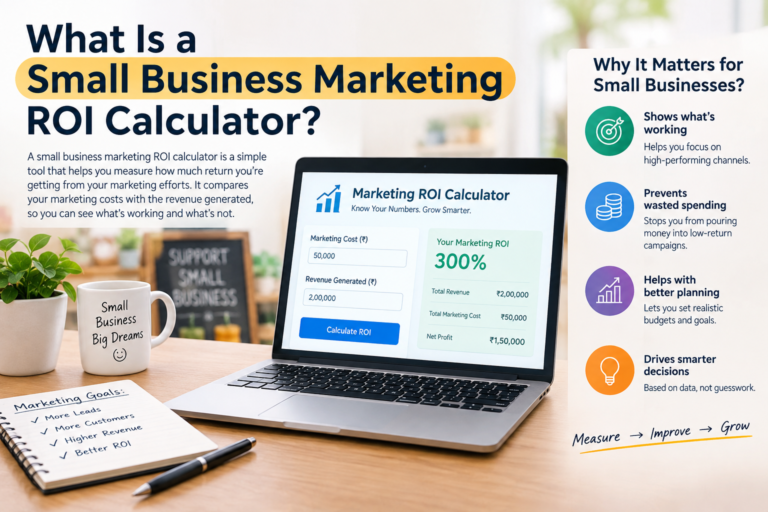
What Is a Small Business Marketing ROI Calculator?
A small business marketing ROI calculator estimates how much financial return your business receives compared with what you spend on marketing.
The basic formula is:
Marketing ROI = (Marketing Profit − Marketing Cost) ÷ Marketing Cost × 100
For a simple example:
- Marketing investment = ₹50,000
- Additional gross profit generated = ₹90,000
- Marketing profit = ₹40,000
Therefore:
ROI = (₹90,000 − ₹50,000) ÷ ₹50,000 × 100 = 80%
An 80% ROI means that after accounting for the marketing cost in this simplified example, the campaign generated ₹0.80 of additional return for every ₹1 invested.
However, small businesses often make one major mistake:
They calculate ROI using revenue instead of profit.
Suppose you spend ₹50,000 and generate ₹2,00,000 in sales.
That sounds excellent.
But if your gross margin is only 20%, your gross profit is ₹40,000.
You spent ₹50,000 to generate ₹40,000 in gross profit.
The campaign is not profitable on that basis.
This is why revenue alone is a dangerous way to judge marketing performance.
ROI vs ROAS: They Are Not the Same
This is one of the most important distinctions for Indian small businesses.
ROAS
ROAS means Return on Ad Spend.
The simple formula is:
ROAS = Revenue generated from ads ÷ Advertising spend
Example:
- Ad spend = ₹50,000
- Revenue = ₹2,00,000
ROAS = ₹2,00,000 ÷ ₹50,000
ROAS = 4X
That sounds impressive.
But 4X ROAS does not automatically mean 4X profit.
ROI
ROI looks at the broader economics of the investment.
It can include:
- Advertising cost
- Agency fees
- Creative production
- Landing page costs
- Software
- Sales costs
- Discounts
- Cost of goods
- Fulfilment
- Other acquisition costs
Google itself distinguishes ROI from simply looking at advertising performance and recommends using conversion measurement to connect advertising with valuable business outcomes.
The practical rule
ROAS tells you how efficiently advertising generated revenue.
ROI tells you whether the overall investment made financial sense.
Do not confuse the two.
The Small Business Marketing ROI Calculator
| Input | Example |
|---|---|
| Monthly marketing spend | ₹50,000 |
| Agency/marketing management fee | ₹20,000 |
| Total marketing investment | ₹70,000 |
| Leads generated | 200 |
| Qualified leads | 100 |
| Customers acquired | 20 |
| Average order value | ₹15,000 |
| Revenue | ₹3,00,000 |
| Gross margin | 40% |
| Gross profit | ₹1,20,000 |
| Marketing investment | ₹70,000 |
| Marketing profit | ₹50,000 |
| Marketing ROI | 71.4% |
The calculation:
Gross profit = ₹3,00,000 × 40% = ₹1,20,000
Marketing profit = ₹1,20,000 − ₹70,000 = ₹50,000
ROI = ₹50,000 ÷ ₹70,000 × 100 = 71.4%
That is much more useful than simply saying:
“We generated ₹3 lakh from ₹50,000 ad spend.”
Because the business did not actually keep ₹3 lakh.
What Numbers Should You Enter Into a Marketing ROI Calculator?
Step 1: Enter Your Total Marketing Cost
Do not enter only your Google or Meta advertising spend if you want to understand the real economics.
Consider including:
- Google Ads
- Meta Ads
- LinkedIn Ads
- SEO
- Agency fees
- Freelancer fees
- Creative costs
- Landing page development
- Marketing software
- Email/SMS costs
- Influencer fees
- Photography/video costs
For example:
Ad spend: ₹40,000
Agency fee: ₹20,000
Creative: ₹5,000
Landing page/software: ₹5,000
Your real marketing investment is:
₹70,000
not ₹40,000
Mistake to avoid
Do not compare ₹40,000 ad spend with ₹3 lakh revenue and call the resulting ROAS your business ROI.
That hides the other acquisition costs.
Step 2: Calculate Your Leads and Customers
For lead-generation businesses, revenue usually does not happen immediately after the advertisement.
The journey may look like:
Ad → Landing Page → Lead → Qualified Lead → Sales Call → Proposal → Customer
Suppose:
- 500 leads
- 200 qualified leads
- 50 sales conversations
- 10 customers
Your lead-to-customer conversion rate is:
10 ÷ 500 × 100 = 2%
This number is far more useful than simply saying:
“We generated 500 leads.”
Google’s conversion measurement system similarly focuses on meaningful actions such as purchases, sign-ups, and phone calls rather than treating clicks as the final business outcome. This approach is also important when evaluating Small business marketing ROI, because real results matter more than clicks alone.
A painful reality
If your ads generate good leads but your sales team follows up poorly, your marketing ROI can look bad even when your advertising is not the problem.
Do not fire the marketing channel before checking what happens after the lead arrives.
Step 3: Calculate Customer Acquisition Cost
Customer Acquisition Cost, or CAC, tells you how much you spend to acquire one customer.
The simple formula is:
CAC = Total acquisition cost ÷ Number of new customers
Example:
- Total marketing and acquisition cost = ₹70,000
- New customers = 20
CAC = ₹70,000 ÷ 20 = ₹3,500
Your business spends ₹3,500 to acquire one customer.
Now ask the more important question:
How much contribution profit does one customer generate?
If the answer is only ₹2,500, you have a problem.
If the customer generates ₹10,000 initially and potentially ₹25,000 over their lifetime, the economics look very different.
Step 4: Include Gross Margin
This is where many marketing ROI calculations become unrealistic.
Imagine an ecommerce business sells a product for ₹2,000.
The business does not necessarily earn ₹2,000.
Suppose:
- Selling price = ₹2,000
- Product cost = ₹1,100
- Packaging = ₹100
- Shipping = ₹100
- Payment/transaction costs = ₹50
Contribution before marketing:
₹2,000 − ₹1,350 = ₹650
If your customer acquisition cost is ₹500, the customer contributes only ₹150 before considering other overheads.
A campaign that looks fantastic on revenue may actually be producing very little profit.
My rule
Never judge marketing performance without knowing your margin.
For low-margin businesses, a marketing campaign that looks good to an agency dashboard can be financially dangerous.
Step 5: Calculate Customer Lifetime Value
Some businesses make their first sale at a low profit but earn substantially more from repeat purchases.
For example:
- First purchase contribution = ₹500
- Second purchase contribution = ₹700
- Third purchase contribution = ₹900
Total contribution:
₹2,100
If your CAC is ₹700, the customer may be economically valuable even though the first transaction alone did not justify the acquisition cost.
This is where Customer Lifetime Value (LTV) becomes important.
A business with strong repeat purchases can often tolerate a higher CAC than a business that sells once and never sees the customer again.
But do not assume future purchases will happen.
Use your actual customer data.
Step 6: Calculate Your Break-Even CAC
This is one of the most useful numbers a small business can calculate.
Suppose your average customer generates:
₹8,000 contribution profit
Then your maximum sustainable CAC cannot simply be assumed to be ₹8,000.
You still need room for:
- Overheads
- Refunds
- Discounts
- Customer support
- Payment costs
- Returns
- Operational expenses
- Profit
If your target contribution after acquisition is ₹3,000:
Maximum CAC = ₹8,000 − ₹3,000 = ₹5,000
If your actual CAC rises to ₹7,000, the campaign may become unattractive even if revenue continues growing.
A Practical Digital Marketing ROI Example for an Indian Small Business
Consider a small Indian D2C business selling home products.
Monthly numbers
- Ad spend: ₹80,000
- Agency fee: ₹20,000
- Creative/software: ₹10,000
- Total marketing cost: ₹1,10,000
- Orders: 100
- Average order value: ₹2,500
- Revenue: ₹2,50,000
- Gross margin after product and variable fulfilment costs: 45%
Gross profit:
₹2,50,000 × 45% = ₹1,12,500
Marketing profit:
₹1,12,500 − ₹1,10,000 = ₹2,500
Marketing ROI:
₹2,500 ÷ ₹1,10,000 × 100 = 2.27%
The owner might say:
“We generated ₹2.5 lakh from ₹80,000 in ads.”
I would say:
“Your business is barely covering the total marketing investment.”
That is a very different conclusion.
Case Study 1: A Small Service Business
Consider a realistic example of a local professional service business.
Starting position
- Monthly marketing investment: ₹60,000
- Leads: 120
- Qualified leads: 50
- Customers: 10
- Average first-sale revenue: ₹12,000
- Average contribution margin: 50%
Revenue:
10 × ₹12,000 = ₹1,20,000
Contribution:
₹1,20,000 × 50% = ₹60,000
At first glance, the campaign has generated ₹60,000 contribution against ₹60,000 marketing cost.
That means the business is roughly at break-even before other overheads.
The owner should not immediately increase the budget.
Instead, I would investigate:
- Can the sales conversion rate improve?
- Are the leads properly qualified?
- Can average order value increase?
- Are repeat purchases possible?
- Can the landing page improve?
- Is the marketing fee too high?
- Which campaign produces the highest-value customers?
The correct next step may be optimization—not more spending.
Case Study 2: An Ecommerce Business
Consider another realistic example.
A business spends:
- ₹1,00,000 on paid advertising
- ₹25,000 on agency/creative costs
- Total acquisition cost = ₹1,25,000
It generates:
- 250 orders
- Average order value = ₹2,400
- Revenue = ₹6,00,000
Suppose contribution margin before marketing is 40%.
Contribution:
₹6,00,000 × 40% = ₹2,40,000
Marketing profit:
₹2,40,000 − ₹1,25,000 = ₹1,15,000
Marketing ROI:
₹1,15,000 ÷ ₹1,25,000 × 100 = 92%
That is much healthier.
But I would still ask one more question:
How many of those 250 customers purchase again?
If repeat purchases are strong, the real customer lifetime economics may be better.
If almost nobody purchases again, the business needs to maintain strict control over CAC.
What Is a Good Marketing ROI for a Small Business in India?
There is no universal number.
Anyone who tells you:
“A good digital marketing ROI is exactly X%”
without knowing your business economics is oversimplifying the problem.
A healthy ROI depends on:
- Gross margin
- Average order value
- CAC
- Repeat purchase rate
- Customer lifetime value
- Sales cycle
- Refund rate
- Operating costs
- Cash flow
- Inventory requirements
- Business model
A ₹1,000 CAC may be excellent for one business and disastrous for another.
Likewise, a 3X ROAS may be excellent for a high-margin business and poor for a low-margin ecommerce business.
Small Business Marketing ROI by Business Type
Ecommerce
Track:
- Revenue
- Gross margin
- Contribution margin
- AOV
- CAC
- Repeat purchase rate
- Refund rate
- ROAS
- LTV
Do not optimize only for revenue.
Local Services
Track:
- Leads
- Qualified leads
- Calls
- Appointments
- Show-up rate
- Customer conversion rate
- Average customer value
- CAC
A ₹100 lead is not automatically better than a ₹500 lead.
The ₹500 lead may be far more valuable.
B2B
B2B marketing requires more patience.
Track:
- Marketing-qualified leads
- Sales-qualified leads
- Meetings
- Opportunities
- Proposals
- Closed deals
- Sales cycle
- Customer acquisition cost
- Contract value
- Lifetime value
Do not judge B2B campaigns only on monthly revenue.
Coaching and Education
Track:
- Lead cost
- Webinar registrations
- Consultation bookings
- Show-up rate
- Enrollment rate
- Revenue per student
- Refunds
- Repeat purchases
A large number of cheap leads can be worse than a smaller number of qualified leads.
The Most Common Marketing ROI Mistakes I See
Mistake 1: Counting clicks as success
Clicks are not customers.
Traffic is not revenue.
Impressions are not profit.
Mistake 2: Counting every lead as equal
A person requesting a ₹500 product is not equivalent to a qualified prospect considering a ₹5 lakh service.
Lead quality matters.
Mistake 3: Ignoring agency fees
If you pay ₹50,000 in advertising and ₹30,000 to manage the account, your actual marketing investment is not ₹50,000.
It is ₹80,000.
Mistake 4: Using revenue instead of profit
This is probably the biggest calculation error.
₹5 lakh revenue can be excellent.
Or it can be terrible.
Your margin determines which one it is.
Mistake 5: Trusting platform attribution blindly
A customer may:
- See your Instagram ad
- Search your company on Google
- Read your website
- Return through organic search
- Call you
- Purchase
Which channel deserves 100% of the credit?
That is not always obvious.
Google Analytics provides attribution approaches designed to understand how different marketing touchpoints contribute to conversions, including data-driven and last-click models.
Why Attribution Can Change Your ROI Calculation
Imagine:
- Google Ads reports 20 sales
- Meta reports 15 sales
- Organic search reports 10 sales
You cannot simply add them together and claim 45 independent customers.
The same customer may have interacted with multiple channels.
This is why cross-channel measurement matters.
Google Analytics supports importing campaign cost data from non-Google advertising platforms so businesses can compare marketing costs with revenue and key events across campaigns.
Practical advice
If your business is spending enough on multiple channels to make attribution important, create one central reporting system.
Do not run your business from:
- Meta Ads dashboard
- Google Ads dashboard
- CRM
- Excel
as four completely separate realities.
What Should a Small Business Marketing ROI Calculator Include?
A useful calculator should ideally allow you to enter:
Business Economics
- Average order value
- Gross margin
- Contribution margin
- Repeat purchase rate
- Customer lifetime value
Marketing Inputs
- Advertising spend
- Agency fee
- Creative cost
- Software cost
- Other marketing expenses
Funnel Inputs
- Impressions
- Clicks
- Website visitors
- Leads
- Qualified leads
- Customers
- Conversion rate
Output Metrics
- Revenue
- Gross profit
- CAC
- CPL
- ROAS
- Marketing ROI
- Break-even CAC
- Profit after marketing
This gives you a much better picture than a basic “revenue divided by ad spend” calculator.
What If Your ROI Is Negative?
Do not automatically conclude:
“Digital marketing doesn’t work.”
First diagnose the problem.
A negative ROI may come from:
Bad targeting
You are reaching people who cannot afford your product.
Bad offer
The audience is interested but does not see enough value.
Bad landing page
People click but do not convert.
Bad sales process
Leads arrive but nobody follows up properly.
High CAC
Your acquisition costs are too high.
Low margins
Your product economics do not support paid acquisition.
Poor retention
You acquire customers but never generate repeat business.
Incorrect tracking
Your marketing may actually be performing better—or worse—than your dashboard indicates.
Google recommends conversion tracking precisely because meaningful business actions need to be measured rather than relying only on clicks and traffic.
When Should You Increase Your Marketing Budget?
I would increase the budget only when the economics are reasonably stable.
Look for:
- Consistent conversion rate
- Predictable CAC
- Healthy contribution margin
- Reliable sales follow-up
- Sufficient cash flow
- Proven demand
- Accurate tracking
If ₹50,000 produces profitable customers consistently, testing ₹60,000–₹70,000 may make sense.
But if ₹50,000 produces random results every month, increasing the budget to ₹1 lakh does not solve the underlying problem.
It simply gives the problem more money.
When Should You Stop or Reduce Advertising?
I would seriously consider reducing spend when:
- CAC is consistently above your sustainable level
- Margins cannot support acquisition
- Lead quality is poor
- Sales conversion is weak
- Tracking is unreliable
- Customers rarely repeat
- Cash flow is under pressure
- You are borrowing money simply to maintain advertising
- The business has not validated the offer
Sometimes the smartest marketing decision is:
Spend less. Fix the business economics first.
Who Should NOT Rely on This Calculator?
A marketing ROI calculator is not a crystal ball.
It is not suitable for making decisions based on:
- Guaranteed future revenue
- Unverified sales projections
- Rumors
- “This ad worked for another business”
- Influencer promises
- Agency promises of guaranteed ROAS
- Short-term vanity metrics
It is also not designed to predict exact future performance.
If your business has very little historical data, treat the calculator as a scenario-planning tool, not a forecast.
Who Should Wait Before Increasing Marketing Spend?
I would tell a business owner to slow down if:
- The product-market fit is unclear
- Customers are not converting
- Refunds are unusually high
- The business has no reliable tracking
- Sales follow-up is weak
- The offer is not competitive
- Gross margins are too thin
- The business cannot financially survive a bad month
You do not need more traffic when the existing traffic is already failing to convert.
Fix the leak before increasing the water pressure.
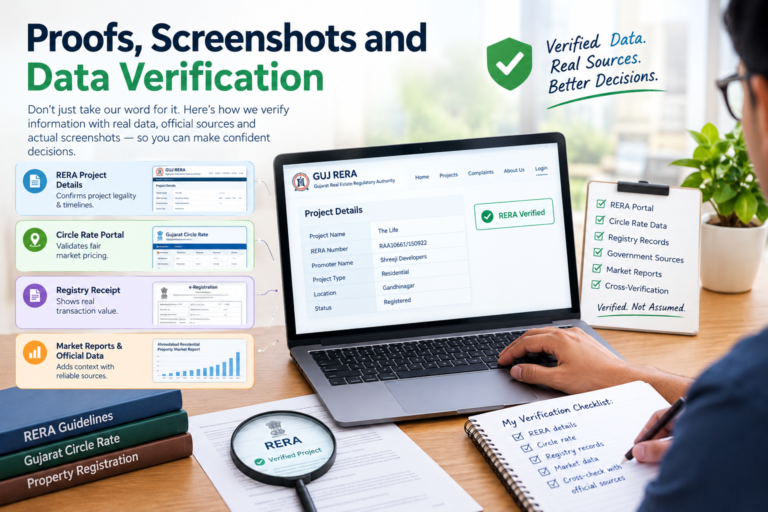
Proofs, Screenshots and Data Verification
If I Were Running a Small Business in India Today
I would not start by asking:
“How much should I spend on digital marketing?”
I would start with:
“How much can I afford to pay to acquire a profitable customer?”
Then I would calculate:
- Average order value
- Contribution margin
- Maximum sustainable CAC
- Current CAC
- Conversion rate
- Customer lifetime value
- Repeat purchase rate
- Marketing ROI
Only after those numbers are reasonably clear would I increase the advertising budget.
What I would negotiate hardest
I would not negotiate primarily for:
“More leads.”
I would negotiate around:
qualified customers, measurable conversions, accurate tracking, and business outcomes.
An agency can produce 1,000 leads.
That does not mean the agency produced 1,000 valuable opportunities.
One red flag I would never ignore
A marketing provider promising guaranteed revenue or guaranteed ROAS without understanding your margins, sales process, offer, and historical conversion data.
That is not a serious profitability analysis.
The Simple Formula You Can Remember
If you remember only one framework from this article, use this:
Revenue
Customers × Average Order Value
Gross Profit
Revenue × Gross Margin
CAC
Total Marketing & Acquisition Cost ÷ New Customers
Marketing Profit
Gross Profit − Marketing & Acquisition Cost
Marketing ROI
Marketing Profit ÷ Marketing & Acquisition Cost × 100
And separately:
ROAS
Revenue Attributed to Ads ÷ Advertising Spend
Do not mix these numbers.
They answer different questions.
Final Takeaway
The biggest mistake a small business can make is asking:
“How much revenue did my marketing generate?”
The better question is:
“How much profitable business did my marketing create after accounting for the real cost of acquiring and serving those customers?”
That is what a small business marketing ROI calculator should help you understand.
Do not increase your budget because an agency says your ROAS looks good.
Do not stop advertising because one month looked bad.
Do not celebrate thousands of leads if your sales team cannot convert them.
And do not compare your marketing ROI with another business without understanding the economics behind both businesses.
Start with your own numbers.
Know your margin.
Know your CAC.
Know your conversion rate.
Know your customer lifetime value.
Then decide how aggressively you can afford to grow.
Marketing should not simply make your business busier. It should make the business more profitable.