

A web design agency gets a request for SEO. An SEO consultant is asked to run Google Ads. A branding agency suddenly needs social media management. A freelance marketer lands a client who wants a complete digital marketing strategy, including content, PPC, website optimisation, email campaigns, and monthly reporting.
For many agencies in India, this is a familiar situation.
Saying “no” means losing potential revenue. Saying “yes” without the right expertise can affect campaign performance, client satisfaction, and long-term reputation. Hiring specialists for every new service is expensive, especially for small and mid-sized agencies trying to grow without significantly increasing their operating costs.
This is one of the biggest reasons why white label digital marketing agencies have become an important part of India’s digital marketing ecosystem.
Instead of building large in-house teams, many agencies now work with trusted white label partners that quietly deliver services behind the scenes. The client continues working with the agency they hired, while the white label team handles the strategy, execution, optimisation, reporting, and ongoing support.
If you’ve ever wondered what a white label digital marketing agency is, how it works in India, and whether it’s the right approach for your business, this guide will help you understand the concept without the marketing jargon.
We’ll also explore when white label partnerships make sense, what services are commonly outsourced, common mistakes agencies make, and how to choose the right partner if you’re considering this model.
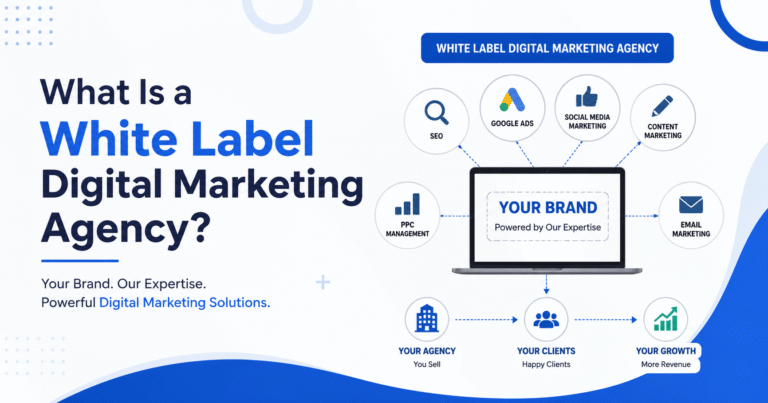
What Is a White Label Digital Marketing Agency?
A white label digital marketing agency is a company that provides digital marketing services that another agency can sell under its own brand.
In simple terms, one agency performs the work while another agency manages the client relationship.
The end client usually doesn’t interact with the white label provider. Instead, they continue communicating with the agency they originally hired. This allows agencies to expand their service offerings without building a large internal team.
Think of it like this:
A client hires an agency for SEO and Google Ads management.
The agency signs the project, discusses goals, prepares the proposal, and communicates with the client throughout the campaign.
Behind the scenes, a white label partner may handle:
- Keyword research
- Technical SEO
- Google Ads management
- Meta Ads campaigns
- Content marketing
- Website optimisation
- Monthly analytics
- Performance reporting
The reports are often customised with the agency’s branding, making the experience seamless for the client.
This business model has become increasingly common because digital marketing has grown far more specialised than it was a few years ago. Businesses no longer expect agencies to offer just one service—they expect complete marketing solutions.
Why Has White Label Digital Marketing Become Popular in India?
India’s digital economy has expanded rapidly over the past decade. Businesses of every size—from local shops and healthcare clinics to SaaS startups, manufacturers, educational institutions, and eCommerce brands—are investing in online marketing.
As demand has grown, client expectations have changed too.
Today, businesses often prefer working with one agency that can manage everything from SEO and paid advertising to website development and social media marketing.
For agencies, meeting these expectations isn’t always easy.
Hiring experienced SEO specialists, PPC managers, designers, developers, content writers, and automation experts requires significant investment in recruitment, training, salaries, and management.
Many agencies, especially startups and small businesses, simply don’t have the resources to build a complete in-house marketing team overnight.
White label partnerships solve this challenge by giving agencies access to experienced professionals without the long-term commitment of hiring full-time employees.
Rather than focusing on recruitment, agencies can focus on client acquisition, strategy, communication, and business growth while relying on a trusted delivery partner for technical execution.
How Does a White Label Digital Marketing Agency Work?
Although every agency follows a slightly different workflow, the overall process is generally straightforward.
Step 1: The Agency Wins the Client
The client contacts a digital marketing agency looking for help with their online marketing.
The agency understands the business goals, conducts an initial consultation, prepares a proposal, and signs the project.
From the client’s perspective, the agency is responsible for the entire project.
Step 2: Project Requirements Are Shared
Once the project begins, the agency shares the necessary information with its white label partner.
This typically includes:
- Business objectives
- Target audience
- Website details
- Marketing budget
- Existing campaigns
- Competitor information
- Target locations
- Campaign goals
Clear communication at this stage helps avoid delays later in the project.
Step 3: Strategy Development
The white label team creates a customised marketing strategy.
Depending on the project, this may involve:
- Competitor analysis
- Search intent research
- Keyword planning
- Website audit
- Landing page review
- Audience research
- Conversion tracking setup
- Campaign planning
Rather than applying the same template to every business, experienced teams adapt their recommendations based on industry, competition, budget, and customer behaviour.
Step 4: Campaign Execution
Once the strategy is approved, campaign execution begins.
Depending on the agreement, the white label partner may handle services such as:
- Search Engine Optimisation (SEO)
- Google Ads
- Meta Ads
- Local SEO
- Social Media Marketing
- Content Marketing
- Website Development
- Email Marketing
- Marketing Automation
Throughout the campaign, specialists continuously monitor analytics, optimise campaigns, and make improvements based on performance data.
Step 5: Reporting and Ongoing Optimisation
Digital marketing isn’t a one-time activity.
Campaigns require continuous monitoring, reporting, testing, and optimisation.
Monthly reports often include:
- Website traffic
- Keyword rankings
- Conversion data
- Lead quality
- Campaign performance
- Recommendations for improvement
Most white label agencies customise these reports with the hiring agency’s branding before they are shared with the client.
This helps maintain a consistent customer experience while giving clients clear visibility into campaign progress.
Read More:- How Does White Label Digital Marketing Work?
A Practical Example
Imagine a web design agency in Ahmedabad that builds websites for local businesses.
One of its clients owns a chain of dental clinics and wants help attracting more patients through Google Search.
The agency has excellent designers and developers but doesn’t employ an SEO specialist or Google Ads expert.
Instead of declining the opportunity, the agency partners with a white label digital marketing provider.
The web design agency continues managing meetings, communication, and project planning.
Meanwhile, the white label team conducts keyword research, improves the website’s technical SEO, creates Google Ads campaigns, tracks conversions, and prepares monthly reports.
To the client, everything appears to come from the same agency.
Behind the scenes, two businesses collaborate to deliver a better outcome.
This arrangement allows the agency to expand its services, improve profitability, and strengthen client relationships without significantly increasing operational costs.
Why Do Agencies Choose White Label Partnerships?
Not every agency chooses the white label model for the same reason. However, after working with businesses across different industries, several common motivations often emerge.
Access to Specialised Expertise
Digital marketing now includes SEO, paid advertising, social media, content marketing, web development, analytics, automation, and conversion optimisation. Hiring specialists in every discipline can be costly.
White label partnerships provide agencies with access to experienced professionals without the expense of building a large in-house team.
Better Scalability
Client demand doesn’t always grow at a steady pace.
An agency may handle five projects one month and twenty the next.
A white label partner provides additional capacity during busy periods, allowing agencies to scale more efficiently without rushing recruitment or compromising quality.
Faster Service Expansion
Launching a new service internally often involves hiring staff, purchasing software, creating workflows, and training employees.
With a trusted white label partner, agencies can introduce new services much more quickly while maintaining consistent delivery standards.
Greater Operational Efficiency
Agency owners can spend less time managing multiple specialist teams and more time focusing on sales, client relationships, and long-term business strategy.
This often leads to improved productivity and better resource allocation.
Benefits of Working with a White Label Digital Marketing Agency
For many agencies, partnering with a white label provider isn’t just about reducing workload—it’s about creating a business model that supports sustainable growth. However, the benefits go beyond cost savings. The right partnership can improve service quality, streamline operations, and help agencies compete more effectively in a crowded market.
Let’s look at the advantages in more detail.
1. Expand Your Services Without Hiring a Large Team
One of the biggest challenges for growing agencies is keeping up with client demands.
A client who initially approaches you for website development may later ask for:
- Search Engine Optimization (SEO)
- Google Ads management
- Meta Ads campaigns
- Social media marketing
- Content marketing
- Email marketing
- Marketing automation
If you don’t offer these services, there’s a risk the client will look for another agency that does.
With a white label partner, you can expand your service portfolio without immediately investing in recruitment, training, software licences, and additional infrastructure.
This allows agencies to respond to new opportunities more confidently while keeping operational costs under control.
2. Gain Access to Experienced Specialists
Digital marketing is no longer a single discipline.
Successful campaigns often require expertise in:
- Technical SEO
- Local SEO
- Google Ads
- Meta Ads
- Conversion Rate Optimisation (CRO)
- Landing page optimisation
- Content strategy
- Website development
- Analytics and reporting
- Marketing automation
Building this level of expertise internally takes time.
White label partnerships give agencies access to professionals who already understand campaign planning, optimisation, audience targeting, and performance measurement.
Instead of learning through trial and error, agencies can benefit from proven workflows and experienced execution.
3. Improve Scalability During Busy Periods
Client demand isn’t always predictable.
For example, a digital agency may receive several website enquiries in one month, followed by multiple SEO and paid advertising projects the next.
Hiring employees for temporary increases in workload isn’t always practical.
White label partnerships allow agencies to scale their delivery capacity as needed.
Whether it’s five projects or fifty, agencies can often manage demand more efficiently without compromising quality or missing deadlines.
4. Focus on Business Development Instead of Daily Delivery
Many agency owners spend too much time managing day-to-day execution.
Tasks such as campaign setup, keyword research, content reviews, technical fixes, and monthly reporting can consume valuable hours.
By delegating delivery to a trusted white label partner, agency leaders can focus on:
- Building client relationships
- Improving sales processes
- Winning new business
- Developing marketing strategies
- Strengthening their brand
- Exploring new markets
This shift often creates more opportunities for long-term business growth.
5. Deliver Consistent Client Experiences
Clients value consistency.
They expect:
- Regular communication
- Professional reporting
- Timely updates
- Reliable support
- Transparent recommendations
A structured white label workflow helps agencies maintain these standards even as they grow.
Rather than struggling to manage multiple freelancers or overloaded internal teams, agencies can rely on established processes that keep projects moving smoothly.
What Services Do White Label Digital Marketing Agencies Offer?
The exact services vary between providers, but most white label agencies support a wide range of digital marketing activities.
Search Engine Optimisation (SEO)
SEO remains one of the most commonly outsourced services.
Typical deliverables include:
- Keyword research
- Competitor analysis
- Technical SEO audits
- On-page optimisation
- Content recommendations
- Internal linking strategies
- Local SEO improvements
- Link-building support
- Performance tracking
For agencies that don’t have dedicated SEO specialists, outsourcing these tasks can improve efficiency while maintaining quality.
Google Ads (PPC) Management
Many businesses invest in Google Ads to generate leads more quickly.
White label PPC services may include:
- Campaign planning
- Keyword selection
- Bid strategy
- Audience targeting
- Ad copy creation
- Conversion tracking
- Landing page recommendations
- Ongoing optimisation
- Monthly reporting
Campaign performance depends on factors such as budget, competition, offer quality, and landing page experience—not just ad spend.
Meta Ads Management
Facebook and Instagram advertising continue to play an important role for many Indian businesses.
White label providers often manage:
- Audience research
- Creative testing
- Campaign setup
- Budget allocation
- Retargeting campaigns
- Performance analysis
- Lead quality reviews
Continuous optimisation helps improve results over time rather than relying on a single campaign setup.
Content Marketing
Content supports SEO, brand visibility, and customer education.
White label content services may include:
- Blog writing
- Website copy
- Landing pages
- Service pages
- Email newsletters
- Case studies
- Social media content
Good content isn’t just about rankings—it’s about helping potential customers make informed decisions.
Website Design and Development
Some agencies specialise in marketing but don’t have developers on staff.
White label web development can include:
- Business websites
- Landing pages
- WordPress development
- eCommerce stores
- Website maintenance
- Speed optimisation
- Mobile responsiveness
A well-designed website supports both SEO and paid advertising by improving user experience and conversions.
Marketing Automation
As businesses grow, manual processes become harder to manage.
Marketing automation services may include:
- CRM integration
- Lead nurturing workflows
- Email automation
- Form integration
- Customer segmentation
- Follow-up sequences
Automation can improve productivity while helping businesses respond to leads more efficiently.
Some agencies specialise in marketing but don’t have developers on staff.
White label web development can include:
- Business websites
- Landing pages
- WordPress development
- eCommerce stores
- Website maintenance
- Speed optimisation
- Mobile responsiveness
A well-designed website supports both SEO and paid advertising by improving user experience and conversions.
Practical Business Example-1
A Website Design Agency Looking to Expand
A small web design agency in Pune builds websites for local businesses.
Several clients ask whether the agency also offers SEO and Google Ads.
The agency doesn’t have experienced marketers on its team.
Instead of declining these opportunities or hiring immediately, it partners with a white label digital marketing company.
The agency continues handling communication and project management.
The white label partner manages:
- SEO audits
- Keyword research
- Google Ads campaigns
- Monthly reporting
As a result, the agency expands its service offerings without significantly increasing fixed costs.
Practical Business Example 2
A Branding Agency Serving Healthcare Clinics
A branding agency works with hospitals and healthcare clinics.
One client requests ongoing digital marketing support after a successful rebranding project.
The agency has creative designers but limited experience managing Local SEO and performance marketing campaigns.
Rather than outsourcing to multiple freelancers, the agency partners with one white label provider.
This simplifies communication, creates a more structured workflow, and gives the client access to multiple services through a single point of contact.
Common Mistakes Agencies Make with White Label Partnerships
White label marketing offers many advantages, but success isn’t guaranteed.
Here are some common mistakes agencies should avoid.
Choosing Based Only on Price
Lower pricing can be attractive, but it shouldn’t be the only deciding factor.
Consider:
- Experience
- Communication quality
- Reporting standards
- Technical expertise
- Response times
- Scalability
The cheapest option may create more problems than it solves.
Poor Communication
Many project delays happen because expectations weren’t clearly discussed.
Before starting any partnership, define:
- Responsibilities
- Timelines
- Reporting schedules
- Revision processes
- Approval workflows
Clear communication reduces misunderstandings and improves client satisfaction.
Ignoring Quality Control
Even when delivery is outsourced, the client still sees your agency as responsible.
Review reports, content, campaigns, and recommendations before sharing them with clients.
Quality assurance protects your reputation.
Many project delays happen because expectations weren’t clearly discussed.
Before starting any partnership, define:
- Responsibilities
- Timelines
- Reporting schedules
- Revision processes
- Approval workflows
Clear communication reduces misunderstandings and improves client satisfaction.
Expecting Instant Results
Whether it’s SEO, paid advertising, or content marketing, digital marketing takes ongoing optimisation.
Agencies should set realistic expectations with clients regarding:
- Timelines
- Budget
- Competition
- Performance fluctuations
Honest conversations build long-term trust.
White Label Agency vs Freelancer vs In-House Team vs Traditional Outsourcing
Model | Best For | Key Advantage | Consideration |
White Label Agency | Growing agencies | Multiple specialised services under one partner | Requires choosing a reliable partner |
Freelancer | Small one-off projects | Lower short-term costs | Limited capacity and availability |
In-House Team | Large agencies | Full control over operations | Higher recruitment and salary costs |
Traditional Outsourcing | Specific business tasks | Flexible external support | Often lacks agency branding and integrated workflows |
The right option depends on your agency’s size, client expectations, growth plans, and available resources.
Myths vs Facts About White Label Digital Marketing
Myth 1: White Label Means Lower Quality
Fact:
Quality depends on the expertise, processes, and communication of the partner—not the business model itself.
Myth 2: Clients Will Always Find Out
Fact:
Many white label partnerships operate transparently behind the scenes with clear confidentiality agreements and branded reporting.
Myth 3: Only Large Agencies Use White Label Services
Fact:
Small agencies, freelancers, web development companies, branding studios, and consultants also use white label services to expand their capabilities.
Myth 4: White Label Is Just Cheap Outsourcing
Fact:
Professional white label partnerships involve strategic planning, technical expertise, quality control, reporting, and long-term collaboration—not simply task delegation.
Myth 5: You Lose Control Over Client Relationships
Fact:
In most white label arrangements, the agency remains the client’s primary point of contact and retains ownership of the relationship.
How to Choose the Right White Label Digital Marketing Agency in India
Selecting a white label partner isn’t simply about comparing pricing. The provider you choose becomes an extension of your agency, and their work directly influences your reputation, client retention, and long-term business growth.
Before entering into a partnership, evaluate the following areas.
1. Look Beyond the Service List
Many providers claim to offer SEO, PPC, social media marketing, website development, and content marketing. Instead of focusing on the number of services, understand how they deliver those services.
Ask questions like:
- How do you conduct keyword research?
- How do you perform competitor analysis?
- What tools do you use for reporting?
- How do you measure campaign performance?
- What is your optimisation process?
- Who manages communication if revisions are required?
A structured workflow usually indicates a more mature and reliable delivery process.
2. Assess Their Reporting Standards
Clients expect transparency.
A professional white label agency should provide reports that explain:
- Organic traffic trends
- Keyword visibility
- Google Ads performance
- Conversion tracking
- Lead quality
- Website improvements
- Recommended next steps
Reports should focus on business outcomes, not just technical metrics.
3. Evaluate Communication and Support
Poor communication is one of the biggest reasons agency partnerships fail.
Before signing an agreement, understand:
- Response times
- Project management process
- Escalation procedures
- Meeting frequency
- Revision policy
- Dedicated account management
Clear communication helps prevent misunderstandings and keeps projects moving efficiently.
4. Ask About Scalability
Your agency may have five active clients today and twenty in six months.
A good white label partner should be able to support that growth without compromising delivery quality.
Ask whether they can:
- Handle larger project volumes
- Support multiple marketing channels
- Provide specialist resources when needed
- Maintain consistent turnaround times
5. Understand Confidentiality Policies
A white label relationship depends on trust.
Ensure there are clear confidentiality agreements covering:
- Client information
- Campaign data
- Reporting
- Intellectual property
- Brand usage
Professional providers understand that they represent your agency behind the scenes and should protect your client relationships.
What Influences White Label Digital Marketing Pricing?
There is no single pricing model that suits every agency. Costs vary depending on the complexity of the work, the services required, and the level of ongoing support.
Common pricing factors include:
- Number of services included
- Campaign size
- Industry competition
- Target locations
- Monthly deliverables
- Reporting frequency
- Technical requirements
- Content production
- Advertising budget
- Custom strategy requirements
Rather than choosing the lowest-priced provider, consider the overall value they bring in terms of expertise, communication, reliability, and long-term partnership.
Conclusion
As digital marketing continues to evolve, agencies are expected to provide a broader range of services while maintaining high standards of quality, communication, and performance. For many businesses, building a large in-house team isn’t always practical or financially sustainable.
A white label digital marketing agency offers a way to bridge that gap.
By partnering with experienced specialists, agencies can expand their capabilities, improve operational efficiency, and focus more on strategy, client relationships, and long-term business growth.
However, success doesn’t come from outsourcing alone.
It depends on choosing the right partner, setting clear expectations, maintaining transparent communication, and continually evaluating campaign performance. Whether you’re serving startups, healthcare providers, manufacturers, educational institutions, real estate firms, or local businesses, the goal should always be to deliver meaningful results that align with each client’s objectives.
White label marketing isn’t about replacing your agency—it’s about strengthening it with the right expertise and processes behind the scenes.

One Response