

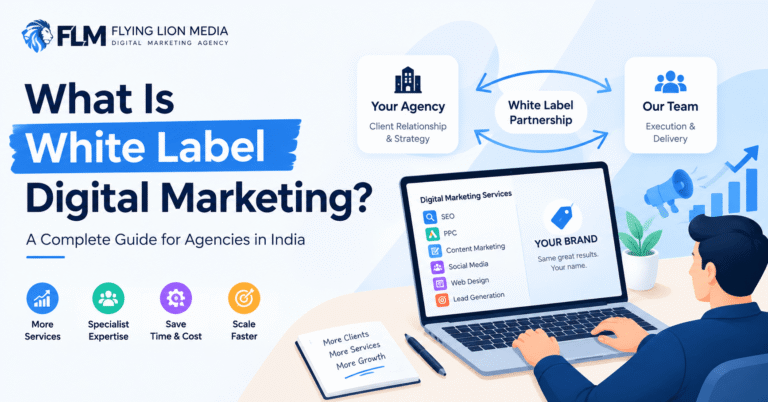
What is white label digital marketing? White label digital marketing is a business model in which one digital marketing agency provides services that another agency can sell to its own clients under its own brand name.
Instead of building a large in-house team for SEO, PPC, content marketing, web design, social media, or lead generation, an agency can partner with a white label digital marketing provider. The provider handles the fulfillment work while the client-facing agency manages the relationship, strategy, communication, and branding.
For agencies in India, this model can make it easier to expand their service portfolio, handle more client accounts, and access specialist expertise without hiring a separate team for every marketing discipline.
This guide explains what white label digital marketing is, how it works, its benefits, common services, pricing factors, potential challenges, and how Indian agencies can use it to scale sustainably.
What Is White Label Digital Marketing?
White label digital marketing is a form of outsourcing where a digital marketing provider completes marketing services on behalf of another agency, while the purchasing agency presents those services to its clients under its own brand.
For example, imagine an Indian web design agency has several clients asking for SEO services.
The agency may not have dedicated SEO specialists, content writers, technical SEO professionals, or link-building resources. Instead of turning those clients away or immediately hiring an SEO department, the agency can work with a white label SEO provider.
The white label provider performs the agreed work, prepares reports and deliverables, and works according to the agency’s requirements. The agency then delivers the service to its client as part of its own marketing offering.
In simple terms:
White label digital marketing = outsourced marketing fulfillment + your agency’s brand + your client relationship.
The model is commonly used by:
- Digital marketing agencies
- Web design and development agencies
- SEO agencies
- Branding agencies
- Advertising agencies
- IT companies
- Business consultants
- Freelancers
- Lead generation companies
- Startup-focused agencies
How Does White Label Digital Marketing Work?
The process is relatively straightforward, but successful partnerships require clear responsibilities and communication.
1. The Agency Acquires the Client
The client signs up with your agency for services such as SEO, Google Ads, social media marketing, content marketing, or lead generation.
Your agency remains responsible for the client relationship.
2. Your Agency Defines the Requirements
You communicate the client’s objectives, target audience, locations, competition, website information, campaign requirements, and reporting expectations to the white label provider.
A strong onboarding process is important because incomplete information can affect campaign execution.
3. The White Label Partner Handles Fulfillment
The provider’s specialists complete the agreed marketing work.
Depending on the partnership, this could include:
- Keyword research
- Technical SEO
- On-page SEO
- Content creation
- Link-building activities
- Google Ads management
- Social media campaigns
- Landing page development
- Lead generation
- Conversion rate optimization
- Analytics and reporting
4. Your Agency Reviews the Work
Before sending deliverables to the client, your team can review the work for accuracy, quality, branding, and alignment with the client’s objectives.
This step is especially important for agencies that want to maintain a consistent client experience.
5. The Agency Delivers the Service Under Its Brand
The completed work is presented to the client as part of your agency’s service offering.
The client does not necessarily need to know which fulfillment partner is involved, provided the commercial arrangement and applicable disclosures are handled appropriately.
What Services Can Be Offered Through White Label Digital Marketing?
White label digital marketing is not limited to SEO. Agencies can outsource several marketing functions depending on their business model.
White Label SEO Services
SEO is one of the most common white label services.
A provider may support:
- Keyword research
- Competitor analysis
- Technical SEO
- On-page optimization
- Content optimization
- Local SEO
- Internal linking
- SEO reporting
- Website audits
- SEO strategy
For agencies targeting Indian businesses, localized SEO can be particularly useful because search behavior and competition can vary significantly between cities and industries.
For example, an agency may need separate strategies for queries related to Ahmedabad, Surat, Mumbai, Pune, Delhi NCR, Bengaluru, Hyderabad, Chennai, or other Indian markets.
White Label PPC Services
Agencies can also outsource paid advertising fulfillment.
Services may include:
- Google Ads campaign setup
- Search campaigns
- Display campaigns
- Remarketing
- Keyword research
- Ad copy
- Conversion tracking
- Campaign optimization
- Performance reporting
The agency can maintain ownership of the client relationship while using specialists for campaign execution.
White Label Content Marketing
Content fulfillment can include:
- SEO blog writing
- Website content
- Landing page copy
- Service pages
- Product descriptions
- Content briefs
- Content optimization
- Thought leadership content
However, outsourcing content does not mean publishing generic articles at scale. Google’s spam policies specifically warn against producing large amounts of unoriginal content primarily to manipulate search rankings.
For this reason, agencies should add genuine expertise, original insights, research, examples, and editorial review to outsourced content.
White Label Web Design
White label social media fulfillment can include:
- Social media strategy
- Content calendars
- Post creation
- Caption writing
- Creative design
- Community management
- Performance reporting
The exact scope depends on the provider and agency agreement.
White Label Lead Generation
Lead generation is another important application.
A white label provider may help agencies with:
- Lead generation campaigns
- Landing pages
- Paid traffic
- Lead qualification processes
- Conversion tracking
- Campaign optimization
- Reporting
This allows agencies to sell a broader performance marketing solution without building every specialist function internally.
Why Do Agencies Use White Label Digital Marketing?
The main reason is not simply cost reduction.
For many agencies, the bigger advantage is capacity.
An agency may have strong sales and account-management capabilities but limited fulfillment resources. Another agency may have excellent web development skills but no dedicated SEO team.
White label partnerships allow agencies to combine their strengths with external specialist capabilities.
1. Expand Your Service Portfolio
A web design agency can add SEO.
An SEO agency can add PPC.
A branding agency can add social media marketing.
An IT company can add digital marketing.
This creates opportunities to offer clients a more complete solution.
2. Reduce the Need for Immediate Hiring
Hiring specialists for every service can require significant investment.
An agency may need:
- SEO specialists
- Content writers
- Designers
- Developers
- PPC managers
- Social media specialists
- Analysts
- Account managers
A white label model can provide access to some of these capabilities without immediately creating a full internal department.
3. Handle More Clients
Suppose an agency has a strong sales pipeline but its internal team is already busy.
Without additional fulfillment capacity, acquiring more clients could create delivery problems.
A reliable white label partner can provide additional operational capacity while the agency maintains control over client strategy and communication.
4. Access Specialist Expertise
Digital marketing changes quickly.
Search algorithms, advertising platforms, analytics systems, content standards, and user behavior continue to evolve.
A specialist provider may maintain dedicated teams for particular marketing disciplines instead of expecting one small agency team to master everything.
5. Improve Operational Flexibility
Agencies often experience fluctuating workloads.
One month may bring several website projects. The next month may bring more SEO accounts or paid advertising campaigns.
White label fulfillment can provide additional flexibility when demand changes.
Local marketing agencies
Local SEO is especially relevant to clinics, restaurants, education businesses, home services, professional firms and other location-dependent businesses.
Google Business Profile optimisation, local landing pages, reviews, location relevance and local search intent may all need consideration.
White Label Digital Marketing vs In-House Digital Marketing
The choice between outsourcing and building an internal team depends on the agency’s size, revenue, client volume, expertise, and long-term strategy.
Factor | White Label Digital Marketing | In-House Marketing |
Initial investment | Generally lower | Generally higher |
Hiring requirement | Lower | Higher |
Specialist access | Available through partner | Requires internal hiring |
Operational control | Shared | High |
Scalability | Often flexible | Depends on team capacity |
Recruitment effort | Lower | Higher |
Training responsibility | Lower | Higher |
Brand ownership | Agency-controlled client relationship | Agency-controlled |
Management | Requires partner management | Requires employee management |
Neither model is automatically better.
For some agencies, building an internal team makes sense because marketing fulfillment is a core competitive advantage.
For others, white label fulfillment may be more practical while they focus internally on sales, strategy, account management, and business development.
Is White Label Digital Marketing Good for Indian Agencies?
Yes, it can be a practical model for Indian agencies, particularly agencies serving small businesses, startups, ecommerce companies, SaaS businesses, healthcare organizations, real estate companies, educational institutions, and professional services.
India has a large and diverse business market. Agencies can also serve clients across different cities and regions without needing a physical team in every location.
For example, an Ahmedabad-based agency could acquire clients in:
- Mumbai
- Pune
- Delhi NCR
- Bengaluru
- Hyderabad
- Chennai
- Kolkata
- Jaipur
- Surat
- Vadodara
A white label fulfillment model can help the agency manage services across these markets without building separate specialist teams for each service.
However, agencies should avoid treating white label services as a shortcut to guaranteed rankings or guaranteed leads. Marketing outcomes depend on factors such as competition, website quality, budget, industry, offer, targeting, market demand, and execution quality.
How Much Does White Label Digital Marketing Cost?
There is no single fixed price for white label digital marketing.
Pricing can depend on:
- Service type
- Number of clients
- Number of campaigns
- Scope of work
- Website size
- Industry
- Target locations
- Content requirements
- Advertising budget
- Reporting requirements
- Level of customization
- Monthly deliverables
- Technical complexity
For example, white label SEO for a local business can have very different requirements from SEO for a large ecommerce website targeting customers across India.
Similarly, managing one Google Ads campaign is different from managing multiple campaigns across different products, locations, and audiences.
Instead of selecting a provider purely based on the lowest price, agencies should compare quality, communication, processes, reporting, expertise, turnaround time, scalability, and client retention potential.
What Should You Look for in a White Label Digital Marketing Partner?
Choosing the right fulfillment partner is critical because your agency’s reputation is connected to the work delivered.
Look for a partner that provides:
Transparent Processes
You should understand how projects move from onboarding to execution, review, reporting, and delivery.
Clear Communication
There should be defined communication channels and response expectations.
Quality Control
A proper review process helps reduce errors before client delivery.
Experienced Specialists
Check whether the provider has genuine expertise in the services you plan to sell.
Flexible Packages
Your client portfolio may change, so rigid packages can become difficult to manage.
White Label Reporting
Reports should be professional, understandable, and suitable for delivery under your agency’s branding.
Scalable Fulfillment
A good partner should be capable of handling additional work as your agency grows.
Data and Account Security
Client accounts, analytics data, advertising accounts, website access, and other sensitive business information should be handled responsibly.
What Are the Risks of White Label Digital Marketing?
White label outsourcing has advantages, but it also creates potential risks.
Quality Inconsistency
If the provider lacks proper quality-control systems, deliverables may vary between clients.
Communication Delays
Poor communication can make it difficult for your agency to respond quickly to clients.
Limited Control
You have less direct control over the day-to-day work compared with a fully internal team.
Brand Reputation Risk
Your client sees your agency as responsible for the final outcome.
Overdependence on One Provider
Depending entirely on one partner for every service can create operational risk.
Poorly Managed Expectations
If your sales team promises unrealistic outcomes, fulfillment teams may struggle to meet those expectations.
The solution is not to avoid white label marketing altogether. Instead, create clear processes, service-level expectations, quality checks, and realistic client communication.
How to Build a Successful White Label Digital Marketing Process
A scalable process could look like this:
Lead Generation → Sales → Client Onboarding → Strategy → White Label Fulfillment → Quality Review → Client Reporting → Optimization
Each stage should have a clear owner.
For example:
Your agency handles:
- Sales
- Client relationship
- Strategy
- Communication
- Final approval
White label partner handles:
- Specialist execution
- Research
- Production
- Technical implementation
- Reporting support
This division of responsibilities can help prevent confusion as the number of clients increases.
White Label Digital Marketing for Agencies: A Practical Example
Consider a small Indian web design agency with 15 active website clients.
Several clients ask for ongoing SEO after their websites launch.
The agency has two choices.
It can hire SEO specialists, content writers, and technical SEO professionals and build an internal department.
Or it can partner with a white label SEO provider and offer SEO under its own service portfolio.
The second approach allows the agency to test demand before making a large hiring investment.
If SEO becomes a major revenue stream, the agency can later decide whether to continue outsourcing, build an internal department, or use a hybrid model.
This flexibility is one of the strongest reasons agencies consider white label digital marketing.
Is White Label Digital Marketing the Same as Reselling?
Not exactly.
The terms are sometimes used interchangeably, but there can be a difference in how the business model operates.
Reselling generally focuses on selling another company’s product or service to customers.
White labeling typically involves delivering a service or product under your own brand, where the underlying provider remains behind the scenes.
In digital marketing, the distinction can depend on the commercial agreement between the agencies.
How White Label Digital Marketing Can Support Agency Growth
White label marketing does not automatically make an agency successful.
The real advantage comes from building a better business system around it.
An agency can use outsourced fulfillment to focus more heavily on:
- Client acquisition
- Sales
- Strategy
- Account management
- Brand building
- Partnerships
- Customer retention
- Business development
Meanwhile, the fulfillment partner focuses on execution.
This creates a division between selling and delivering that can be useful when an agency begins to scale.
Conclusion
What is white label digital marketing? At its core, it is a way for agencies to expand their marketing capabilities by using an external fulfillment partner while maintaining their own client-facing brand.
For Indian agencies, the model can be useful when the business wants to:
- Expand its service portfolio
- Serve more clients
- Access specialist expertise
- Reduce immediate hiring pressure
- Improve fulfillment capacity
- Enter new digital marketing services
- Focus more on sales and client relationships
But the partnership needs to be managed carefully.
The strongest white label model is not simply about finding the cheapest fulfillment provider. It is about building a reliable system where your agency owns the client relationship, the strategy remains clear, fulfillment is consistent, and the final service provides genuine value to the customer.
If your agency is considering white label digital marketing, start with one or two services, define your fulfillment process, establish quality standards, measure client outcomes, and scale only after the system works consistently.