

Imagine you’ve just landed three new clients in a single month.
One wants SEO to improve organic rankings. Another needs Google Ads to generate leads quickly. The third expects social media management, content marketing, and monthly performance reports. Winning these clients feels like a major achievement—until you realize your small team doesn’t have the capacity or specialized expertise to deliver everything on time.
This is a common challenge for many digital marketing agencies, web design companies, branding studios, and freelancers across India. Clients increasingly prefer working with one agency that can handle multiple marketing services instead of coordinating with several vendors. However, hiring specialists for every service can be expensive and time-consuming.
That’s where white label digital marketing comes in.
Instead of turning away projects or rushing to build an in-house team, agencies can partner with an experienced white label provider that handles campaign execution while the agency continues managing client relationships under its own brand.
But how does white label digital marketing work? Is it simply outsourcing, or is there more to it? How do agencies maintain quality, protect client relationships, and grow their business without increasing operational complexity?
In this guide, we’ll explain how white label digital marketing works, why it’s becoming increasingly popular in India, and how agencies can use this model to expand services while maintaining consistent delivery and long-term client trust.
A few months ago, I spoke with a senior IT professional who wanted to upgrade from a standard residential apartment in Ahmedabad to a premium luxury apartment in Gandhinagar. He had already visited multiple projects, spoken with several brokers, and received countless offers claiming “last few units left” and “prices increasing next month.”
Despite having the budget, he was more confused after three weeks of research than when he started.The problem wasn’t a lack of options.The problem was too much marketing and too little practical guidance.
Most online articles discussing luxury apartment projects in Gandhinagar simply list amenities, brochure highlights, and builder claims. Very few explain how to identify genuine value, avoid overpriced projects, verify builder credibility, or determine whether a project actually fits your family’s lifestyle and long-term goals.
In my experience advising buyers in the Gandhinagar market, the best purchase decisions come from understanding location quality, builder reliability, infrastructure growth, and realistic future demand—not from attractive sales presentations.This guide is designed to provide clarity, not sales talk.
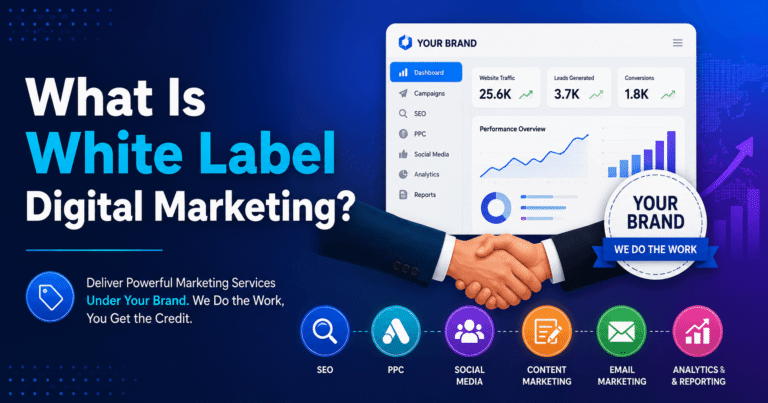
What Is White Label Digital Marketing?
White label digital marketing is a business model where one company performs digital marketing services, and another agency sells those services under its own brand.
From the client’s perspective, they work directly with the agency they hired. Behind the scenes, a trusted white label partner handles the technical work, campaign execution, reporting, and ongoing optimization.
For example:
- A web design agency offers SEO without employing an in-house SEO team.
- A branding agency provides Google Ads management through a specialist partner.
- A startup marketing consultancy expands into social media marketing without hiring additional employees.
The client receives a complete solution, while the agency benefits from additional revenue, improved profitability, and access to specialized expertise
White Label Marketing vs Traditional Outsourcing
Many people confuse white label marketing with traditional outsourcing, but they’re not the same.
White Label Digital Marketing | Traditional Outsourcing |
Services are delivered under your agency’s brand. | The outsourced company may be visible to the client. |
You remain the primary point of contact. | Clients may communicate directly with freelancers or vendors. |
Reports, dashboards, and deliverables are branded for your business. | Branding is usually not customized. |
Focuses on long-term agency partnership and collaboration. | Often project-based and transactional. |
The biggest difference is ownership of the client relationship. In a white label model, your agency remains responsible for strategy, communication, and business growth, while the provider focuses on high-quality fulfillment.
Why Is White Label Digital Marketing Growing So Quickly?
The digital marketing industry has evolved significantly over the past few years.
Businesses no longer need just a website or a Facebook page. They expect agencies to provide:
- Search Engine Optimization (SEO)
- Google Ads
- Meta Ads
- Local SEO
- Content Marketing
- Website Development
- Marketing Automation
- Analytics and Reporting
- Lead Generation
- Conversion Optimization
For many small and mid-sized agencies, building separate teams for each service isn’t practical.
Recruiting specialists, purchasing software, training employees, and managing multiple workflows require significant investment.
Instead, agencies increasingly rely on trusted white label providers who already have experienced teams, proven management processes, and established systems.
This approach allows agencies to scale more efficiently while maintaining service quality.
How Does White Label Digital Marketing Work?
At its core, white label digital marketing follows a straightforward process. Each stage is designed to ensure that clients receive professional marketing services while the agency retains complete ownership of the relationship.
Step 1: The Agency Wins the Client
Everything starts with the agency.
The agency is responsible for:
- Finding new clients
- Conducting consultations
- Understanding business goals
- Preparing proposals
- Setting pricing
- Managing contracts
Whether the lead comes through referrals, organic search, paid advertising, or networking, the client chooses your agency because they trust your brand.
The white label partner remains invisible throughout the process.
Step 2: Project Discovery and Strategy
Once the client signs the agreement, the agency gathers detailed information before beginning execution.
This usually includes:
- Business objectives
- Target audience
- Existing website
- Marketing budget
- Previous campaign performance
- Competitor information
- Products or services
- Geographic location
The agency then shares this information with the white label partner.
At this stage, effective communication becomes one of the most important factors for project success.
Incomplete information often leads to poor campaign planning, while clear project briefs improve overall quality and campaign performance.
Step 3: Research and Planning
Before launching any campaign, experienced white label teams spend time understanding the client’s business.
This generally involves:
Keyword Research
Identifying how potential customers search online and which keywords have commercial intent.
Competitor Analysis
Studying competing businesses to understand their strengths, weaknesses, content strategies, advertising, and search visibility.
Website Review
Checking website structure, user experience, loading speed, technical SEO issues, and conversion opportunities.
Audience Analysis
Understanding customer demographics, buying behavior, and search intent.
Rather than guessing, every recommendation should be based on data gathered from research and analytics.
Step 4: Campaign Execution
After planning comes execution.
Depending on the client’s goals, the white label team may manage:
- White label SEO services
- White label PPC services
- White label social media marketing
- White label content marketing
- White label web development
- White label lead generation
- Marketing automation
- Local SEO
- Email marketing
Throughout this stage, the agency continues interacting with the client while the fulfillment partner focuses on implementation.
This clear division of responsibilities improves efficiency and allows agencies to serve more businesses without significantly increasing operational costs.
Step 5: Reporting and Ongoing Optimization
Digital marketing isn’t a one-time activity.
Campaigns require continuous monitoring, testing, and improvement.
Professional white label partners provide regular reporting using branded dashboards that agencies can share directly with clients.
Typical reports include:
- Organic traffic
- Keyword rankings
- Paid campaign performance
- Website conversions
- Qualified leads
- Cost per lead
- Return on Investment (ROI)
- User engagement
- Campaign improvements
These reports help agencies demonstrate progress while identifying opportunities for further optimization.
A Realistic Business Scenario
Consider a web design agency based in Ahmedabad.
Initially, the agency focuses only on building websites. Over time, clients begin asking for SEO, Google Ads, and social media marketing.
Hiring specialists for every service would require:
- Additional salaries
- Software subscriptions
- Office space
- Training
- Project managers
- Senior marketing experts
Instead, the agency partners with a white label digital marketing company.
The agency continues handling client meetings, proposals, and account management, while the white label team executes campaigns behind the scenes.
From the client’s perspective, everything is delivered by a single agency. Behind the scenes, both companies work together through structured collaboration, streamlined operations, and transparent reporting.
This allows the agency to expand its service offering without sacrificing client experience.
Why Agencies Choose White Label Partnerships
Agencies don’t adopt white label marketing simply to reduce costs. They choose it because it helps them build a more scalable business.
Some of the biggest advantages include:
Access to Specialized Expertise
Instead of hiring separate SEO specialists, PPC managers, designers, developers, and content writers, agencies gain immediate access to experienced professionals.
Improved Scalability
As the number of projects grows, agencies can handle increased demand without constantly recruiting new employees.
Better Service Delivery
Established white label providers follow standardized workflows, improving consistency, project delivery, and overall client satisfaction.
Increased Business Growth
Agency owners spend less time managing production and more time building relationships, acquiring new clients, and developing long-term business strategies.
Types of White Label Digital Marketing Services
Not every agency requires the same level of support. Some only need help with SEO, while others want a complete digital marketing solution that includes paid advertising, content creation, website development, and marketing automation.
The flexibility of white label digital marketing allows agencies to choose the services that best fit their clients’ needs. As your agency grows, you can expand your offerings without rebuilding your internal team.
Let’s look at the most common white label services agencies use today.
1. White Label SEO Services
Search Engine Optimization (SEO) is one of the most requested services, but it’s also one of the most complex to deliver consistently. Search algorithms change regularly, competitors continuously improve their websites, and every industry has different ranking challenges.
A white label SEO partner handles the technical work while your agency focuses on client communication and overall strategy.
Typical white label SEO services include:
- Keyword research
- Technical SEO audits
- On-page optimization
- Content optimization
- Internal linking
- Local SEO
- Link-building strategies
- Google Search Console monitoring
- Monthly SEO reporting
Practical Example
A web design agency builds a great-looking website for a healthcare clinic in Pune. A few months later, the clinic asks why it’s not appearing on Google’s first page.
Instead of hiring an SEO specialist, the agency partners with a white label SEO provider. The provider identifies technical issues, improves website content, optimizes local search visibility, and creates a long-term SEO strategy.
The client continues working with the web design agency, unaware of the behind-the-scenes collaboration.
2. White Label PPC Services
Many businesses cannot wait several months for organic rankings. They need immediate visibility through paid advertising.
This is where white label PPC services become valuable.
A professional PPC partner manages campaigns across platforms such as:
- Google Ads
- Microsoft Ads
- YouTube Ads
- Display Advertising
- Shopping Campaigns
- Remarketing Campaigns
Their responsibilities usually include:
- Campaign setup
- Audience targeting
- Bid management
- Ad copy creation
- Landing page recommendations
- Conversion tracking
- Budget optimization
- Performance reporting
Rather than simply increasing ad spend, experienced specialists focus on generating better-quality leads while improving ROI.
3. White Label Social Media Marketing
Many businesses believe social media is only about posting attractive graphics.
In reality, effective social media marketing requires planning, audience research, creative testing, campaign management, and ongoing optimization.
White label social media marketing often includes:
- Content calendars
- Graphic design
- Copywriting
- Reels and short-form videos
- Community management
- Paid social campaigns
- Audience engagement
- Monthly reporting
This helps agencies offer complete social media management without hiring designers, writers, and advertising specialists separately.
4. White Label Content Marketing
Content is much more than writing blog posts.
It supports SEO, builds trust, answers customer questions, and improves website conversions.
A white label content team may produce:
- SEO blog articles
- Website content
- Landing pages
- Product descriptions
- Email campaigns
- Case studies
- Industry guides
- Social media content
High-quality content should always be based on user intent, competitor research, and business objectives—not simply keyword placement.
4. White Label Content Marketing
Many marketing agencies receive website enquiries but lack an experienced development team.
White label website development enables agencies to deliver:
- Business websites
- WordPress websites
- eCommerce websites
- Landing pages
- Website redesigns
- Website maintenance
- Speed optimization
- Technical improvements
Because websites often serve as the foundation of digital marketing, development and marketing teams work closely together throughout the project.
6. White Label Lead Generation
For many clients, website traffic isn’t the final goal.
They want enquiries, phone calls, WhatsApp messages, demo bookings, or online sales.
White label lead generation services focus on improving the entire customer journey.
This may involve:
- Landing page optimization
- Lead forms
- Call tracking
- CRM integration
- Conversion tracking
- Marketing automation
- Follow-up workflows
- Campaign optimization
Rather than measuring success by visitor numbers alone, agencies can demonstrate meaningful business outcomes.
Why Businesses Prefer Agencies Offering Multiple Services
Modern businesses rarely want to coordinate with five different marketing companies.
For example, a manufacturing company might require:
- Website improvements
- SEO
- Google Ads
- Content Marketing
- Analytics
- Monthly Reporting
Managing separate vendors often creates communication delays and inconsistent strategies.
Agencies offering integrated marketing solutions become easier to work with because they provide:
- Better communication
- Unified strategy
- Consistent branding
- Simplified reporting
- Improved accountability
White label partnerships make this possible without dramatically increasing operational costs.
Common Mistakes Agencies Make with White Label Marketing
White label digital marketing can be highly effective, but only when managed correctly.
Here are some common mistakes agencies should avoid.
1. Choosing the Cheapest Provider
Lower pricing may seem attractive, but poor-quality work often leads to unhappy clients and damaged relationships.
Instead of comparing only cost, evaluate:
- Experience
- Processes
- Communication
- Reporting quality
- Technical expertise
- Long-term reliability
2. Selling Services You Don't Understand
Some agencies begin offering SEO or paid advertising without understanding how these services work.
Even if a white label partner performs the execution, agency owners should still understand the basics so they can explain strategies and answer client questions confidently.
3. Poor Client Communication
One of the fastest ways to lose a client is inconsistent communication.
Clients don’t expect daily updates, but they do expect transparency.
Regular meetings, monthly reports, and proactive recommendations help build trust.
3. Poor Client Communication
Many agencies focus only on rankings or impressions.
Experienced marketers look deeper.
Important performance indicators include:
- Qualified leads
- Conversion rates
- Cost per lead
- Revenue contribution
- Customer acquisition cost
- Return on investment
- Sales quality
Data should guide future decisions rather than assumptions.
Industry-Specific Examples
Every industry has different marketing objectives, competition levels, and customer journeys.
Here are a few examples.
Healthcare Clinics
A clinic may receive hundreds of website visitors but very few appointment bookings.
The problem may not be traffic.
It could involve:
- Weak landing pages
- Slow website speed
- Poor call-to-action placement
- Missing trust signals
- Limited local SEO visibility
An experienced white label team identifies these issues before recommending additional advertising.
Real Estate Companies
A builder launches Google Ads and receives many enquiries.
However, most leads have low buying intent.
Instead of increasing advertising budgets, the marketing strategy may require:
- Better audience targeting
- Improved keyword selection
- Higher-quality landing pages
- Better lead qualification
- CRM integration
Quality matters far more than lead quantity.
Manufacturing Businesses
Many B2B manufacturers target broad keywords with high competition.
Instead, experienced marketers often recommend focusing on highly specific commercial keywords that attract purchasing managers and business decision-makers.
This approach usually produces more relevant enquiries.
Myths vs Facts About White Label Digital Marketing
Myth 1
White label marketing is only for large agencies.
Fact: Small agencies, freelancers, and startups often benefit the most because they can expand services without hiring large internal teams.
Myth 2
Clients will eventually discover the white label provider.
Fact: Professional white label partnerships are designed to remain behind the scenes. Your agency continues managing the client relationship.
Myth 3
Outsourcing always reduces quality.
Fact: Quality depends on the provider’s processes, expertise, and quality assurance—not whether the work is completed internally or externally.
Myth 4
White label services eliminate agency responsibilities.
Fact: Agencies remain responsible for strategy, client communication, pricing, relationship management, and overall business growth.
Myth 5
More services automatically mean more profit.
Fact: Sustainable profitability comes from delivering quality work, maintaining client satisfaction, and building long-term relationships—not simply expanding your service list.
How to Choose the Right White Label Digital Marketing Partner
Not all white label providers offer the same level of service. Some focus only on completing tasks, while others become a long-term extension of your agency. Choosing the right partner is one of the most important decisions because their work directly affects your reputation, client retention, and future growth.
Before signing an agreement, evaluate the provider using these criteria.
1. Look Beyond Pricing
Every agency wants competitive pricing, but the cheapest option isn’t always the most cost-effective.
Ask questions such as:
- How experienced is the team?
- Do they have specialists for SEO, PPC, content, web development, and social media?
- What quality assurance process do they follow?
- How are campaigns reviewed before delivery?
- What support is available after launch?
A provider with structured processes often delivers better long-term value than one competing only on price.
2. Review Their Communication Process
Successful white label partnerships depend on clear communication.
A reliable provider should offer:
- Regular project updates
- Monthly performance reports
- Clear timelines
- Dedicated account management
- Fast response times
- Transparent discussions when campaigns need adjustments
Good communication helps agencies confidently answer client questions without delays.
3. Evaluate Reporting and Transparency
Clients expect measurable results, not vague promises.
Professional reporting should explain:
- Organic visibility improvements
- Website traffic trends
- Keyword performance
- Campaign costs
- Conversion rates
- Lead quality
- Areas for improvement
- Next month’s action plan
Transparent reporting builds trust and supports informed decision-making.
4. Assess Their Technical Expertise
Digital marketing covers multiple disciplines. Your partner should have experience in:
- White label SEO services
- White label PPC services
- White label Google Ads management
- White label Facebook Ads services
- White label content writing
- White label email marketing
- White label local SEO
- White label eCommerce marketing
- White label website development
- Marketing automation
A provider with broad expertise makes it easier to expand your agency’s service portfolio without managing multiple vendors.
What Does White Label Digital Marketing Cost?
There is no fixed pricing because costs depend on several factors, including:
- Number of services required
- Industry competition
- Campaign complexity
- Website size
- Number of target locations
- Monthly deliverables
- Reporting requirements
- Level of customization
For example, a local SEO campaign for a single-location business will usually require fewer resources than a nationwide SEO and PPC strategy for an eCommerce brand.
Instead of choosing a provider based solely on pricing, consider the overall value they bring through expertise, service quality, and long-term support.
What Does White Label Digital Marketing Cost?
White label marketing is a practical choice if your agency:
- Wants to expand services without hiring a large in-house team.
- Receives requests for SEO, PPC, web development, or content marketing that it cannot currently deliver.
- Needs additional capacity during busy periods.
- Wants to improve operational efficiency.
- Prefers focusing on client acquisition and relationship management rather than day-to-day fulfillment.
However, if your agency already has experienced specialists for every service and sufficient capacity, a white label partnership may only be necessary for highly specialized or temporary projects.
Conclusion
If you’re still wondering how does white label digital marketing work?, the answer is simple: your agency manages the client relationship, while a trusted fulfillment partner handles the execution behind the scenes.
When implemented correctly, this model can help agencies:
- Expand their service offerings.
- Improve scalability.
- Access specialized expertise.
- Deliver consistent quality.
- Strengthen client relationships.
- Increase recurring revenue.
- Focus on long-term business growth.
The most successful agencies treat their white label partner as an extension of their own team rather than just another vendor.