

A founder comes to an agency with a simple-looking problem:
“We are getting traffic, but sales are not growing.”
Another says:
“We are spending ₹2 lakh every month on Meta and Google Ads. The agency sends us reports, but I still don’t know whether we are actually making money.”
And then there is the most dangerous situation: sales are increasing, but the business is losing money because discounts, advertising costs, returns, shipping, payment fees and operational expenses have quietly eaten the margin.
This is where choosing an Ecommerce Growth Marketing Agency in India becomes much more important than simply finding an agency that can run Facebook or Google Ads.
In my experience studying ecommerce growth models, the biggest mistake businesses make is hiring an agency for a channel rather than hiring one to solve a business problem.
An agency can generate clicks.
It can generate leads.
It can increase website traffic.
It can even produce impressive-looking ROAS numbers.
But none of those automatically means the ecommerce business is becoming healthier.
The real question is:
Are you acquiring profitable customers, increasing repeat purchases, improving conversion rates and building a business that can grow without continuously increasing advertising spend?
That is what this guide is designed to help you understand.
India’s ecommerce market continues to expand rapidly. Recent industry research estimates India’s online shopper base at roughly 290–300 million in 2025, while Tier-2 and smaller cities contributed a significant share of new shoppers. Industry projections also point to continued double-digit growth through 2030.
That opportunity is real.
But growing ecommerce competition means simply “running ads” is becoming less useful as a definition of growth marketing.
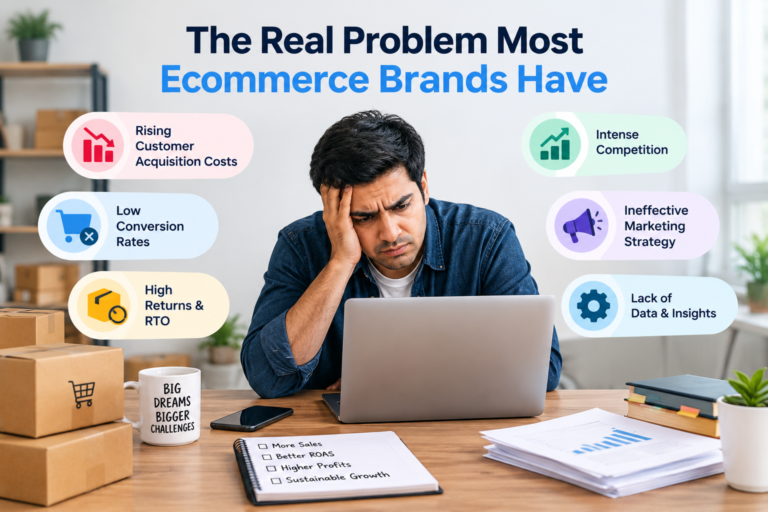
The Real Problem Most Ecommerce Brands Have
Suppose your ecommerce store generates ₹20 lakh in monthly revenue.
That sounds good.
But imagine the following:
- ₹20 lakh revenue
- ₹7 lakh product cost
- ₹3 lakh advertising
- ₹1.5 lakh shipping
- ₹80,000 returns and RTO-related costs
- ₹50,000 payment and technology costs
- ₹2 lakh salaries and operations
Suddenly, the headline revenue number does not look nearly as impressive.
This is why I would never judge an ecommerce marketing agency only by how much revenue it reports.
A serious growth discussion should examine:
Revenue → Contribution Margin → Customer Acquisition Cost → Conversion Rate → Average Order Value → Repeat Purchase Rate → Customer Lifetime Value
If an agency cannot connect its marketing activity to these numbers, you should be careful.
Most articles tell you:
- Run Meta Ads
- Run Google Ads
- Hire influencers
- Do SEO
- Create reels
- Use email marketing
- Improve your website
All of these can be useful.
But they don’t answer the more important question:
Which problem should you solve first?
If your product page converts at 0.7%, increasing advertising spend may simply buy more expensive visitors who don’t purchase.
If your conversion rate is healthy but customer acquisition costs are too high, CRO alone won’t solve the problem.
If first-order profitability is weak but customers naturally reorder several times, the strategy should be different.
This is why ecommerce growth marketing must be treated as a connected system rather than a collection of marketing channels.
Real Problems Ecommerce Businesses Actually Face
Price and performance confusion
One agency says:
“Your ROAS is 4X.”
Another says:
“Your CPA is ₹700.”
The founder asks:
“Is that good?”
There is no universal answer.
A ₹700 customer acquisition cost could be excellent for one business and disastrous for another.
If your gross contribution before advertising is ₹2,000, the economics are different from a product where the available contribution is only ₹600.
The agency should understand your economics before recommending aggressive scaling.
Mistake to avoid
Do not accept a performance report that only shows:
- Impressions
- Clicks
- CTR
- CPC
- ROAS
Ask for:
- New customer CAC
- First-order contribution
- Repeat purchase rate
- Blended CAC
- MER
- AOV
- Conversion rate
- Refund/return rate
- RTO rate where relevant
- Customer lifetime value
Fake Urgency in Agency Sales
One of the most common problems is not inside the advertising account.
It happens before the contract is signed.
You may hear:
“Your competitors are already scaling.”
“You need to spend at least ₹5 lakh immediately.”
“We can guarantee 5X ROAS.”
“You will see massive growth in 30 days.”
Be careful with guarantees.
Ecommerce performance depends on variables an agency does not completely control:
- Product-market fit
- Pricing
- Reviews
- Product quality
- Inventory
- Competition
- Website experience
- Delivery
- Returns
- Seasonality
- Offer strength
- Creative quality
- Customer demand
A good agency should be confident enough to explain what it can control and honest enough to explain what it cannot.
Step-by-Step Action Plan Before Hiring an Ecommerce Growth Marketing Agency
Step 1: Define What "Growth" Actually Means
What to do
Write down your current numbers before speaking to agencies.
At minimum:
- Monthly revenue
- Monthly orders
- Average order value
- Gross margin
- Advertising spend
- New customers
- Repeat customers
- Website conversion rate
- Refund rate
- Return rate
- RTO rate
- Customer acquisition cost
Why it matters
Without a baseline, an agency can claim success simply because revenue increased.
But revenue can increase while profitability falls.
Mistake to avoid
Do not say:
“We want more sales.”
Instead say:
“We want to grow from ₹10 lakh to ₹20 lakh monthly revenue while maintaining a contribution margin above X%.”
That gives the agency something measurable to solve.
Pro tip
Ask the agency:
“Which metric would you refuse to improve if improving it damaged profitability?”
The answer can tell you a lot about how commercially mature the agency is.
Step 2: Validate Your Unit Economics
Before increasing advertising spend, understand your economics.
For example:
Selling price: ₹2,499
Product cost: ₹900
Shipping: ₹120
Payment/technology cost: ₹80
Expected returns/refunds: ₹150
Approximate contribution available before marketing:
₹1,249
If your customer acquisition cost is ₹1,100, scaling may create revenue without creating much economic value.
This is why a growth marketing agency should understand:
Customer Acquisition Cost
How much does it cost to acquire a new customer?
Customer Lifetime Value
How much gross contribution can that customer potentially generate over time?
Average Order Value
How much does the average customer spend per order?
Contribution Margin
How much money remains after variable costs?
These numbers should influence your advertising strategy.
Step 3: Evaluate the Agency's Actual Capabilities
An ecommerce growth marketing agency should ideally understand more than paid advertising.
Look for experience across:
- Meta Ads
- Google Ads
- Google Shopping
- Performance Max
- Ecommerce SEO
- Conversion rate optimization
- Landing pages
- Product-page optimization
- Email marketing
- WhatsApp marketing
- Retargeting
- Customer retention
- Creative strategy
- Analytics
- Tracking
- Marketing automation
But don’t hire an agency simply because it lists 20 services.
Ask:
“Which of these services do you believe my business actually needs?”
A strong agency should be willing to tell you what not to spend money on.
Step 4: Audit the Website Before Scaling Traffic
Sending more traffic to a weak ecommerce website is one of the easiest ways to waste money.
Check:
Product page
- Is the value proposition immediately clear?
- Are product benefits obvious?
- Are images good enough?
- Are reviews visible?
- Are delivery details easy to understand?
- Is the return policy clear?
- Are FAQs available?
- Is there social proof?
- Are size/specification details easy to find?
Checkout
Check:
- Number of checkout steps
- Payment failures
- Mobile experience
- Guest checkout
- COD availability where appropriate
- Shipping transparency
- Unexpected charges
Mobile performance
This matters particularly because a large share of Indian ecommerce activity happens through mobile devices.
Do not assume your desktop store represents the customer experience.
Step 5: Verify Tracking Before Trusting the Dashboard
This is one of the most important steps.
If tracking is wrong, the agency may optimize toward incorrect information.
Check:
- Meta Pixel
- Conversions API
- Google Analytics 4
- Google Ads conversion tracking
- Enhanced conversions
- Purchase event
- Add-to-cart event
- Begin-checkout event
- Revenue values
- Transaction IDs
- UTM tracking
Ask:
“Can you demonstrate that the purchase revenue reported by the ad platforms matches our actual ecommerce orders within a reasonable reconciliation process?”
Do not blindly trust platform-reported numbers.
Different systems can attribute the same purchase differently.
Step 6: Evaluate Creative Strategy, Not Just Ad Management
Performance advertising increasingly depends on creative testing.
An agency should be able to explain:
- Which customer problem the creative addresses
- Which hook is being tested
- Which audience it is intended for
- Which format is being tested
- What the next creative iteration will be
- Why an ad was scaled or stopped
A simple testing framework could include:
Hook → Problem → Product Demonstration → Proof → Offer → CTA
Instead of creating one advertisement and running it for months, the agency should develop a repeatable creative testing process.
Step 7: Negotiate the Agency Relationship Carefully
Do not negotiate only on monthly fees.
Discuss:
- Scope of work
- Ad account ownership
- Creative ownership
- Data ownership
- Reporting frequency
- Notice period
- Minimum commitment
- Approval process
- Testing expectations
- Communication process
- Performance review process
One red flag
If an agency refuses to give you appropriate access to your own advertising accounts, analytics, ecommerce data or website assets, stop and investigate before signing.
Your business data should not become hostage to your agency relationship.
Read More :- White Label Ecommerce SEO Reporting
What an Ecommerce Growth Marketing Agency Should Actually Do
A mature ecommerce growth system usually works across several stages.
Acquisition
Bring qualified customers through:
- Meta advertising
- Google advertising
- Shopping campaigns
- Influencer campaigns
- SEO
- Content marketing
- Affiliate marketing
- Marketplace strategies
Conversion
Turn visitors into buyers through:
- Better product pages
- Better offers
- Social proof
- CRO
- Faster websites
- Better checkout experience
- Better messaging
Retention
Bring customers back through:
- Email marketing
- WhatsApp campaigns
- Loyalty programs
- Product replenishment reminders
- Cross-selling
- Upselling
- Personalized offers
Expansion
Once the model works:
- Increase geographic reach
- Expand product categories
- Increase AOV
- Develop bundles
- Introduce subscriptions
- Expand marketplace presence
- Test new acquisition channels
This is the difference between performance marketing and genuine growth marketing.
Case Study 1 — D2C Brand Scaling Carefully
Important: The following is an illustrative example showing how the economics can work. It is not presented as a verified client result.
A hypothetical D2C personal-care brand has:
- Monthly revenue: ₹8 lakh
- AOV: ₹1,600
- Monthly orders: approximately 500
- Advertising spend: ₹2 lakh
- Website conversion rate: 1.4%
The agency discovers that the biggest problem isn’t simply traffic.
The product pages have weak reviews, limited product education and unclear bundles.
The strategy changes.
Instead of immediately doubling ad spend:
- Product pages are redesigned.
- Customer reviews are moved higher.
- Product bundles are introduced.
- New UGC-style creatives are tested.
- Retargeting is segmented.
- Email and WhatsApp flows are introduced.
- Existing customers receive cross-sell campaigns.
Suppose the brand eventually reaches:
- ₹12 lakh monthly revenue
- AOV: ₹1,850
- Higher repeat purchase contribution
- Improved conversion rate
The important lesson isn’t the revenue number.
The lesson is that fixing conversion and retention can sometimes create more sustainable growth than simply increasing acquisition spend.
Case Study 2 — Ecommerce Investor/Founder Focused on Profitability
Again, this is an illustrative scenario, not a verified client testimonial.
A hypothetical fashion ecommerce business is spending ₹4 lakh per month on advertising.
The founder sees:
ROAS: 3.8X
It looks healthy.
But after:
- Product costs
- Discounts
- Returns
- Shipping
- COD/RTO losses
- Payment charges
- Agency fees
the actual contribution is much weaker than expected.
The agency changes the reporting system.
Instead of optimizing solely toward platform ROAS, it tracks:
Blended Revenue ÷ Total Marketing Spend
and monitors contribution after variable costs.
The business stops several campaigns that looked attractive inside the advertising platform but were economically weak.
It then concentrates spending on:
- Higher-margin products
- Better-performing customer segments
- Stronger creatives
- Higher-AOV bundles
- Repeat customers
The result is not necessarily explosive revenue growth.
But the business becomes easier to scale because management has a clearer understanding of where its money is going.
That is often more valuable than an impressive advertising dashboard.
Testimonials: What Should You Actually Publish?
Testimonials can strongly improve trust, but they should never be invented.
If you have verified client feedback, publish it with permission and include useful context.
For example:
“We were spending consistently on Meta Ads but didn’t understand why our sales weren’t translating into profit. The biggest improvement was getting clarity on our numbers and fixing the product pages before increasing the budget.”
— D2C Founder, Ahmedabad
Another useful format:
“The agency didn’t simply ask us to increase the ad budget. They first audited our tracking, creatives and checkout process. That changed how we looked at marketing.”
— Ecommerce Brand Founder, Mumbai
These should only be published if they are based on genuine client feedback.
Never create fictional customer identities, revenue claims or ROI screenshots simply to make an agency website look more credible.
That creates the exact opposite of the trust an agency is trying to build.
Current Ecommerce Market Context in India
India remains one of the world’s largest and fastest-changing ecommerce markets.
Recent industry data indicates that India had roughly 290–300 million online shoppers in 2025, while Tier-2 and smaller cities contributed substantially to incremental shopper growth. With the ecommerce market becoming increasingly competitive, Choosing an ecommerce growth marketing agency requires businesses to look beyond basic advertising and consider customer acquisition, conversion, retention, and long-term growth.
The market is also changing in ways that directly affect ecommerce marketing.
Tier-2 and Tier-3 growth
Customer acquisition is no longer limited to Mumbai, Delhi, Bengaluru or other major metros.
Smaller cities are becoming increasingly important for ecommerce expansion.
That creates opportunities, but also requires brands to understand:
- Language
- Pricing sensitivity
- Delivery expectations
- COD behaviour
- Regional preferences
- Trust signals
Quick commerce
Quick commerce is becoming an increasingly important part of India’s online retail ecosystem. Industry estimates put the segment at roughly US$7–8 billion in FY25, with substantial projected expansion through 2030.
For some categories, this changes customer expectations around convenience and delivery speed.
But that does not mean every ecommerce brand should immediately enter quick commerce.
The economics have to work.
Digital payments
UPI continues to play a major role in India’s digital commerce ecosystem. IBEF reports that UPI processed 22.35 billion transactions in April 2026, with digital payments continuing to expand across online commerce.
This makes payment experience, checkout optimization and payment reliability increasingly important.
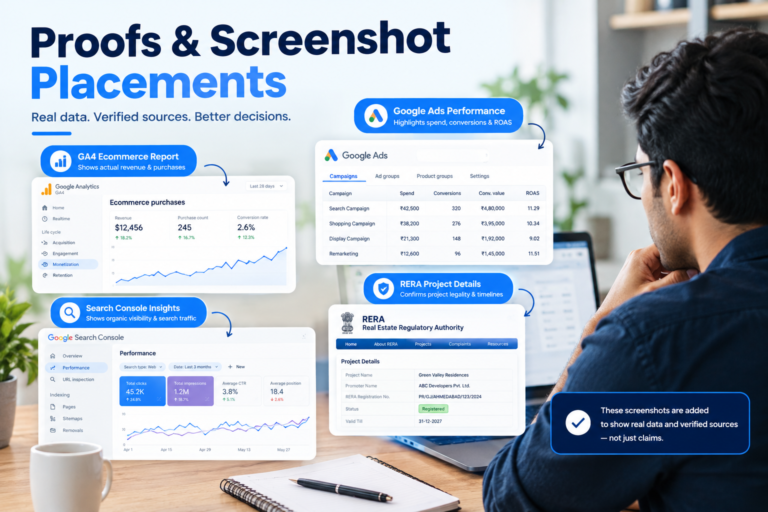
Proofs & Screenshot Placements
Who This Guide Is NOT For
This guide is not for every ecommerce business.
You may not need an ecommerce growth marketing agency yet if:
- Your product has almost no proven demand.
- Your margins are too low to support paid acquisition.
- Your website has major usability problems.
- Your fulfilment is unreliable.
- You have frequent stockouts.
- Your return rate is extremely high.
- You have not identified your target customer.
- Your product positioning is unclear.
- You expect an agency to fix a fundamentally weak product.
Sometimes the right decision is not to increase advertising.
It may be better to fix:
- Product-market fit
- Pricing
- Packaging
- Reviews
- Product quality
- Website conversion
- Fulfilment
- Customer support
This guide also isn’t for businesses looking for:
- Guaranteed overnight growth
- Fake ROAS promises
- Quick-profit schemes
- Manipulated reporting
- Vanity traffic
- Artificial followers
- Fake reviews
- Short-term tricks with no sustainable strategy
Growth marketing should build a system, not just produce a screenshot for the next monthly meeting.
If I Were Hiring an Ecommerce Growth Marketing Agency Today
If I were choosing an ecommerce growth partner today, I would not start by asking which agency promises the highest ROAS.
I would start with the business economics.
I would ask the agency to audit:
- Product economics
- Customer acquisition cost
- Website conversion
- Tracking
- Creative performance
- Retention
- Existing customer value
- Advertising account structure
Then I would ask:
“If you had to reduce our marketing budget by 20%, where would you cut first and why?”
That question is revealing.
An agency that only knows how to spend more money may struggle when efficiency matters.
I would also want clear ownership of:
- Ad accounts
- Analytics
- Creative assets
- Customer data
- Website
- Tracking systems
I would negotiate hardest around measurement and accountability, not simply the monthly agency fee.
And there is one red flag I would not ignore:
An agency that guarantees a specific ROAS or revenue number without first understanding the product, margins, website, customer journey and historical data.
No serious growth strategy should pretend those variables don’t exist.
Conclusion:
India’s ecommerce opportunity is substantial. The country had approximately 290–300 million online shoppers in 2025, and industry projections continue to point toward significant expansion through the end of the decade.
But opportunity does not automatically create a successful ecommerce business.
The brands that survive increasing competition will need to understand the entire growth equation:
Customer → Traffic → Conversion → Order → Contribution → Repeat Purchase → Lifetime Value
An Ecommerce Growth Marketing Agency in India should therefore do more than manage advertising campaigns.
The right partner should help you understand:
- Where your customers come from
- Why they buy
- Why they don’t buy
- How much acquisition actually costs
- Which products deserve more budget
- Where your website loses customers
- How to increase average order value
- How to bring existing customers back
- Which channels deserve more investment
- Which channels should be stopped
And sometimes the most valuable advice an agency can give is:
“Don’t increase the advertising budget yet. Fix the economics first.”
That may not sound as exciting as a promise of explosive growth.
But it can save an ecommerce business a significant amount of money.
If you’re evaluating an ecommerce marketing agency, start with a simple exercise: collect your last 90 days of revenue, advertising spend, orders, AOV, conversion rate, returns and customer data. Ask the agency to explain what those numbers actually mean before asking them to scale anything.
That conversation will tell you far more than a sales presentation.