

The SEO work may be progressing well, but someone still has to collect ranking data, review organic traffic, check product and category pages, interpret Search Console data, prepare charts, explain changes, and turn everything into a client-friendly report.
The challenge becomes bigger when your agency manages ecommerce brands across different Indian cities, categories, budgets, and platforms.
A fashion D2C brand in Mumbai does not have the same SEO priorities as a B2B ecommerce manufacturer in Gujarat. An online education store has different conversion metrics from a beauty products brand. Simply sending the same monthly spreadsheet to every client rarely communicates the real business story.
This is where White Label Ecommerce SEO Reporting becomes useful.
A good white label reporting system allows an agency to receive SEO performance information from a specialist fulfillment partner, apply its own branding and client communication process, and deliver a professional ecommerce SEO report without building a large reporting operation internally.
But the objective should not be to make a report look impressive.
The objective is to help the client understand what changed, why it changed, what matters commercially, and what happens next.
What Is White Label Ecommerce SEO Reporting?
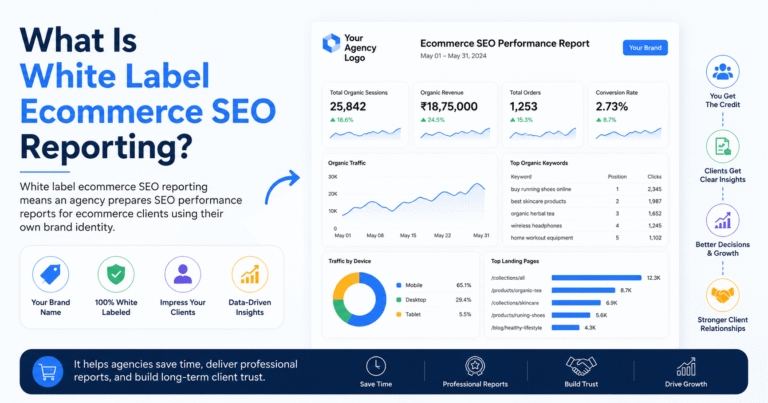
White Label Ecommerce SEO Reporting is the process of preparing ecommerce SEO performance reports that an agency can present to its clients under its own brand.
The reporting may cover areas such as:
- Organic traffic
- Search impressions
- Clicks
- Keyword rankings
- Product page performance
- Category page performance
- Organic conversions
- Ecommerce revenue
- Technical SEO issues
- Backlinks
- Search visibility
- Content performance
- SEO tasks completed
- Recommendations for the next period
The fulfillment partner may handle data collection, analysis, report preparation, and SEO insights behind the scenes, while the agency maintains the client relationship.
This is different from simply exporting data from an SEO tool.
A useful ecommerce SEO report should interpret the data in a business context.
For example:
Organic clicks increased, but revenue from organic traffic remained flat.
That is more useful than simply saying:
Organic traffic increased by 18%.
The first statement creates a question worth investigating. The second is only a metric.
Google Search Console’s performance reporting can help marketers examine queries, countries, devices, clicks, impressions and other search-performance information.
Why Ecommerce SEO Reporting Is Different From Standard SEO Reporting
Ecommerce websites can contain hundreds, thousands, or even millions of URLs.
A typical ecommerce website may include:
- Homepage
- Product pages
- Category pages
- Subcategories
- Brand pages
- Collection pages
- Filtered URLs
- Search pages
- Blog content
- Buying guides
- Seasonal landing pages
That creates a reporting challenge.
A standard SEO report might focus heavily on keyword rankings and organic sessions. For ecommerce, that is rarely enough.
An agency should also understand whether important commercial pages are receiving visibility and whether organic visitors are progressing toward purchases.
For example, imagine an ecommerce brand ranking for informational searches such as:
“how to choose running shoes”
but not performing well for:
“buy running shoes online India.”
Traffic may look healthy, but commercial search visibility may still be weak.
That distinction should appear in the report.
The report should connect SEO activity to the ecommerce funnel
A practical reporting structure can look like this:
Visibility → Traffic → Engagement → Product discovery → Cart activity → Purchase
Not every business will be able to attribute every stage perfectly to SEO, and attribution can be complicated.
However, this framework helps agencies move beyond vanity metrics.
Read More:- How Agencies Can Outsource SEO Work
What Should a White Label Ecommerce SEO Report Include?
A professional report does not need to contain every available metric. Instead, SEO reporting for ecommerce clients should focus on the metrics that help the client understand performance, identify opportunities, and make informed marketing decisions.
1. Executive Summary
Start with a short summary written for the business owner.
Include:
- Major improvements
- Important declines
- Significant SEO activities completed
- Commercial opportunities
- Issues requiring attention
- Priorities for the next month
Avoid starting with 30 charts.
A client who has five minutes to review the report should understand the overall situation within that time.
2. Organic Search Performance
The report can include:
- Organic clicks
- Organic impressions
- Click-through rate
- Average position
- Organic landing pages
- Search queries
- Search visibility trends
The important point is to compare meaningful periods.
Depending on the business, you might compare:
- Month over month
- Year over year
- Previous quarter
- Pre-season vs peak season
- Campaign period vs previous campaign period
For an Indian ecommerce brand, year-over-year comparison can be especially useful when demand is seasonal.
For example, comparing October with September may not tell the complete story for a business affected by festive shopping.
SEO delivery involves recurring work.
For multiple clients, that may include:
- Monthly keyword tracking
- Technical monitoring
- Content planning
- On-page optimisation
- Competitor research
- Reporting
- Recommendations
- Client-specific priorities
As the number of accounts increases, these tasks can consume substantial internal bandwidth.
A structured SEO fulfillment service can absorb part of this operational workload.
3. Keyword Ranking Performance
Keyword tracking is still useful, but ecommerce agencies should avoid reporting rankings without context.
Instead of showing only:
Keyword | Position
consider grouping keywords into categories such as:
- Product keywords
- Category keywords
- Brand keywords
- Commercial keywords
- Informational keywords
- Location-based keywords
- High-value keywords
For example:
Keyword Type | Example | Reporting Value |
Product | Buy leather wallets online | High commercial intent |
Category | Leather wallets for men | Category visibility |
Informational | How to choose a leather wallet | Content discovery |
Brand | Brand name + wallets | Brand demand |
Local | Leather wallets Ahmedabad | Location-specific demand |
This gives the agency a better story to communicate.
4. Product and Category Page Performance
This is one of the most important areas for ecommerce SEO reporting.
A website may have excellent overall organic traffic while its most profitable products receive little search visibility.
The report should identify:
- Top-performing product pages
- Declining product pages
- High-impression/low-click pages
- Pages gaining rankings
- Pages losing rankings
- Category pages with growth potential
- Pages with technical problems
- Products receiving organic traffic but few conversions
This analysis can lead directly to SEO recommendations.
For example:
A category page receives substantial impressions but has a low click-through rate.
Possible actions could include reviewing the title tag, meta description, search intent alignment, structured content, or SERP competition.
The point is not to assume one fix. The data should lead to further investigation.
5. Organic Revenue and Ecommerce Conversions
If ecommerce tracking is properly configured, the report should move closer to business outcomes.
Relevant metrics may include:
- Ecommerce purchases
- Revenue
- Conversion rate
- Average order value
- Transactions
- Product performance
- Organic-assisted conversions where appropriate
However, agencies should be careful with attribution.
Organic search may introduce a customer who later purchases through another channel. Therefore, a report should not automatically claim that every sale was caused exclusively by SEO.
This is one reason transparent reporting builds more trust than exaggerated reporting.
6. Technical SEO Performance
Technical SEO reporting should focus on issues that can affect search visibility or user experience.
Depending on the website, this may include:
- Indexing problems
- Crawl issues
- Duplicate URLs
- Canonicalisation
- Broken links
- Redirect issues
- Page speed
- Mobile usability
- XML sitemap issues
- Structured data
- Thin content
- Faceted navigation problems
For large ecommerce websites, faceted navigation can become particularly important.
A store selling shoes, for example, may generate URLs for:
- Size
- Colour
- Brand
- Price
- Material
- Gender
- Style
If these URLs are not managed carefully, the website can create unnecessary crawl and indexing complexity.
The report should explain the issue in business language instead of simply saying:
“Canonicalisation problem detected.”
A better explanation would be:
“Several filtered URLs are creating duplicate search paths. We are reviewing which versions should be indexed so search engines can focus on the primary category pages.”
7. Content Performance
Ecommerce SEO is not limited to product pages.
Content can help businesses capture informational searches and support customers earlier in the buying journey.
Reports can include:
- Blog traffic
- Buying guide traffic
- Informational keyword growth
- Content-assisted conversions
- Top-performing articles
- Underperforming content
- Content opportunities
For example, an Indian skincare ecommerce brand could create content around:
- How to choose a face serum
- Skincare routine for oily skin
- Ingredients for sensitive skin
- Sunscreen buying guide
The report can then identify whether these pages are attracting relevant organic visitors.
8. Link-Building and Authority Activities
If link building is part of the SEO campaign, the report can show:
- Links acquired
- Referring domains
- Target pages
- Anchor text
- Publication status
- Relevant authority metrics
- Outreach progress
But agencies should avoid turning backlink quantity into the main success metric.
A single relevant editorial mention may be more meaningful than dozens of low-quality links.
Flying Lion Media’s white label link-building service, for example, describes manual outreach, editorial placements, campaign tracking, quality assurance and transparent reporting as components of its fulfillment process.
A Step-by-Step White Label Ecommerce SEO Reporting Workflow
A reliable reporting process can be structured into seven stages.
Step 1: Understand the Client's Business
Before reviewing numbers, understand:
- Products
- Margins
- Best-selling categories
- Target customers
- Geographic markets
- Seasonal demand
- Competitors
- Business objectives
A D2C fashion brand and an industrial ecommerce supplier should not receive identical reports.
Step 2: Collect Data
Relevant sources may include:
- Google Search Console
- Google Analytics
- Ecommerce platform data
- SEO tools
- Rank tracking software
- Technical audit tools
- CRM data where available
Step 3: Validate the Data
Check whether:
- Tracking is working
- Conversions are configured correctly
- Revenue data is consistent
- Important pages are included
- Reporting periods match
- Organic traffic is being classified correctly
Bad data produces bad decisions.
Step 4: Identify Meaningful Changes
Do not report every fluctuation.
Look for:
- Significant ranking movements
- Traffic changes
- Revenue changes
- Product-page opportunities
- Technical problems
- Search demand changes
- Competitor movements
Step 5: Interpret the Findings
Ask:
Why did this change?
For example, traffic may decline because:
- Rankings dropped
- Search demand changed
- A major product went out of stock
- A seasonal period ended
- A technical issue affected pages
- A competitor gained visibility
The report should distinguish between correlation and confirmed cause.
Step 6: Create Client-Friendly Reporting
Use the agency’s:
- Logo
- Brand colours
- Terminology
- Communication style
- Client-facing recommendations
The end client should experience a consistent agency relationship.
Step 7: Turn Reporting Into the Next Action Plan
Every report should answer:
What are we doing next?
Possible priorities include:
- Improve underperforming category pages.
- Fix indexing issues.
- Expand commercial keyword coverage.
- Refresh declining content.
- Strengthen internal linking.
- Improve product page content.
- Investigate high-impression, low-CTR queries.
Practical Example: Ecommerce Brand With High Traffic but Low Sales
Consider a hypothetical Indian D2C accessories brand.
The monthly report shows strong organic traffic growth.
At first glance, the campaign looks successful.
But the business owner says:
“We are getting visitors, but sales aren’t increasing at the same rate.”
An experienced agency should not immediately declare the SEO campaign successful or unsuccessful.
Instead, it can investigate:
- Which landing pages receive traffic?
- Are visitors reaching product pages?
- Which products receive organic visits?
- Are high-traffic products actually available?
- What is the organic ecommerce conversion rate?
- Are mobile users converting?
- Are product pages competitive?
- Are prices significantly different from competitors?
- Is the checkout experience creating friction?
The SEO report has now become a business diagnostic tool.
That is much more valuable than a ranking screenshot.
Practical Example: Real Estate vs Ecommerce Reporting
Although this article focuses on ecommerce, the same reporting principle applies to other industries.
Consider a hypothetical real estate agency receiving 100 enquiries from organic and paid campaigns.
A report showing 100 leads sounds positive.
But if most enquiries are from outside the service area or people looking for properties below the company’s minimum budget, lead volume alone is misleading.
The lesson is simple:
Marketing reports should measure business quality, not only marketing activity.
For ecommerce, this means looking beyond sessions toward product engagement, transactions, revenue, conversion behaviour, and commercial search visibility where reliable data is available.
How Indian Agencies Can Improve White Label Ecommerce SEO Reports
Indian agencies often manage clients through a mixture of email, calls, WhatsApp, spreadsheets and dashboards.
That flexibility is useful, but reporting can become inconsistent as the client portfolio grows.
A scalable process should define:
- Reporting deadlines
- Data sources
- Report format
- Approval process
- Client communication
- Revision process
- Escalation process
- KPI ownership
- Next-month priorities
Flying Lion Media’s published white label fulfillment approach similarly emphasizes defined responsibilities, campaign execution, quality control, reporting and communication rather than treating outsourcing as simply moving tasks to another company.
For an agency operating across Ahmedabad, Mumbai, Bengaluru, Delhi NCR, Pune, Hyderabad, Surat and other Indian markets, standardisation can make reporting much easier to manage.
Common White Label Ecommerce SEO Reporting Mistakes
Mistake 1: Reporting Too Many Metrics
More data does not automatically mean more transparency.
If a client sees 50 metrics but does not know what they mean, the report has failed.
Mistake 2: Focusing Only on Rankings
Rankings matter, but they are not the complete business outcome.
Traffic, commercial intent, conversions and revenue should also be considered where reliable measurement is available.
Mistake 3: Using the Same Report for Every Client
A fashion store, electronics marketplace and B2B ecommerce business have different priorities.
Reporting should reflect the client’s business model.
Mistake 4: Hiding Negative Results
SEO does not improve every metric every month.
An honest report can explain:
- What declined
- What caused concern
- What was investigated
- What action is being taken
That is more credible than presenting every month as a success.
Mistake 5: No Action Plan
A report that ends with charts leaves the client wondering what happens next.
Every important insight should lead to an action, recommendation, or investigation.
Myths vs Facts About Ecommerce SEO Reporting
Myth 1: More traffic always means better SEO.
Fact: Traffic is valuable only when it is relevant. A smaller volume of high-intent visitors can be more commercially useful than large volumes of unrelated traffic.
Myth 2: A report should show only positive results.
Fact: SEO performance naturally fluctuates. Transparent reporting should explain both improvements and problems.
Myth 3: Keyword rankings are enough to measure ecommerce SEO.
Fact: Rankings are one indicator. Product visibility, organic traffic, conversions, revenue and technical health can provide additional context.
Myth 4: Every ecommerce client needs the same KPIs.
Fact: Reporting should reflect the business model, product categories, customer journey and objectives.
Myth 5: White label reporting is just putting another agency's logo on a PDF.
Fact: Effective white label reporting involves data analysis, interpretation, presentation, quality control and consistent client communication.
Ecommerce SEO Reporting Checklist for Agencies
Before sending a monthly report, check:
- Are the reporting dates correct?
- Is Search Console data reviewed?
- Is organic traffic analysed?
- Are important keyword movements identified?
- Are product and category pages reviewed?
- Are technical SEO issues documented?
- Is ecommerce conversion data checked where available?
- Are major changes explained?
- Are negative trends acknowledged?
- Are client-specific KPIs included?
- Is the report branded correctly?
- Are recommendations prioritised?
- Is next month’s action plan clear?
- Has the report been quality-checked before delivery?
How White Label Ecommerce SEO Reporting Supports Agency Growth
For a growing agency, reporting can quietly consume a significant amount of operational time.
The problem becomes more noticeable when the agency wins several ecommerce accounts at once.
Instead of spending internal resources on:
- Data collection
- Spreadsheet preparation
- Dashboard maintenance
- Report formatting
- SEO analysis
- Repetitive explanations
the agency can use a structured white label fulfillment process.
This does not remove the agency’s responsibility.
The agency still needs to:
- Understand the client’s objectives
- Own the relationship
- Review strategic recommendations
- Explain business implications
- Manage expectations
- Communicate with the client
The fulfillment partner supports the delivery system.
This distinction matters.
A white label partner should function as an extension of the agency—not as a replacement for agency strategy.
When Should an Agency Consider White Label Ecommerce SEO Reporting?
It may be worth considering when:
- Your agency has multiple ecommerce SEO clients.
- Reporting takes too much staff time.
- Reports are inconsistent between account managers.
- Your SEO specialists spend too much time formatting reports.
- You want to add ecommerce SEO without hiring a large team.
- Your agency is growing across multiple Indian markets.
- Clients expect professional dashboards and regular updates.
- Your team needs more time for strategy and client acquisition.
- You want a repeatable reporting workflow.
It may be less suitable if your agency already has a strong internal analytics and reporting team and does not have a capacity problem.
The right decision depends on your client volume, internal expertise, margins and operational priorities.
How to Choose a White Label Ecommerce SEO Reporting Partner
Before partnering with a provider, ask practical questions.
Can they understand ecommerce KPIs?
A provider should know the difference between reporting traffic and reporting commercial performance.
Can reports be customised?
Your clients should not all receive an identical template.
Can they explain negative trends?
A good reporting partner should investigate problems rather than hide them.
Are data sources transparent?
You should know where reported metrics come from.
Is quality control included?
Reports should be reviewed before reaching your client.
Can they scale with your agency?
If you move from 5 ecommerce accounts to 30, the process should remain manageable.
Can they work under your brand?
The entire client-facing experience should remain consistent with your agency.
Flying Lion Media positions its white label services around agency-branded delivery and scalable fulfillment, alongside transparent reporting and specialist support.
Conclusion
How white label SEO helps agencies scale comes down to capacity, specialisation and operational flexibility.
A capable white label SEO partner can help an agency expand its service offering, handle additional SEO accounts and access specialist fulfilment without immediately building a large internal SEO department.
But outsourcing is not a substitute for strategy.
The agencies that use the model effectively usually have clear service scopes, realistic client expectations, quality-control systems, reliable communication and proper performance measurement.
For Indian agencies, this can create a practical middle ground between turning away SEO opportunities and investing prematurely in a full in-house SEO team.
The best next step is to evaluate where your agency’s actual bottleneck exists. If sales are growing but SEO delivery capacity is holding the business back, white label SEO services may be worth evaluating as part of a broader scaling strategy.

One Response