

A digital marketing agency can reach an uncomfortable stage of growth: the sales team is capable of bringing in more clients, but the delivery team is already stretched.
You may have clients asking for SEO leads, Google Ads enquiries, Meta Ads campaigns, landing pages, lead qualification, or complete lead-generation support. Turning down the opportunity means leaving revenue on the table. Hiring several specialists, however, means taking on salaries, recruitment, training, management, software costs, and additional operational responsibility.
This is why many agencies start looking for ways to scale lead generation without hiring a large in-house team.
The answer is not simply to outsource everything. A scalable lead-generation model requires the right combination of strategy, technology, campaign execution, tracking, quality control, and fulfillment.
For Indian digital marketing agencies, particularly small and mid-sized agencies, outsourcing selected delivery functions can provide additional capacity without immediately building a large internal department.
This guide explains how to scale agency lead generation, when outsourcing makes sense, what should remain in-house, how to measure lead quality, and how white-label fulfillment can support growth.
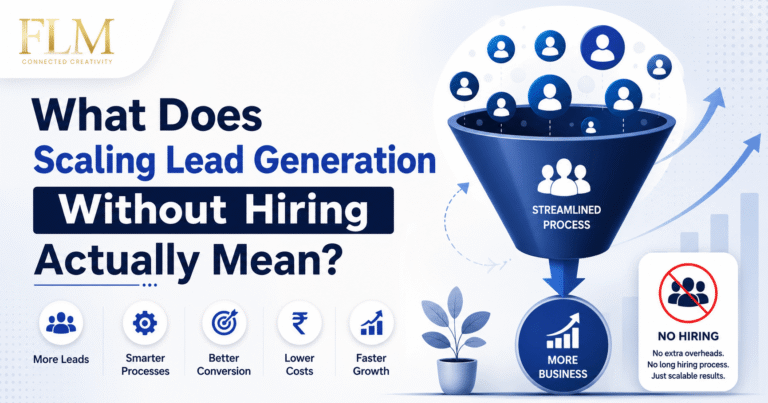
What Does Scaling Lead Generation Without Hiring Actually Mean?
Scaling lead generation without hiring means increasing your agency’s ability to generate and manage qualified leads without proportionally increasing your permanent internal workforce.
This can involve:
- Outsourcing campaign execution
- Using white-label lead generation services
- Automating repetitive marketing tasks
- Standardising campaign workflows
- Reusing proven processes and templates
- Improving conversion tracking
- Using specialist partners for specific channels
- Building stronger lead qualification systems
- Improving landing pages and conversion paths
- Connecting lead generation with CRM and follow-up systems
The objective is not to eliminate your team.
It is to make your existing team more productive while bringing in specialist capacity when required.
For example, an agency with five employees may be capable of managing strategy, client relationships and reporting but may not have enough internal resources for paid media execution, landing-page development, creative production and lead qualification for 20 additional clients.
A specialist fulfillment partner can handle selected operational functions while the agency maintains control over strategy and client relationships.
Why Agencies Struggle to Scale Lead Generation
Lead generation looks straightforward from the outside.
Run an advertisement, attract prospects, collect their details and send the leads to the client.
In practice, every stage can create problems.
1. Campaign execution requires specialist skills
Google Ads, Meta Ads, SEO, landing pages, conversion tracking and remarketing all require different skill sets.
A growing agency may have strong SEO expertise but limited paid-media resources. Another may be excellent at website development but lack experience in B2B lead generation.
Hiring one specialist for every capability quickly becomes expensive.
2. Lead volume and lead quality are different
One of the biggest mistakes agencies make is measuring success only by the number of leads generated.
Suppose a real estate client receives 100 enquiries.
That sounds impressive until the sales team discovers that most prospects are outside the service area, have unrealistic budgets, are not genuinely interested, or submitted the form accidentally.
The agency did not necessarily solve the client’s business problem.
A better question is:
How many of those leads are relevant, reachable and commercially valuable?
3. Client demand can be unpredictable
Agency growth rarely happens in a perfectly linear way.
You might acquire three lead-generation clients in one month and then six in the next.
Building a permanent team based on the highest possible workload can create unnecessary fixed costs during quieter periods.
4. Lead generation involves more than advertising
A campaign can fail even when the advertising account is correctly configured.
The problem could be:
- Weak offer
- Poor landing page
- Slow website
- Incorrect audience
- Weak creative
- Poor keyword targeting
- Missing conversion tracking
- Slow sales follow-up
- Inadequate lead qualification
- Mismatch between advertisement and landing page
Experienced marketers therefore investigate the entire customer journey rather than blaming one channel.
The Most Scalable Lead Generation Model for Agencies
A scalable agency model usually separates strategy, client management and fulfillment.
Your internal team can remain responsible for:
- Client communication
- Strategic direction
- Commercial decisions
- Account management
- Business goals
- Final approvals
- Client reporting and relationship management
Specialist partners or outsourced teams can support:
- Campaign setup
- Keyword research
- Audience research
- Landing-page implementation
- Creative production
- Campaign management
- Lead qualification
- Technical tracking
- Reporting support
- Campaign optimisation
This structure allows the agency to increase delivery capacity without immediately hiring specialists for every function.
White-label fulfillment can be particularly useful
White label lead generation services allow an agency to use an external specialist while presenting the service under its own brand.
The client continues dealing with the agency.
The agency maintains the relationship and commercial ownership.
The fulfillment partner handles agreed operational work behind the scenes.
Flying Lion Media’s existing white-label lead-generation offering is designed around this type of agency fulfillment model. Its broader white-label SEO offering also describes support for agencies that want to expand services without building every capability internally.
7 Practical Ways to Scale Lead Generation Without Hiring
1. Standardise your lead-generation process
Before outsourcing anything, document your existing process.
Create a repeatable workflow covering:
- Client onboarding
- Business and competitor research
- Target audience definition
- Offer development
- Keyword or audience research
- Campaign planning
- Landing-page requirements
- Tracking setup
- Campaign launch
- Lead-quality monitoring
- Optimisation
- Reporting
This becomes your operating system for lead generation.
Without documented processes, outsourcing can create confusion instead of scale.
2. Separate strategy from execution
Your agency does not necessarily need to perform every task internally.
For example, your account manager can decide:
- Who the client wants to reach
- What business objective matters
- Which services should be promoted
- What geographical areas should be targeted
- What constitutes a qualified lead
A specialist fulfillment team can then execute the technical campaign work according to those requirements.
This creates a more efficient division of responsibilities.
3. Outsource specialist functions instead of everything
You do not need to outsource your entire marketing operation.
Start with the functions creating the biggest capacity bottleneck.
For example:
Agency handles:
- Strategy
- Client communication
- Sales
- Approvals
Specialist partner handles:
- Campaign execution
- Tracking implementation
- Creative testing
- Landing-page optimisation
- Lead-generation operations
This approach gives the agency more control while reducing pressure on the internal team.
4. Build reusable campaign frameworks
Every client needs a customized strategy, but not every task needs to start from zero.
Create internal frameworks for:
- Campaign structures
- Keyword research
- Audience research
- Landing-page briefs
- Tracking checklists
- Reporting
- Lead-quality analysis
- Client onboarding
For example, an agency serving local businesses can create a standard discovery framework covering location, service areas, phone calls, WhatsApp enquiries, Google Business Profile visibility and local landing pages.
The framework stays consistent while the actual strategy changes according to the client.
5. Improve conversion tracking before increasing spending
Increasing advertising spend without reliable tracking can make scaling dangerous.
You need to know which activities produce meaningful actions.
Depending on the business, conversions may include:
- Contact-form submissions
- Phone calls
- WhatsApp enquiries
- Demo requests
- Appointment bookings
- Quote requests
- Purchases
Google Analytics documentation recommends measuring the steps users take through lead-generation forms rather than looking only at website visits.
For agencies, this matters because a campaign generating traffic but not qualified enquiries may need a landing-page, targeting or offer change rather than a larger budget.
6. Create a lead-quality feedback loop
The marketing team should know what happens after a lead arrives.
Ask the client:
- Was the prospect relevant?
- Was the phone number valid?
- Did the prospect answer?
- Was the prospect within the target location?
- Did they have the required budget?
- Did they request the correct service?
- Did the sales team follow up?
- Did the lead become an opportunity?
This information can improve targeting and campaign decisions.
Lead generation should not end when a form is submitted.
7. Use outsourcing as a capacity strategy
Outsourcing works best when it solves a specific operational problem.
For example:
An agency has 12 existing clients and receives requests from five additional clients for lead-generation campaigns.
Instead of immediately hiring several specialists, the agency can evaluate whether an external fulfillment partner can support the additional workload.
The agency can then test the model, monitor quality and increase internal hiring later if the workload becomes stable enough to justify permanent employees.
When Should an Agency Outsource Lead Generation?
Outsourcing is worth considering when one or more of these conditions exist:
- Your sales pipeline is growing faster than delivery capacity.
- Existing employees are overloaded.
- You are turning away potential clients.
- Clients are asking for services your team does not specialise in.
- Hiring specialists would create significant fixed costs.
- You need temporary additional capacity.
- You want to launch a new service quickly.
- Campaign execution is taking time away from strategy.
- You need access to specialised skills.
- You want to test demand before building a permanent department.
However, outsourcing is not automatically the right answer.
If your agency has predictable demand, strong recurring revenue and enough workload to support full-time specialists, internal hiring may eventually make more economic sense.
The decision should be based on workload, margins, quality requirements and long-term business plans.
How to Maintain Quality When Using Lead Generation Outsourcing Services
The biggest concern agencies have about outsourcing is often quality control.
That concern is valid.
A poorly managed outsourcing arrangement can lead to inconsistent campaigns, weak communication and unhappy clients.
Use a clear quality-control process.
Define deliverables
Do not say:
“Generate leads for this client.”
Instead define:
- Target audience
- Geographic area
- Campaign channels
- Services
- Lead criteria
- Required landing pages
- Conversion actions
- Reporting requirements
- Communication process
- Approval process
Set reporting standards
Your reporting should make it possible to answer:
- How much was spent?
- How many enquiries were generated?
- What sources generated them?
- Which campaigns performed best?
- What was the lead quality?
- What was changed?
- What should happen next?
Maintain client ownership
Even when fulfillment is outsourced, the agency should understand what is happening.
Your client should not feel that their account has disappeared into an unknown third-party system.
The agency remains responsible for communication, expectations and strategic direction.
Two Practical Agency Scenarios
Scenario 1: Local service clients
Imagine an Ahmedabad-based digital marketing agency manages websites and SEO for several local businesses.
Several clients now want more enquiries through Google Ads and Meta Ads.
The agency’s existing team understands SEO and content but does not have enough paid-media specialists to manage every new campaign.
Instead of immediately recruiting multiple employees, the agency could outsource selected campaign execution while keeping strategy and client communication internal.
The important lesson is that capacity can be expanded before headcount is expanded.
Scenario 2: Real estate lead generation
Consider an agency working with real estate businesses.
The agency generates a high number of enquiries, but the sales team reports that many are poor quality.
Hiring more people will not solve the underlying problem.
The agency should first investigate:
- Location targeting
- Property targeting
- Lead-form questions
- Creative messaging
- Landing-page content
- Search intent
- Audience quality
- Follow-up speed
- CRM classification
Only after understanding the quality problem should the agency consider increasing campaign volume.
More leads are not necessarily the answer.
Better leads are.
What Agencies Should Measure When Scaling Lead Generation
A scalable lead-generation operation should track more than clicks and impressions.
Marketing metrics
- Impressions
- Click-through rate
- Cost per click
- Landing-page visits
- Conversion rate
- Cost per lead
- Qualified leads
Business metrics
- Lead-to-opportunity rate
- Sales-qualified leads
- Appointment rate
- Opportunity-to-sale rate
- Customer acquisition cost
- Revenue generated
- Repeat business
The exact metrics should depend on the client’s business model.
For example, an ecommerce brand may care heavily about purchases and revenue, while a B2B manufacturer may have a much longer sales cycle where enquiries, qualified opportunities and sales pipeline are more meaningful.
Google Analytics also supports lead-focused measurement, including lead events and converted-lead reporting, which can help agencies move beyond simple traffic reporting.
How Lead Generation Strategy Differs by Industry
Healthcare
Clinics and healthcare businesses need strong location targeting, service-specific landing pages and careful lead qualification.
The goal is not simply to generate enquiries but to attract people looking for relevant treatments or appointments.
Real Estate
Real estate campaigns often require careful segmentation by:
- Location
- Property type
- Budget
- Buyer intent
- Project stage
Lead quality can vary significantly depending on targeting and offer structure.
Manufacturing
Manufacturers usually need a different approach from local consumer businesses.
Searches may involve:
- Product specifications
- Industrial applications
- Suppliers
- Bulk requirements
- OEM requirements
- B2B procurement
The sales cycle may also be considerably longer.
Education
Education businesses often face seasonal demand.
An admission campaign may require different messaging and budgets during peak admission periods compared with the rest of the year.
Ecommerce
Ecommerce agencies should look beyond traffic.
Important areas include:
- Product pages
- Checkout experience
- Conversion rate
- Cart abandonment
- Retargeting
- Repeat purchases
- Customer acquisition cost
Common Mistakes Agencies Make
Mistake 1: Hiring before understanding the bottleneck
If the real problem is poor processes, another employee may simply add another person to the same inefficient system.
Mistake 2: Measuring only lead volume
A campaign producing 200 irrelevant enquiries may be less valuable than one producing 30 genuinely qualified opportunities.
Mistake 3: Outsourcing without documentation
Partners cannot consistently deliver a process that the agency itself has never defined.
Mistake 4: Ignoring sales follow-up
A good marketing campaign cannot compensate indefinitely for slow or inconsistent sales follow-up.
Mistake 5: Scaling budget before validating the funnel
More advertising spend magnifies both good and bad campaign systems.
Fix the funnel before aggressively increasing spend.
Myths vs Facts
Myth 1: More leads automatically mean more revenue.
Fact: Lead quality, sales follow-up, conversion rates, offer strength and customer fit all influence revenue.
Myth 2: The largest agency needs the largest internal team.
Fact: Operational efficiency, systems, technology and specialist partnerships can allow smaller agencies to serve substantial client demand.
Myth 3: Outsourcing means losing control.
Fact: With clear processes, reporting, approvals and quality checks, an agency can outsource execution while retaining strategic and client control.
Myth 4: Every lead-generation task should be outsourced.
Fact: Agencies should identify their specific capacity bottlenecks and outsource selectively.
Myth 5: Increasing advertising budget solves lead-generation problems.
Fact: Budget cannot fix poor targeting, weak offers, inadequate tracking or poor landing-page conversion.
When Professional Lead Generation Support Makes Sense
Professional support can make sense when your agency already understands its clients and strategy but lacks delivery capacity.
For example, you may be comfortable selling:
- Google Ads
- Meta Ads
- SEO
- Landing pages
- Lead generation
- Conversion optimisation
But your team may not have enough specialists to execute everything for every account.
In that situation, agency lead generation services or white-label fulfillment can help bridge the capacity gap.
The important part is selecting a partner based on process quality, communication, transparency and ability to work within your agency’s delivery standards—not simply the lowest price.
Flying Lion Media’s white-label lead-generation service is positioned specifically for agencies looking to expand their lead-generation capabilities without building every operational function internally.
Conclusion
Scaling lead generation does not always mean adding more employees. For digital marketing agencies, sustainable growth often comes from combining standardised processes, automation, specialist outsourcing, white-label fulfillment, accurate tracking, and strong lead-quality management.
The key is to identify where your agency is losing capacity before deciding whether to hire. If your team is spending too much time on campaign execution, technical work, reporting, or repetitive tasks, outsourcing selected functions can help you handle more client work while keeping strategy and client relationships in-house.
For Indian agencies, the right approach will depend on your client portfolio, services, budget, team capabilities, and growth targets. Instead of focusing only on generating a higher number of leads, build a system that consistently attracts relevant prospects, measures lead quality, and supports your clients’ sales process.
If your agency wants to scale lead generation without hiring a large internal team, Flying Lion Media can help you evaluate your fulfillment requirements and identify practical opportunities for additional marketing capacity. Explore a strategy that fits your agency’s current stage and long-term growth plans.