

How To Find SEO Competitor Gaps and Discover Untapped Opportunities: If your content is solid, optimized, and regularly published, yet your organic traffic has plateaued while competitors capture the top rankings, you are likely suffering from a blind spot in your strategy. You are working hard to create content, but you might not be creating the right content.
The most efficient way to break through traffic plateaus is not by guessing what your audience wants—it is by conducting an SEO competitor gap analysis.
By systematically evaluating the keywords, content formats, and backlink portfolios of the websites currently dominating your target search results, you can reverse-engineer their success and capture high-intent traffic with maximum efficiency.
This comprehensive, step-by-step guide covers how to execute a competitor gap analysis, uncover untapped keywords, and structure your content to rank #1 on Google.
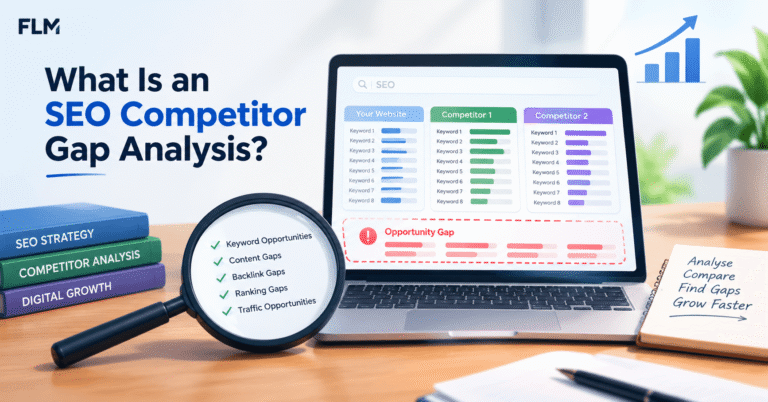
What Is an SEO Competitor Gap Analysis?
An SEO competitor gap analysis is the strategic comparison of your website’s search visibility against your top competitors to identify missing opportunities. These gaps typically manifest in three key areas:
- Keyword Gaps: High-value search queries that your competitors rank for, but your domain does not.
- Content Gaps: Subtopics, user intent angles, or formats (such as interactive calculators, templates, or original data studies) that your rivals have missed or covered superficially.
- Backlink Gaps: Authoritative websites linking to your competitors that have yet to link to you.
Closing these gaps allows you to skip months of trial and error, focusing your resources exclusively on topics with proven search demand.
Step 1: Identify Your True Organic Search Competitors
A common mistake in SEO is analyzing the brands you view as business competitors rather than your actual search competitors. In the SERPs, your competitor is any domain ranking for your target keywords—this frequently includes industry blogs, resource hubs, and publishers that do not sell competing products.
How to Find Them:
- Manual SERP Auditing: Enter your core seed keywords into an incognito browser. Note which domains consistently occupy positions 1 through 5.
- SEO Tool Discovery: Plug your domain into tools like Semrush, Ahrefs, or SE Ranking and review their Organic Competitors or Domain Overview reports.
- Filter by Authority: Select 3 to 5 direct competitors whose Domain Rating (DR) or Authority Score (AS) is reasonably close to yours to ensure realistic benchmarking.
Step 2: Uncover Keyword Gaps Using the Matrix Method
Once your competitor set is locked in, you need to identify the exact terms driving traffic to their sites while leaving yours empty.
Execution Framework:
- Open your SEO suite’s Keyword Gap or Content Gap tool.
- Input your domain alongside 2 or 3 competitor domains.
- Apply filters to show keywords where competitors rank in positions 1 through 20, but your domain has no ranking.
- Filter for high-value, low-friction opportunities:
- Search Volume: Minimum 150–500 monthly searches (tailored to your niche size).
- Keyword Difficulty (KD): Keep it under 40 if your domain authority is developing; scale up only if your backlink profile is strong.
- Search Intent: Prioritize Informational (guides, how-tos) and Commercial (best tools, comparisons) terms that align with your funnel.
Step 3: Perform a Deep-Dive Content & Format Gap Analysis
Ranking high requires more than just sprinkling target keywords into an article. You must satisfy search intent better than anyone else on the page. When auditing a competitor’s ranking piece, look for structural weaknesses you can exploit:
- Superficial Depth: Does the ranking article skim the surface without offering practical examples, step-by-step frameworks, or expert commentary? Your opportunity: Write a comprehensive, 2,500+ word ultimate guide with custom visuals and actionable takeaways.
- Outdated Information: Are the top-ranking results referencing old case studies, legacy tools, or data from past years? Your opportunity: Publish an updated guide featuring current trends and fresh insights.
- Missing Format Elements: Do users want a checklist, a downloadable template, or a workflow diagram, but the current results only provide text? Your opportunity: Build a ready-to-use resource into your post.
Step 4: Exploit the Backlink Gap
Even the best-written content can stall on page two if your domain lacks authority. A backlink gap analysis shows you exactly which external sites trust your competitors.
How to Close the Gap:
- Run a Link Intersect report in your SEO tool, entering your domain and multiple competitors.
- Filter for referring domains that link to two or more of your competitors, but not to you.
- Export these URLs. These site owners have already proven an interest in your niche topic.
- Pitch them a unique angle: offer an updated data point, an expert quote, or a complementary resource that adds value to their existing content.
Step 5: Structure Your Content for SERP Dominance
To ensure your newly discovered gap content ranks on page one and captures featured snippets or AI Overviews, adhere to this structural checklist:
- Optimized Title Tag & Meta Description: Keep meta titles punchy using a vertical pipe separator (|) and craft click-worthy meta descriptions between 165 and 170 characters.
- Clear Semantic Hierarchy (H1, H2, H3): Use your primary keyword in the H1 and integrate closely related secondary keywords naturally across subheadings.
- Scannability: Break up text walls with bullet points, numbered lists, and custom callout blocks to maximize user dwell time.
- Internal Linking: Point links from your established pages to your new gap content to pass authority and accelerate indexing.
Conclusion:
Finding SEO competitor gaps is not a one-time task; search landscapes shift dynamically as competitors publish new material and user search behavior evolves. By systematically auditing keyword opportunities, identifying structural content flaws, and closing your backlink deficit, you can outmaneuver competitors and secure sustainable, high-converting organic traffic.