

An agency can sell SEO to 10, 20, or even 50 clients and still struggle to deliver consistent content.
The problem usually appears after the sales process works: content briefs pile up, writers need more direction, client industries become harder to manage, approvals take longer, and account managers start spending too much time fixing articles that should have been right the first time.
For Indian digital marketing agencies, this challenge becomes even more noticeable when clients range from local businesses in Ahmedabad or Surat to SaaS companies, manufacturers, healthcare providers, ecommerce brands and real estate companies.
A White Label SEO Content Strategy for Indian Agencies solves more than the writing problem. It creates a repeatable system for deciding what to publish, why to publish it, who should receive it, how it should support commercial pages, and how performance should be measured.
This guide explains how agencies can build that system using White Label SEO Content Services, structured content planning, search intent analysis, quality control and performance measurement—without turning content production into a volume game.
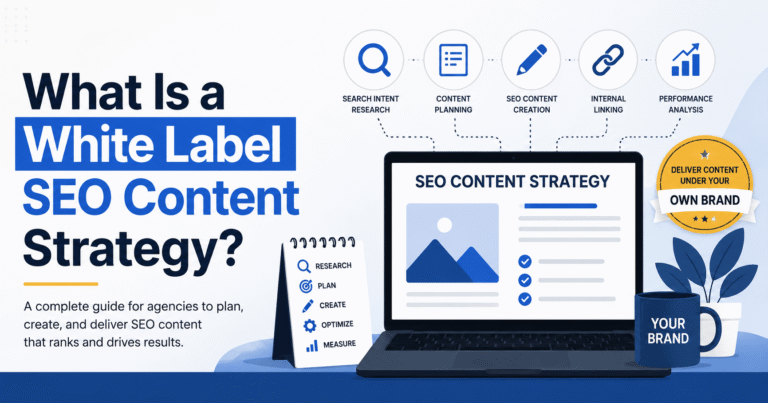
What Is a White Label SEO Content Strategy?
A white label SEO content strategy is a structured approach where an external SEO/content fulfillment team researches, plans, creates or optimizes content for an agency’s clients, while the agency presents the finished work under its own brand.
The work can include:
- Keyword and search-intent research
- Competitor content analysis
- Topic clustering
- Content calendars
- SEO content briefs
- White Label SEO Content Writing
- SEO blog writing
- Service-page content
- Local SEO content
- Content optimization
- Internal-link recommendations
- Content performance analysis
- Reporting and revisions
The important distinction is that white label content should not mean generic content with another agency’s logo on it.
A useful white label workflow starts with the client’s business model, audience, products, locations, competitors and commercial priorities.
Google’s guidance similarly emphasizes helpful, reliable, people-first content and warns against creating content primarily to manipulate search rankings.
For an agency, that means the objective should be better content delivery, not simply more published URLs.
Why Indian Agencies Struggle With SEO Content Delivery
Many agencies initially manage content internally.
One SEO specialist researches keywords. A writer produces the article. An account manager checks it. The client requests changes. Another person uploads it.
This process may work for a few accounts.
It becomes difficult when the agency manages many clients with different industries and locations.
Consider the difference between:
- An Ahmedabad-based dental clinic
- A Gujarat industrial manufacturer
- A Bengaluru SaaS company
- A Mumbai real estate developer
- An ecommerce fashion brand
- A coaching institute targeting students across India
Each requires different terminology, search intent, content depth, conversion paths and editorial standards.
Common problems include:
Content is planned around keywords instead of business priorities
An agency may identify hundreds of keywords but still fail to answer a basic question:
Which topics are most likely to help this client attract the right customers?
A manufacturer may need content around technical product applications and procurement questions rather than dozens of generic articles about “digital transformation.”
Writers don't receive enough business context
A writer cannot create useful B2B content if the brief only says:
Keyword: industrial machinery manufacturer
A better brief explains the product, target industries, buying process, differentiators, service areas, customer concerns and relevant competitors.
Every client receives the same content formula
Publishing five generic blogs per month may look efficient internally, but different businesses have different content requirements.
A local clinic might need location and treatment-intent content.
A SaaS company may need comparison, integration and use-case content.
A manufacturer may need technical explainers and application-focused pages.
Agencies measure output instead of usefulness
“20 articles published” is a production metric.
It does not tell the client whether those articles:
- Attracted relevant searches
- Supported commercial pages
- Improved organic visibility
- Generated qualified enquiries
- Helped users understand the product
- Strengthened topical coverage
That is why SEO Content Strategy for Agencies needs to connect production with business objectives.
The Core Framework for White Label SEO Content Services
A scalable content system can be built around eight stages.
1. Understand the Client Before Researching Keywords
Start with the business, not the keyword tool.
Document:
- Main products and services
- Target customer
- Primary locations
- Important commercial pages
- Customer problems
- Buying journey
- Competitors
- Existing content
- Existing organic visibility
- Business priorities
- Conversion actions
For example, a hypothetical Ahmedabad manufacturer may want more B2B enquiries from Gujarat and other Indian industrial markets.
Its content strategy should therefore consider product applications, industries served, technical questions, procurement concerns and location relevance.
This information gives the writer context that keyword volume alone cannot provide.
2. Map Search Intent
Search intent describes what someone is actually trying to accomplish with a search.
A practical content strategy usually considers several intent categories.
Informational:
“What is industrial automation?”
Commercial investigation:
“Best industrial automation companies in India”
Transactional:
“Industrial automation services Ahmedabad”
Problem-solving:
“How to reduce manufacturing downtime”
The mistake is trying to force every keyword into a blog post.
Some searches deserve service pages, product pages, location pages, comparison pages or detailed guides instead.
This is one of the most important parts of an Agency SEO Content Strategy because it prevents content from competing with the wrong page type.
3. Build Topic Clusters
Instead of treating every blog as an independent project, organize related subjects into clusters.
For example, a hypothetical SEO agency client offering Google Ads could have:
Main service:
Google Ads Management
Supporting topics:
- Google Ads campaign structure
- Search Ads vs Performance Max
- Google Ads budget planning
- Lead quality
- Conversion tracking
- Landing-page optimization
- B2B Google Ads
- Local Google Ads
- Google Ads reporting
The supporting articles can naturally connect to the main service page.
This gives the content strategy a purpose beyond publishing.
4. Create Detailed Content Briefs
A strong white label brief should give the writer enough information to make decisions.
Include:
- Primary topic
- Search intent
- Target audience
- Recommended page type
- Secondary topics
- Important questions
- Competitor observations
- Internal-link opportunities
- Conversion objective
- Suggested structure
- Brand positioning
- Required evidence or references
- Editorial requirements
A good brief reduces revision cycles because the writer understands the assignment before drafting begins.
5. Produce Content Around Real Customer Questions
White Label SEO Content Writing should sound like it understands the customer’s problem.
For example, instead of:
“SEO is important for every business.”
A stronger topic for an Indian manufacturer might be:
“How Manufacturers Can Evaluate Whether SEO Is Generating the Right B2B Enquiries”
That topic addresses a genuine business decision.
The same principle applies across industries.
A healthcare business may need content explaining treatment options and patient questions.
A real estate company may need location, pricing and property-comparison content.
An ecommerce brand may need buying guides, product comparisons and category-support content.
An education company may need course-selection, eligibility and admission-related content.
6. Add Editorial Quality Control
Outsourced content should pass through a quality-control process before reaching the client.
A useful review can check:
- Factual accuracy
- Search intent alignment
- Originality
- Readability
- Keyword relevance
- Internal links
- Brand voice
- Claims and evidence
- Grammar
- CTA relevance
- Duplicate or overlapping topics
- Industry-specific terminology
For sensitive sectors such as healthcare and finance, review standards should be particularly careful.
The agency should know who created the content, what sources were used and whether claims can be supported.
7. Optimize and Publish
SEO content is not finished when the writer submits a document.
Depending on the page, optimization may include:
- Title and heading refinement
- Meta description
- URL structure
- Internal links
- Image alt text
- Relevant structured data
- Related-page connections
- Conversion elements
- Mobile readability
Google’s Search Essentials recommends using words people would use to find content in prominent and descriptive locations such as titles, headings, alt text and link text.
The key is to optimize naturally rather than repeating the same phrase throughout the page.
8. Measure Performance and Improve
Content should be reviewed after publication.
Google Search Console can show impressions, clicks, click-through rate and search queries, while its Performance reports can be filtered and grouped to investigate pages and queries.
For business-focused content, also examine:
- Organic landing pages
- Enquiries
- Form submissions
- Calls
- Key events
- Assisted conversions
- Engagement
- Commercial-page visits
Google Analytics allows important interactions to be marked as key events, helping businesses evaluate actions that matter to their objectives.
The result should be a feedback loop:
Research → Brief → Content → Publish → Measure → Improve
That is much more useful than simply delivering a monthly article quota.
How to Build an SEO Content Calendar for Agency Clients
A content calendar should reflect priorities, not just dates.
A simple monthly framework could look like:
Content Type | Purpose |
Service-support article | Strengthen commercial topic |
Problem-solving guide | Capture informational intent |
Comparison article | Support commercial investigation |
Location-focused article | Support local visibility |
Industry guide | Build topical depth |
Existing-content update | Improve useful content already published |
The exact mix should depend on the client.
A small local service business may need fewer articles and stronger service/location pages.
A national SaaS company may require a broader content ecosystem.
An ecommerce business may need category, product and buying-guide optimization alongside editorial content.
This is where SEO Content Planning for Agencies becomes commercially useful: the calendar becomes a prioritization tool rather than a publishing schedule.
Website projects often create a natural opportunity for SEO.
After launching a website, clients may ask:
“How will people find us on Google?”
A white label SEO arrangement allows the web agency to continue the relationship instead of sending the client elsewhere.
Practical Example: Local Business With Traffic but Few Enquiries
Consider a hypothetical home-interior company serving Ahmedabad.
The website receives organic visitors from informational searches such as interior-design ideas and home-decoration tips.
However, the business receives relatively few enquiries.
The initial temptation might be to publish even more blog posts.
An experienced SEO team would first investigate:
- Which pages attract traffic?
- Which pages attract commercial searches?
- Are service pages optimized?
- Are Ahmedabad-specific searches covered appropriately?
- Are visitors being directed toward relevant services?
- Is the enquiry process easy?
- Are calls and forms being measured?
The solution may involve improving service pages, internal linking, conversion paths and commercial content rather than simply increasing article volume.
Marketing lesson: More content is not always the answer. Sometimes the existing content-to-service journey is the real problem.
Practical Example: Real Estate Agency With Many Low-Quality Leads
Consider a hypothetical real estate company targeting buyers in Ahmedabad.
The company publishes articles around broad property searches and generates substantial enquiry volume.
But sales staff report that many enquiries are from people who are not looking for the right property type or budget.
The content strategy should then become more specific.
Possible topics might include:
- Property type comparisons
- Locality comparisons
- Buyer guides
- Budget-based searches
- Amenities
- Financing considerations
- Possession-related questions
- Developer comparisons
The goal is not to eliminate every low-quality enquiry.
It is to make the website more useful to people who fit the company’s actual customer profile.
Marketing lesson: Qualified demand matters more than raw traffic or enquiry volume.
White Label SEO Content Services for Different Indian Industries
Healthcare
Healthcare content needs accuracy, clarity and appropriate expertise.
Topics should reflect genuine patient questions while avoiding unsupported medical claims.
Real Estate
Real estate content can benefit from location-specific search intent, property comparisons, buyer questions and local market considerations.
Manufacturing
Manufacturing SEO often requires deeper technical understanding.
Content may need to address applications, specifications, industries served, maintenance, procurement and engineering questions.
Education
Education content can be seasonal.
Admission cycles, course searches, eligibility questions, fees and career-related topics may influence the content calendar.
Ecommerce
Ecommerce content should connect editorial content with product and category pages.
Buying guides, comparisons, product education and category optimization can work together.
SaaS
SaaS companies often need content across the full customer journey, including problem awareness, solutions, comparisons, integrations, use cases and implementation questions.
Common Mistakes in White Label SEO Content
Myth 1: More articles automatically produce more rankings
Fact: Publishing volume does not replace relevance, quality, search intent, technical accessibility or authority.
Myth 2: Every keyword deserves a separate article
Fact: Related keywords may belong on one comprehensive page, while some keywords require a service page, product page or location page.
Myth 3: White label content should be invisible to the client
Fact: The delivery may be white label, but the agency still needs transparency around processes, quality standards and responsibilities.
Myth 4: Traffic is the main content KPI
Fact: Traffic is useful, but businesses should also consider relevant queries, landing-page performance, enquiries and meaningful actions.
Myth 5: One content template works for every industry
Fact: A local clinic, manufacturer, SaaS company and ecommerce store have different customers and buying journeys.
Myth 6: SEO content can be evaluated immediately
Fact: Content performance should be evaluated over a reasonable period and alongside technical, competitive and business factors. SEO outcomes are influenced by more than the article itself.
White Label SEO Content Strategy Checklist
Before delivering content for an agency client, review:
- Is the client’s target audience clearly defined?
- Is the search intent understood?
- Is the correct page type selected?
- Does the topic support a genuine business objective?
- Has competitor content been reviewed?
- Does the brief contain enough business context?
- Are important customer questions answered?
- Are internal links relevant?
- Are claims supported where necessary?
- Has the content passed editorial quality control?
- Does the article have a clear next step?
- Is the content connected to relevant service or product pages?
- Are performance metrics defined before publishing?
How to Choose a White Label SEO Content Partner
If your agency is considering SEO Content Outsourcing for Agencies, don’t evaluate providers only by price per article.
Ask:
White Label SEO Scaling Checklist
Can they understand different industries?
A partner should be able to adapt content for B2B, local, ecommerce, SaaS, healthcare and other business models.
Do they provide strategy or only writing?
Good White Label SEO Writing Services should fit into a broader SEO workflow.
Can they follow your brand requirements?
The final content should match your agency’s standards and client expectations.
Is there quality control?
You need a process for checking factual accuracy, SEO relevance, originality and readability.
Can they scale?
If your agency grows from five clients to 25, the delivery process should remain organized.
Do they understand reporting?
A useful partner should help connect content production with measurable outcomes rather than reporting only article counts.
Can they work behind your brand?
The workflow, communication and deliverables should fit your white label operating model.
Flying Lion Media’s broader white label SEO approach includes content, SEO fulfillment and reporting workflows designed to help agencies increase delivery capacity without having to build every capability internally.
When Should an Indian Agency Outsource SEO Content?
Outsourcing may make sense when:
- Your sales team is winning more SEO clients than your content team can handle.
- Writers are overloaded with repetitive production.
- SEO specialists are spending too much time managing content operations.
- You need industry-specific expertise.
- You want to add SEO services without immediately building a full internal department.
- Client reporting and content production are becoming difficult to standardize.
- You want your internal team to spend more time on strategy and client relationships.
It may not make sense to outsource everything immediately.
Some agencies prefer a hybrid model where strategy, client communication and approvals remain internal while keyword research, briefs, writing, optimization or reporting are outsourced.
The right model depends on your team’s strengths, margins, client volume and desired level of control.
How to Measure Whether Your Content Strategy Is Working
Avoid using one metric as the final answer.
Review performance at three levels.
SEO performance
Track:
- Impressions
- Clicks
- CTR
- Search queries
- Organic landing pages
- Ranking trends
Search Console provides query and page-level performance information that can help identify which content is gaining visibility and where opportunities remain.
Engagement performance
Review:
- Engaged sessions
- Relevant page visits
- Internal-link clicks
- Key events
- User journeys
Business performance
Where reliable tracking exists, assess:
- Enquiries
- Calls
- Form submissions
- Qualified leads
- Sales opportunities
- Revenue influenced by organic search
This matters because a page can attract thousands of visitors and still contribute little commercial value, while a smaller page can attract fewer but much more relevant prospects.
Conclusion
A successful White Label SEO Content Strategy for Indian Agencies is not a system for producing the largest number of articles at the lowest possible cost.
It is a system for producing the right content for the right client, audience, search intent and business objective.
The strongest workflow connects:
Business research → Search intent → Topic planning → Content brief → Expert writing → SEO optimization → Internal linking → Quality control → Measurement → Improvement
For Indian agencies, this approach is particularly useful when client requirements span local SEO, B2B search, ecommerce, healthcare, education, real estate and SaaS.
If your agency is spending too much time coordinating SEO content, or your client demand has grown beyond your internal delivery capacity, it may be worth evaluating a structured White Label SEO Content Services model.
Flying Lion Media can help agencies assess their current SEO fulfillment workflow, identify delivery gaps and determine whether outsourced content and SEO support makes commercial sense for their business. The right solution should depend on your client portfolio, internal capabilities, budget and growth plans—not on a one-size-fits-all package.