

Imagine you run a digital marketing agency in Ahmedabad. You have built relationships with local businesses, and a new client approaches you for SEO, Google Ads, social media management and monthly performance reporting.
There is just one problem: your team can manage SEO and client communication, but you do not have enough specialists to deliver every service effectively.
You have two options. You can recruit employees, invest in software, train specialists and spend months building an internal team. Alternatively, you can partner with another agency that handles selected services behind the scenes while you manage the client relationship under your own brand.
The second option is known as white label digital marketing.
At first, the arrangement sounds simple. Another company performs the marketing work, and your agency sells those services under its own name. However, the commercial reality involves much more than outsourcing tasks.
You still need to manage client expectations, maintain service quality, protect your profit margins, monitor performance and take responsibility when something goes wrong.
A low-cost delivery partner can help your agency expand. The wrong partner can damage client relationships, reduce profitability and affect your reputation.
This guide explains what a white label digital marketing agency is, how the business model works in India, which services you can outsource, how pricing and profit margins work, and what to check before choosing a white label partner.
The objective is simple: help you decide whether white label digital marketing is a sensible business decision for your agency.
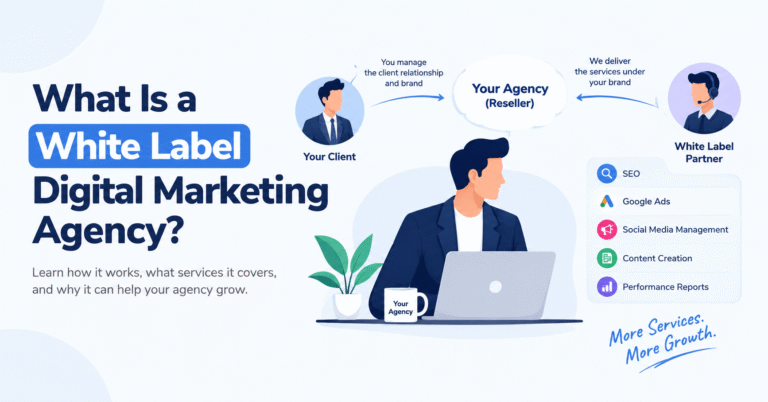
What Is a White Label Digital Marketing Agency?
A white label digital marketing agency is a service provider that delivers marketing work for another agency, consultant or business, allowing the reseller to offer those services under its own brand.
In this arrangement, the delivery partner handles the agreed execution activities, while the reseller generally manages the client relationship, pricing, communication and overall service experience.
For example, suppose a business approaches your agency for technical SEO, content marketing and Google Ads management.
Your internal team understands SEO but does not have enough capacity to manage content production and paid advertising.
Instead of immediately recruiting additional employees, you can partner with a white label provider that specialises in those services.
The provider completes the agreed work, your agency reviews the deliverables, and you present the approved work to your client under your brand.
This allows your business to expand its service offerings without building every specialist department internally.
Common White Label Digital Marketing Services
Depending on the provider’s expertise, you can outsource several marketing activities.
1. White Label SEO Services
- Technical SEO audits
- Keyword research and mapping
- On-page SEO optimisation
- Content briefs and content production
- Internal linking recommendations
- Link-building support
- Local SEO
- Google Business Profile optimisation
- SEO performance reporting
2. White Label PPC and Google Ads Management
- Google Ads account audits
- Search campaign management
- Display and remarketing campaigns
- Keyword and negative keyword research
- Conversion tracking
- Campaign optimisation
- Landing page recommendations
- Performance reporting
3. White Label Social Media Management
- Social media strategy support
- Content calendar creation
- Post design and scheduling
- Caption writing
- Community management
- Social media performance analysis
- Paid social campaign management
4. White Label Website Design and Development
- WordPress website development
- Shopify and WooCommerce development
- Landing page creation
- Website redesign
- Website maintenance
- Website speed optimisation
- Mobile responsiveness improvements
5. White Label Content Marketing
- Blog writing
- Website content
- SEO content optimisation
- Content planning
- Case study development
- Email newsletter content
- Content distribution support
6. White Label Analytics and Reporting
- Google Analytics 4 reporting
- Google Search Console analysis
- Google Ads performance reports
- Meta Ads reporting
- Conversion tracking checks
- Monthly performance dashboards
Not every provider delivers all these services at the same level. Evaluate each service independently rather than assuming that a company offering ten different services has ten equally capable departments.
Read More:- How Does White Label Digital Marketing Work?
White Label Digital Marketing vs Traditional Outsourcing: What Is the Difference?
White labelling and outsourcing are related, but they are not identical.
Outsourcing means assigning work to an external individual or organisation. White labelling adds an arrangement in which the reseller can offer the resulting service under its own brand.
Comparison factor | Traditional outsourcing | White label digital marketing |
Primary purpose | Delegate specific work | Expand services under your brand |
Branding | May use the contractor’s branding | Usually uses the reseller’s branding |
Client relationship | May involve direct provider communication | Generally managed by the reseller |
Reporting | May come directly from the contractor | Prepared for branded client delivery |
Commercial model | Hourly, project-based or retainer | Wholesale delivery cost and resale price |
Service responsibility | Depends on the agreement | Reseller remains accountable for its client commitments |
Business objective | Reduce workload or access expertise | Expand service capacity and offerings |
For example, hiring a freelance content writer to produce five articles is outsourcing.
Partnering with a specialist agency that produces articles, follows your reporting requirements and allows you to deliver the service under your agency’s branding is a white label arrangement.
However, white labelling does not automatically mean that the delivery partner must remain anonymous in every situation. Confidentiality, subcontracting, disclosure and branding requirements should be agreed upon contractually.
How Does a White Label Digital Marketing Agency Work in India?
The white label model generally involves five stages: acquiring the client, selecting the delivery partner, setting the price, completing the work and managing performance.
Let’s understand how the process works with a practical example.
Step 1: Your Agency Acquires a Client
Your agency approaches a business that needs digital marketing support.
For example, a real estate company in Ahmedabad wants to improve its organic visibility, generate property enquiries and increase website traffic.
During the initial discussion, you identify its requirements, marketing budget, target audience, current website performance and business objectives.
Before preparing a proposal, understand which services the business genuinely needs.
Do not sell SEO, PPC and social media management together simply because your white label provider offers all three.
Step 2: You Select the Right White Label Partner
Once you understand the client’s requirements, identify which activities your internal team can handle and which require external specialists.
For example:
- Your team manages SEO strategy and client communication.
- Your white label partner performs technical SEO audits.
- An external content team prepares approved blog content.
- A paid advertising specialist manages agreed campaign activities.
- Your account manager reviews the deliverables.
The responsibilities should be documented before the project starts.
Otherwise, important activities may be missed because both teams assume the other is responsible.
Step 3: Your Agency Creates the Pricing Structure
The white label provider shares its delivery quotation.
You then calculate your client-facing price by considering:
- External delivery costs
- Internal employee time
- Account management
- Quality assurance
- Software and reporting expenses
- Sales and administration costs
- Expected contribution margin
For instance, if the provider charges ₹18,000 for monthly SEO delivery, your client price should not automatically be ₹20,000 or ₹22,000.
Your agency still needs enough revenue to manage the account and maintain quality.
Step 4: The Partner Delivers the Marketing Work
After agreeing on the scope, the provider begins execution.
For an SEO project, this might involve:
- Website technical analysis
- Keyword research
- On-page optimisation recommendations
- Content briefs
- Internal linking suggestions
- Monthly progress documentation
For Google Ads, the work may include campaign structure, keyword selection, conversion tracking, bid optimisation and performance analysis.
Your agency should review the work before sharing it with the client.
Remember that outsourcing execution does not eliminate your responsibility to check the quality of the work.
Step 5: Your Agency Reports Results to the Client
Your agency manages the monthly review and explains the campaign’s progress.
A meaningful SEO report should include:
- Organic traffic trends
- Search impressions and clicks
- Relevant keyword visibility
- Technical improvements
- Qualified organic enquiries, where tracking is available
- Conversion trends
- Completed activities
- Upcoming priorities
For Google Ads, reports should explain advertising expenditure, conversions, cost per conversion, campaign performance and lead quality wherever reliable data exists.
Do not present impressions, rankings or clicks as proof of business growth without considering their relationship to enquiries, sales and revenue.
Complete White Label Workflow
Client acquisition → Requirement analysis → Partner selection → Pricing and proposal → Service delivery → Quality assurance → Branded reporting → Client communication.
A successful partnership requires clear responsibilities at every stage.
Why Are Digital Marketing Agencies Choosing White Label Services?
White label partnerships can help agencies solve capacity problems without immediately creating additional departments.
However, the benefits depend on the quality of the provider and how effectively the reseller manages the relationship.
1. Expand Your Service Portfolio
Your agency may specialise in SEO but regularly receive enquiries for Google Ads, social media marketing and website development.
Instead of turning away every opportunity, you can use specialist partners to deliver services outside your current capabilities.
This can help you offer more complete marketing solutions while retaining control of the client relationship.
2. Avoid Immediate Recruitment Costs
Building an internal team requires recruitment, salaries, training, management and software investment.
A white label arrangement allows you to access external expertise without immediately taking on all those fixed employment costs.
However, outsourcing is not automatically cheaper. Compare the complete cost of both models, including supervision, revisions and long-term workload.
3. Increase Delivery Capacity
Suppose your agency currently manages five SEO clients comfortably but receives enquiries from another four businesses.
A suitable white label partner may help you accommodate additional work without overloading your existing employees.
The important condition is that the provider must have enough genuine delivery capacity.
4. Access Specialist Expertise
Technical SEO, conversion tracking, paid advertising and website development require different skill sets.
A specialist partner may bring experience that would take your agency considerable time to develop internally.
You should still retain enough knowledge to evaluate the work and explain its impact to clients.
5. Focus More on Business Development
When specialist execution is handled through a reliable delivery arrangement, your internal team can dedicate more time to:
- Building client relationships
- Understanding business requirements
- Developing marketing strategies
- Acquiring new clients
- Improving retention
- Identifying additional opportunities
The objective should be to improve operational efficiency, not simply to sell more services.
The Real Problems Agencies Face With White Label Digital Marketing
White label partnerships can create growth opportunities, but they also introduce operational and commercial risks.
Understanding these problems before signing an agreement can prevent expensive mistakes.
Problem 1: Cheap Pricing Can Create Expensive Delivery Failures
A provider quoting ₹8,000 per month for SEO may appear more attractive than one quoting ₹20,000.
However, a lower fee does not guarantee that the provider includes technical analysis, content recommendations, quality control and meaningful reporting.
If the work is inaccurate or incomplete, your agency may spend additional hours correcting it.
What should you do?
Compare the deliverables, not just the monthly quotation.
Ask for a detailed scope covering the activities included, exclusions, revision limits and reporting responsibilities.
Problem 2: Your Client Holds Your Agency Responsible
Imagine your external content team delivers inaccurate information or misses an agreed deadline.
Your client is unlikely to accept the explanation that an outsourced provider caused the problem.
Your agency sold the service and made the commitment.
What should you do?
Establish quality checks, delivery deadlines and escalation procedures.
Do not send work to clients without reviewing it against the agreed requirements.
Problem 3: Professional Reports Can Hide Weak Results
A report showing increased impressions, published articles and completed activities may look impressive.
But what happens if organic enquiries decline or advertising leads are irrelevant?
Activity metrics do not necessarily demonstrate commercial success.
What should you do?
Agree on meaningful performance indicators before launching the campaign.
Evaluate lead quality, conversion trends and business outcomes alongside marketing activity.
Problem 4: Poor Account Access Can Create Security Risks
White label delivery may require access to:
- Google Analytics
- Google Search Console
- Google Ads
- Meta Business tools
- WordPress websites
- Customer relationship management systems
Giving an external provider unrestricted access can create unnecessary risks.
What should you do?
Use individual accounts, role-based permissions and appropriate confidentiality agreements.
Keep client-owned advertising accounts, analytics properties and website assets under suitable client or agency control.
Document the access removal process before starting the partnership.
Problem 5: Your Sales Promises May Exceed Delivery Capacity
An agency may sign several clients because a provider claims to have unlimited delivery capacity.
But if the actual team cannot manage the workload, deadlines and quality may suffer.
What should you do?
Start with a small pilot.
Measure delivery consistency, communication quality and the amount of internal supervision required before increasing the number of accounts.
Problem 6: Your Actual Profit May Be Lower Than Expected
Suppose you charge a client ₹35,000 per month and pay your white label partner ₹18,000.
The difference is ₹17,000.
But this is not your final profit.
You still have account management, quality assurance, reporting and other business expenses.
What should you do?
Calculate the complete delivery cost before accepting the client.
A sustainable partnership should leave enough contribution to support the business and handle unexpected work.
The illustrative contribution margin is 25%.
The client’s advertising spend is separate from the agency’s management revenue in this example. If the client spends ₹2 lakh on advertising, that amount should not be counted as agency revenue merely because the agency manages the account. The actual accounting treatment depends on the contractual arrangement.
How to Choose the Right White Label Digital Marketing Agency in India
Choosing a provider is one of the most important decisions in the white label business model.
A good sales presentation is not sufficient evidence of delivery capability.
Use the following process to evaluate potential partners.
Step 1: Identify the Services You Actually Need
Start by identifying your current client requirements.
For example:
Service | Internal capability | Outsourcing requirement |
SEO strategy | Available | Limited specialist support |
Technical SEO | Limited | Yes |
Content production | Limited | Yes |
Google Ads | Not available | Yes |
Client communication | Available | No |
Monthly reporting | Available | Specialist data support if required |
This exercise helps you identify exactly what needs to be outsourced.
Mistake to avoid: Choosing a provider simply because it offers a large service portfolio.
Step 2: Evaluate Pricing and Profitability
Before selecting a provider, calculate your complete delivery expenses.
Use this formula:
Contribution before overhead and tax = Client revenue − Direct delivery costs
Consider the following illustrative SEO package.
Cost component | Monthly amount |
Client revenue | ₹35,000 |
White label delivery | ₹18,000 |
Internal account management | ₹4,000 |
Tools and reporting allocation | ₹1,000 |
Quality assurance allowance | ₹2,000 |
Contribution before overhead and tax | ₹10,000 |
The contribution margin is approximately 28.6%.
This is an illustrative calculation, not an industry benchmark or guaranteed profit margin.
It does not include all general business expenses, such as sales, administration, bad debts and income tax.
Practical tip: Calculate your profitability under both normal and difficult delivery conditions. Include additional meetings, revisions and delayed client payments in your planning.
Step 3: Verify the Provider's Expertise
Ask the provider to demonstrate its actual delivery capabilities.
For SEO, request examples of:
- Technical SEO audits
- Keyword mapping documents
- Content briefs
- On-page recommendations
- Reporting formats
For Google Ads, evaluate:
- Campaign structure
- Conversion tracking
- Keyword research
- Optimisation methodology
- Budget monitoring
- Performance reporting
Ask who will handle your projects and how the provider manages workload during busy periods.
Red flags:
- Guaranteed first-page rankings
- Guaranteed leads or revenue
- No clear explanation of delivery methods
- Unverifiable case studies
- Unwillingness to provide sample deliverables
Step 4: Test the Delivery Process
Before assigning multiple clients, give the provider a small, clearly defined assignment.
Evaluate:
- Understanding of your brief
- Accuracy of the work
- Communication speed
- Delivery timelines
- Response to feedback
- Revision quality
Also measure how much time your internal team spends correcting the work.
A low-cost provider may become expensive if your team needs to supervise every task.
Step 5: Check Account Security and Data Ownership
Before granting access, establish who controls the relevant accounts and deliverables.
Your agreement should explain:
- Account access permissions
- Client data handling
- Confidentiality
- Intellectual property ownership
- Ownership and transfer of source files
- Subcontracting permissions
- Account handover
- Termination procedures
Avoid sharing passwords wherever individual user access is available.
For projects involving personal information, review the applicable Indian data-protection obligations with a qualified professional.
Step 6: Sign a Clear White Label Partnership Agreement
A written agreement should cover:
- Services and deliverables.
- Monthly pricing and payment terms.
- Delivery timelines.
- Revision and correction policies.
- Communication and escalation.
- Confidentiality requirements.
- Intellectual property ownership.
- Data protection and account access.
- Subcontracting arrangements.
- Termination and handover procedures.
Do not negotiate only on price.
A slightly higher delivery fee may be worthwhile if the provider offers more reliable communication, better quality control and predictable turnaround times.
White Label Digital Marketing Pricing and Profit Margins in India
One of the most common questions among agency owners is how much they can earn by reselling white label marketing services.
There is no universal price or guaranteed margin.
The economics depend on the service, complexity, client requirements, provider charges and internal management expenses.
How to Calculate White Label Service Profitability
Consider this example.
Your agency sells an SEO package for ₹35,000 per month.
The white label provider charges ₹18,000.
Your internal team spends ₹4,000 worth of time managing the account. Tools and reporting cost ₹1,000, while quality assurance and rework require another ₹2,000.
The calculation is:
Client revenue = ₹35,000
Total direct delivery costs = ₹25,000
Contribution before overhead and tax = ₹10,000
Contribution margin = 28.6%
This is the amount available to cover general overhead and generate operating profit.
What Factors Affect White Label Pricing?
- Service complexity: Technical SEO and custom website development may require more specialist time than routine content scheduling.
- Deliverable volume: A project requiring ten landing pages will have different delivery requirements from one requiring two.
- Turnaround time: Urgent delivery may require additional resources.
- Reporting requirements: Custom dashboards and detailed performance analysis require additional work.
- Revision requirements: Unlimited revisions can create unpredictable costs.
- Client communication: Some providers only execute tasks, while others offer project coordination and specialist support.
Important: Compare quotations against the same scope of work. Otherwise, a cheaper package may simply include fewer deliverables.
Practical White Label Digital Marketing Examples
The following examples are hypothetical scenarios created to explain the commercial model. They are not actual Flying Lion Media client results or independently verified performance claims.
Example 1: A Small Agency Expanding Its SEO Services
An agency has three clients who need monthly SEO services.
It decides to outsource selected technical and content activities instead of immediately recruiting additional specialists.
Particulars | Monthly amount |
Number of clients | 3 |
Client fee per account | ₹35,000 |
Total monthly revenue | ₹1,05,000 |
Partner delivery cost | ₹54,000 |
Internal account management | ₹12,000 |
Tools and quality assurance | ₹9,000 |
Contribution before overhead and tax | ₹30,000 |
The illustrative contribution margin is 28.6%.
What does this example demonstrate?
The agency can expand its delivery capacity while retaining client communication and strategic control.
However, if the partner’s quality declines or client requirements increase, the agency’s actual contribution may fall.
Example 2: A Performance Marketing Agency Outsourcing Google Ads Execution
A marketing agency receives a client requirement for Google Ads campaign management.
It retains responsibility for strategy, client communication and budget approvals while outsourcing selected campaign operations.
Particulars | Monthly amount |
Management fee | ₹60,000 |
External delivery cost | ₹30,000 |
Internal account management | ₹8,000 |
Reporting and tools | ₹3,000 |
Quality assurance allowance | ₹4,000 |
Contribution before overhead and tax | ₹15,000 |
The illustrative contribution margin is 25%.
The client’s advertising budget is separate from the management fee in this example.
For instance, if the client spends ₹2 lakh directly on Google Ads, that amount should not automatically be treated as agency revenue.
What does this example demonstrate?
Outsourcing campaign execution does not guarantee more leads, lower acquisition costs or increased sales.
Campaign outcomes also depend on the client’s offer, competition, landing page, creative quality, tracking and sales process.
White Label Digital Marketing vs Hiring an In-House Team
White labelling is not always the best option.
If your agency has stable recurring demand, sufficient capital and a need for close daily collaboration, hiring an internal team may provide better long-term control.
Consider the differences.
Factor | White label partnership | In-house team |
Initial investment | Generally lower | Recruitment and setup costs |
Fixed salary commitments | Usually lower | Higher |
Delivery control | Depends on the agreement | More direct |
Specialist availability | Depends on the provider | Depends on recruitment |
Scaling | Depends on partner capacity | Requires additional hiring |
Internal knowledge | May remain with the provider | Builds within your business |
Management requirements | Partner and quality management | Employee and team management |
When Should You Choose White Label Services?
Consider outsourcing when:
- You have genuine client demand but insufficient specialist capacity.
- You need to offer additional services.
- Your internal team can review the work.
- You want to test a service before hiring.
- The commercial arrangement leaves a sustainable contribution.
When Should You Hire Internally?
Consider recruitment when:
- You have stable long-term demand.
- The work requires continuous collaboration.
- The service is central to your competitive advantage.
- You need direct control over daily execution.
- You can support recruitment, salaries and management costs.
When Should You Avoid Both Options?
If your agency has inconsistent client acquisition, poor retention or unclear service positioning, adding more delivery commitments may increase operational problems.
First establish which services your clients consistently need and whether your pricing supports sustainable delivery.
How to Maintain Quality in a White Label Partnership
Signing an agreement is only the beginning.
The real challenge is maintaining consistent delivery as your agency adds more clients.
Use the following practices.
Create Standard Operating Procedures
Prepare written instructions for recurring activities, including SEO audits, content briefs, campaign reviews and monthly reports.
This reduces confusion between your internal team and the delivery partner.
Establish Quality Checklists
Create a review checklist for each service.
For SEO content, check factual accuracy, search intent, originality, readability, keyword relevance and internal linking.
For Google Ads, check conversion tracking, campaign settings, targeting, budget allocation and reporting accuracy.
Schedule Regular Performance Reviews
Hold periodic reviews with your delivery partner.
Discuss missed deadlines, recurring corrections, performance concerns and upcoming workload.
Do not wait until a client complains to identify operational problems.
Keep Client Communication Under Control
Your agency should have a clear process for responding to client questions and explaining campaign decisions.
The external partner can provide specialist information, but your agency should coordinate the final client communication.
Prepare an Exit Plan
A provider may become unavailable, increase its prices or fail to meet agreed standards.
Maintain access to documentation, approved deliverables, source files and client-owned accounts.
A proper handover process helps protect business continuity.
How to Measure the Success of a White Label Partnership
Do not evaluate your partner only on the number of completed tasks.
Measure the commercial and operational performance of the relationship.
Measurement area | What to evaluate |
Delivery quality | Accuracy and completeness of work |
Timeliness | Percentage of deliverables completed on schedule |
Communication | Response time and issue resolution |
Rework | Number of corrections required |
Profitability | Contribution after direct delivery costs |
Client satisfaction | Feedback and retention |
Campaign performance | Relevant marketing outcomes |
Operational efficiency | Internal time spent managing delivery |
For example, if your partner delivers work on time but requires extensive corrections, the relationship may not be as efficient as it initially appears.
Similarly, a provider may complete every SEO activity but fail to explain why organic enquiries are declining.
The best partner is not necessarily the cheapest or fastest. It is the one that consistently delivers work your agency can confidently stand behind.
Credibility and Trusted Resources for White Label Digital Marketing
White label digital marketing is a business arrangement, not a certification that automatically proves a provider’s competence.
When evaluating a partner, use independent documentation and platform resources to understand the quality standards expected from each service.
- Google Search Central
Google’s documentation explains search fundamentals, helpful content and technical SEO requirements.
Resource: https://developers.google.com/search/docs
Use it to evaluate whether an SEO provider follows sound search optimisation practices.
- Google Analytics
Google Analytics documentation explains how to measure website activity and user interactions.
Resource: https://support.google.com/analytics/
Use it to understand whether the provider can explain the website’s performance and conversion measurement.
- Google Search Console
Search Console provides information about search queries, impressions, clicks and website visibility.
Resource: https://support.google.com/webmasters/
Use it to review organic search performance rather than relying entirely on provider-created screenshots.
- Google Ads Help
Google Ads documentation provides information about campaign management, conversion measurement and advertising tools.
Resource: https://support.google.com/google-ads/
Use it to understand the processes your paid advertising partner should be able to explain.
- Meta Business Help Centre
Meta provides documentation about business assets, account access and advertising tools.
Resource: https://www.facebook.com/business/help
Use it to establish appropriate access and management practices for social media advertising.
- Ministry of Corporate Affairs
For Indian companies, the Ministry of Corporate Affairs provides access to corporate information and relevant company records.
Resource: https://www.mca.gov.in/
Use official records as part of business due diligence where applicable. Company registration alone does not establish delivery quality or financial reliability.
Who Should Not Use White Label Digital Marketing Services?
White label services are not suitable for every agency.
You should reconsider outsourcing if:
- You cannot evaluate the quality of the service you intend to sell.
- You have no time or process for reviewing deliverables.
- Your provider cannot demonstrate relevant expertise.
- Your profit margins cannot absorb rework and account management.
- Your client requires specialist involvement that the provider cannot offer.
- You are relying on guaranteed rankings, leads or revenue.
- You have not established account ownership and data protection requirements.
You should also avoid selling services simply to make your agency appear larger.
A white label arrangement should improve your ability to serve clients, not encourage you to make promises your business cannot responsibly fulfil.
If I Were Building a Digital Marketing Agency in India Today
I would not outsource every service simply because an external provider offered an attractive package.
I would first identify where my agency was losing opportunities because of limited delivery capacity.
For example, if I had a strong SEO team but lacked specialists for technical development and paid advertising, I would consider outsourcing those specific activities.
I would follow three principles.
First, start small.
I would begin with one or two clearly defined services and a limited number of clients.
Second, retain strategic control.
I would keep client communication, marketing priorities, budget approvals and quality assurance within my agency.
Third, measure the actual economics.
I would calculate the complete cost of delivery, including internal management, revisions, software and overhead.
I would also negotiate clear terms covering ownership, deadlines, confidentiality, account access and termination.
One red flag I would never ignore is a provider that guarantees rankings, leads or revenue without explaining the methodology, limitations and measurement process.
My preference would be to work with a specialist partner that communicates honestly, even when results are below expectations.
My final judgment: White label digital marketing is a delivery model, not a shortcut to building a successful agency. It works when the reseller understands its clients, the partner has demonstrable capabilities, the responsibilities are clear and the financial model is sustainable.
If those conditions are missing, I would delay outsourcing rather than risk client trust.
Conclusion:
A white label digital marketing agency allows another provider to deliver agreed marketing services under your agency’s brand.
For Indian agencies, freelancers and marketing consultants, this arrangement can create an opportunity to expand service offerings without immediately building every specialist department internally.
However, the business case depends on much more than the difference between the provider’s quotation and your selling price.
You need to evaluate delivery quality, internal management time, reporting accuracy, account security, client expectations and actual contribution margins.
Before entering a white label partnership, remember these principles:
- Start with a specific service and a limited pilot.
- Verify the provider’s expertise through real deliverables.
- Compare quotations using the same scope of work.
- Calculate contribution after all direct delivery costs.
- Establish clear responsibilities and deadlines.
- Protect client accounts, data and intellectual property.
- Review meaningful business outcomes rather than attractive screenshots.
- Maintain an exit and handover process.
- Never promise marketing results you cannot responsibly support.
Your next step: Prepare a one-page checklist covering service requirements, client expectations, delivery budgets, turnaround times, quality standards, reporting and contractual protections.
Compare at least two or three potential partners against the same requirements.
A structured evaluation will tell you more than a sales presentation.
If your agency has genuine demand but limited delivery capacity, white label digital marketing may be worth testing. Start small, measure the results and expand only when the partnership proves commercially and operationally valuable.

3 Responses