

Many Indian marketing agencies reach a point where sales are growing faster than their delivery capacity. The agency may be good at branding, website development, or client acquisition, but suddenly clients also want SEO, Google Ads, social media, content, local SEO, and performance marketing.
Hiring specialists for every service can increase workforce requirements, operational costs, management responsibilities, and deadlines.
This is where a White Label Digital Marketing Company in India can become a practical growth option.
Instead of building every capability internally, an agency can work with a specialist partner that handles campaign strategy, execution, optimization, reporting, and other deliverables behind the agency’s brand. The agency maintains the client relationship while the partner provides the operational support.
For Indian agencies, the real question is not simply whether outsourcing is cheaper. It is whether the right partnership can improve capacity, service quality, productivity, scalability, and profitability without weakening client relationships.
This guide explains how white label digital marketing works, what services agencies can outsource, how to evaluate a provider, what mistakes to avoid, and how to decide whether the model fits your agency.
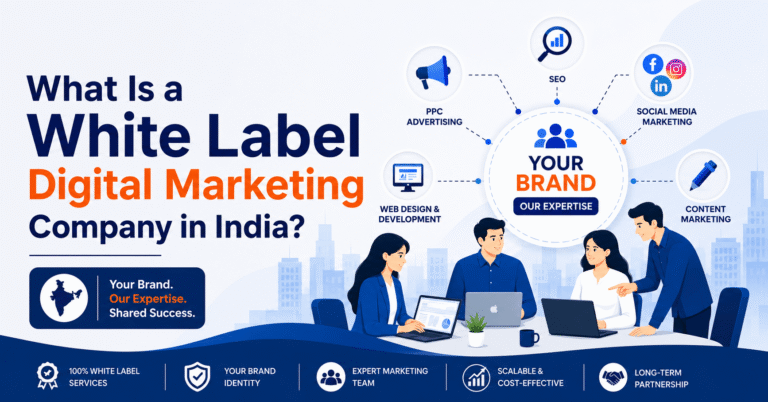
What Is a White Label Digital Marketing Company in India?
A white label digital marketing company provides marketing services that another agency can resell under its own brand.
The partner typically manages the behind-the-scenes strategy, execution, optimization, analytics, reporting, and fulfillment, while the client-facing agency manages communication, branding, pricing, and the overall customer relationship.
For example, a web design agency may win a client that needs ongoing SEO. Instead of immediately hiring SEO specialists, the agency can outsource the SEO execution to a white label partner and present the service as part of its own marketing offering.
The model can involve:
- SEO and technical optimization
- PPC and Google Ads
- Social media management
- Content creation
- Local SEO
- Lead generation
- Website development
- Ecommerce marketing
- Conversion optimization
- Analytics and reporting
The important distinction is that white label outsourcing is not simply handing work to a freelancer. A structured white label partnership should have defined workflows, quality controls, communication processes, deadlines, reporting systems, and responsibilities.
Why Are Indian Agencies Considering White Label Marketing?
Agency growth creates a capacity problem.
An agency may have strong sales and client acquisition but limited delivery resources. Adding five or ten new clients can suddenly increase the workload across SEO, content, advertising, design, development, reporting, and account management.
This creates pressure on:
- Workforce
- Productivity
- Quality
- Communication
- Deadlines
- Client retention
- Profitability
A white label model can provide additional operational capacity without requiring the agency to immediately build a larger internal department.
For an agency in Ahmedabad, Mumbai, Bengaluru, Delhi, Surat, Pune, or another Indian market, this can be especially useful when clients expect a broad range of digital marketing services but the agency specializes in only a few areas.
What Services Can You Outsource to a White Label Digital Marketing Company?
A strong white label provider should be able to support different stages of the marketing funnel rather than offering only one isolated service.
1. White Label SEO Services
Discover how scalable white label marketing solutions help agencies outsource SEO, improve service delivery, expand capacity, and support sustainable client growth.
SEO outsourcing can cover:
- Keyword research
- Search intent analysis
- Technical SEO
- On-page optimization
- Content planning
- Internal linking
- Local SEO
- Ecommerce SEO
- Competitor analysis
- Performance reporting
The objective should not be simply to increase rankings. The strategy should connect search visibility with qualified traffic, enquiries, conversions, and business growth.
2. White Label PPC Services
Paid advertising requires continuous campaign management rather than simply creating advertisements.
A white label PPC team may handle:
- Google Ads campaign structure
- Keyword research
- Audience targeting
- Ad copy
- Bid management
- Landing page recommendations
- Conversion tracking
- Remarketing
- Campaign optimization
- Performance reporting
Flying Lion Media’s PPC approach, for example, combines campaign strategy, keyword research, landing page optimization, conversion tracking, reporting, and continuous optimization rather than treating advertising as a one-time setup.
3. White Label Social Media Marketing
Social media outsourcing can include:
- Content calendars
- Creative planning
- Caption writing
- Audience research
- Campaign management
- Engagement monitoring
- Paid social advertising
- Performance reporting
The right strategy depends on the audience, business model, platform, offer, and customer journey.
4. White Label Content Marketing
Content is useful when it supports a clear marketing objective.
A white label content team can help with:
- Blog articles
- Service-page content
- Landing pages
- SEO content
- Website copy
- Social content
- Content calendars
- Topic research
Good content should connect content, search intent, visibility, engagement, and conversions rather than producing articles simply to increase publishing volume.
5. White Label Web Design and Development
Agencies can also outsource:
- Business websites
- Ecommerce websites
- Landing pages
- WordPress development
- Shopify development
- Custom development
- Website maintenance
- Conversion-focused improvements
This is particularly useful for branding agencies, SEO agencies, and marketing consultants that frequently receive website requirements but do not maintain a large development workforce internally.
Read More:- White Label Digital Marketing Pricing Guide
How Does White Label Digital Marketing Fulfillment Work?
A professional fulfillment process should be structured.
A typical workflow looks like this:
Step 1: Client Discovery
The agency gathers information about the client’s:
- Business model
- Target audience
- Location
- Products or services
- Competitors
- Marketing objectives
- Existing campaigns
- Website
- Budget
- Expected results
Step 2: Strategy Development
The white label team analyzes the business and creates a suitable strategy.
For SEO, this could involve technical audits, competitor analysis, search intent, keyword research, and content planning.
For PPC, it may involve campaign architecture, audience targeting, landing pages, budget allocation, and conversion tracking.
Step 3: Campaign Execution
The team completes the agreed deliverables.
This may include content, campaigns, technical work, advertising setup, website changes, or optimization tasks.
Step 4: Quality Control
Before delivery, the work should be reviewed for:
- Accuracy
- Brand alignment
- Technical quality
- Compliance
- Completeness
- Client requirements
Step 5: Reporting
The agency receives reports that can be presented to its client.
Reporting should focus on meaningful performance, not simply large numbers of impressions, clicks, or tasks completed.
Step 6: Optimization
Digital marketing requires ongoing optimization.
Campaign data, customer behaviour, traffic, conversions, lead quality, and competitor activity should influence future decisions.
What Makes a Good White Label Marketing Partner?
Choosing a partner based only on price can create problems later.
A reliable provider should demonstrate strength in several areas.
Expertise
Look for specialists with experience across SEO, PPC, content, social media, analytics, development, or whichever services your agency plans to outsource.
Communication
Poor communication can damage a client relationship even when the actual marketing work is good.
Define:
- Who handles communication
- How often updates are provided
- Where tasks are managed
- How urgent issues are escalated
- What information is included in reports
Quality
The partner’s quality standards directly affect your agency’s reputation.
Ask how work is reviewed before delivery.
Scalability
Your requirements may change from five projects to twenty or from ten clients to fifty.
The partner should have the resources and workflow to accommodate increasing volume.
Confidentiality
White label relationships require strong confidentiality because the end client belongs to the agency.
Flying Lion Media describes its white label offering as confidential and NDA-protected, with client relationships remaining under the agency’s control.
Reporting
A useful report should explain what happened, why it happened, and what should happen next.
The Most Important Factors That Affect White Label Marketing Results
White label outsourcing does not automatically create better marketing performance.
The outcome depends on several connected factors.
Business Strategy
A campaign without a clear business objective can generate activity without producing meaningful business value.
Target Audience
A campaign aimed at the wrong audience may produce traffic or leads but poor-quality enquiries.
Offer
Even excellent advertising can struggle if the offer is unclear, uncompetitive, or poorly presented.
Website Conversion
Traffic is only an opportunity.
If visitors cannot quickly understand the offer, trust the business, or contact the company, conversion performance can remain weak.
Budget
A marketing budget must reflect the industry, competition, location, audience size, customer value, and business objectives.
Follow-Up
A lead is not automatically a customer.
Response time, sales communication, qualification, CRM processes, and follow-up all affect the final conversion.
Measurement
Without reliable analytics and tracking, agencies may make decisions based on assumptions.
Google Analytics supports key-event and conversion measurement so businesses can connect important user actions with marketing performance and Google Ads optimization.
Why Lead Quality Matters More Than Lead Volume
Consider a real-world scenario.
A real estate agency starts a campaign and receives 200 enquiries. At first, the campaign looks successful.
But after speaking with the sales team, the agency discovers that most enquiries are:
- Outside the target location
- Looking for a much lower price range
- Not ready to purchase
- Duplicate enquiries
- Not genuine prospects
Now compare that with a campaign producing 50 enquiries where a much larger proportion match the property type, location, budget, and buying intent.
The second campaign may be more valuable even though it generates fewer leads.
This is why performance, leads, conversions, audience quality, and revenue need to be considered together.
How White Label Marketing Can Support Different Indian Industries
Different businesses require different strategies.
Healthcare
Clinics and healthcare businesses may prioritize local visibility, appointment enquiries, reputation, and location-specific searches.
Real Estate
Real estate marketing often requires location targeting, audience segmentation, lead qualification, remarketing, and strong follow-up.
Manufacturing
Manufacturers frequently need high-intent B2B traffic rather than large volumes of general visitors. Search terms related to specific products, applications, specifications, and procurement requirements may be more valuable.
Education
Education businesses often deal with admission cycles and seasonal demand. Campaign planning should account for course categories, locations, admission periods, and student intent.
Ecommerce
Ecommerce businesses need to look beyond traffic. Product visibility, conversion rate, advertising costs, repeat purchases, average order value, and customer lifetime value can all influence profitability.
Local Businesses
Restaurants, salons, repair companies, clinics, gyms, and home-service businesses often depend heavily on location and mobile search behaviour.
Here, local SEO, Google Business Profile optimization, calls, WhatsApp enquiries, reviews, and location-based advertising can play important roles.
Example: A Local Business With Traffic but Few Enquiries
Imagine an Ahmedabad-based home improvement company receives substantial website traffic, but very few visitors call or submit an enquiry.
An inexperienced approach might simply increase SEO or advertising activity.
An experienced marketing team would investigate:
- Which pages receive traffic?
- What search queries bring visitors?
- Are visitors from the service area?
- Is the service clearly explained?
- Is the phone number easy to find?
- Is WhatsApp available where appropriate?
- Does the page build trust?
- Is the enquiry form too complicated?
- Are calls and forms being tracked?
- Are visitors reaching commercial-intent pages?
The problem may not be traffic.
It could be visibility without conversion.
That distinction is one of the reasons experienced marketing strategy matters.
Example: A Manufacturer Targeting the Wrong Searches
Consider a hypothetical Indian manufacturer selling specialized industrial equipment.
The company focuses its SEO strategy on broad terms that receive considerable search activity.
However, procurement managers may use much more specific searches when they are actually looking for suppliers.
The better approach may involve mapping:
Product → Application → Industry → Location → Buyer Intent → Enquiry
The objective is not simply higher rankings. It is connecting relevant searches with commercial opportunities.
Common Mistakes When Choosing a White Label Digital Marketing Company
Consider a hypothetical Indian manufacturer selling specialized industrial equipment.
The company focuses its SEO strategy on broad terms that receive considerable search activity.
However, procurement managers may use much more specific searches when they are actually looking for suppliers.
The better approach may involve mapping:
Product → Application → Industry → Location → Buyer Intent → Enquiry
The objective is not simply higher rankings. It is connecting relevant searches with commercial opportunities.
Mistake 1: Choosing Only on Price
A low monthly fee does not necessarily mean lower total cost.
Poor-quality work can create:
- Rework
- Client complaints
- Missed deadlines
- Lost clients
- Reputation damage
Mistake 2: Outsourcing Without a Clear Brief
A vague brief creates vague deliverables.
Every project should define objectives, target audience, services, location, platforms, deadlines, approval requirements, and success measurements.
Mistake 3: Ignoring Client Communication
The agency remains responsible for the client relationship.
The white label partner should support communication rather than making the agency dependent on last-minute updates.
Mistake 4: Measuring Only Traffic
More traffic is not automatically more revenue.
Look at qualified leads, conversions, customer acquisition costs, revenue, retention, and other business-specific metrics.
Mistake 5: Expecting Immediate SEO Results
SEO is influenced by competition, website authority, technical conditions, content quality, search demand, and many other factors.
A professional partner should explain realistic timelines rather than promising instant rankings.
Myths vs Facts About White Label Digital Marketing
Myth | Fact |
White label means low-quality outsourcing. | Quality depends on the provider’s expertise, process, resources, and quality control. |
More leads always mean better performance. | Lead quality and business relevance matter more than volume alone. |
The cheapest partner is the most profitable. | Rework, delays, and client dissatisfaction can make cheap services expensive. |
White label eliminates the need for strategy. | Strategy remains essential because execution must support business objectives. |
SEO should produce immediate rankings. | SEO performance usually develops through ongoing technical, content, authority, and optimization work. |
Outsourcing means losing control. | With clear workflows, reporting, communication, and agreements, agencies can retain client ownership and strategic control. |
Practical Checklist Before Choosing a White Label Partner
Use this checklist before signing a partnership:
- Does the provider understand your business model?
- Can they support your required services?
- Is the workflow clearly documented?
- Are responsibilities clearly defined?
- Is client confidentiality protected?
- Are reports available under your branding?
- Is there a quality-control process?
- Can the provider handle increasing workload?
- Are deadlines realistic?
- Is communication consistent?
- Can campaign performance be measured?
- Are conversion tracking requirements understood?
- Can they work with your existing tools and platforms?
- Is pricing transparent?
- Are expectations realistic?
How to Measure Whether Your White Label Partnership Is Working
Do not evaluate the relationship only by the number of tasks completed.
Look at four levels of performance.
Operational Performance
Measure:
- Delivery time
- Task completion
- Revision frequency
- Quality issues
- Communication
Marketing Performance
Depending on the service, monitor:
- Organic visibility
- Qualified traffic
- Click-through rate
- Conversion rate
- Cost per acquisition
- Lead volume
- Lead quality
- Engagement
Business Performance
Connect marketing activity with:
- Sales opportunities
- Revenue
- Customer acquisition
- Customer retention
- Profitability
Partnership Performance
Ask:
- Are clients satisfied?
- Are deadlines being met?
- Is communication improving?
- Can your agency take on more work?
- Are your margins sustainable?
- Are you able to focus more on sales and relationships?
Analytics increasingly supports cross-channel views that help businesses understand how paid and organic activities contribute to important outcomes.
When Should an Agency Consider White Label Digital Marketing?
White label outsourcing may make sense when:
- Your agency is winning clients faster than your team can fulfill work.
- Clients are requesting services outside your core expertise.
- Hiring specialists would create significant fixed costs.
- Your internal team is overloaded.
- You want to expand your service portfolio.
- You need additional technical expertise.
- You want to increase capacity without immediately expanding headcount.
- You need structured support for recurring campaigns.
It may not be the right solution if your agency has highly specialized requirements that demand complete internal control or if you have not yet established a clear service model.
The decision should be based on capacity, expertise, economics, quality, and client expectations.
Conclusion:
A White Label Digital Marketing Company in India can be more than an outsourcing vendor. For the right agency, it can become an extension of the delivery team.
The strongest partnerships are built around expertise, communication, quality, scalability, execution, reporting, and trust.
Before choosing a provider, look beyond service lists and pricing. Ask whether the partner can consistently deliver the right work, maintain your standards, protect your client relationships, communicate clearly, and scale with your workload.
For Indian agencies dealing with increasing client demand, a carefully structured white label model can provide additional capacity while allowing the agency to stay focused on what it does best: building relationships, winning clients, developing its brand, and creating sustainable business growth.