

White Label Lead Generation Campaign Optimization : A digital marketing agency can be excellent at winning clients and still struggle to deliver consistent lead-generation results.
The problem usually appears when several clients start asking for more enquiries from Google Ads, Meta Ads, landing pages, local campaigns, or other performance channels. Suddenly, the agency has to manage audience research, campaign setup, creative testing, conversion tracking, lead qualification, reporting, follow-up data and ongoing optimisation—often across very different industries.
This is where White Label Lead Generation Campaign Optimization becomes important.
Instead of treating lead generation as a campaign that is launched once and left running, agencies can use a structured optimisation process to continuously improve targeting, messaging, landing pages, lead quality, conversion tracking and campaign economics.
For Indian agencies, this matters even more because a campaign for an Ahmedabad real estate company may behave very differently from one for a Bengaluru SaaS company, a Gujarat manufacturer, a healthcare clinic in Surat or an education institute targeting students across India.
This guide explains how agencies can approach white label lead generation campaign optimization, what to measure, which mistakes to avoid, and when outsourcing campaign fulfillment makes commercial sense.
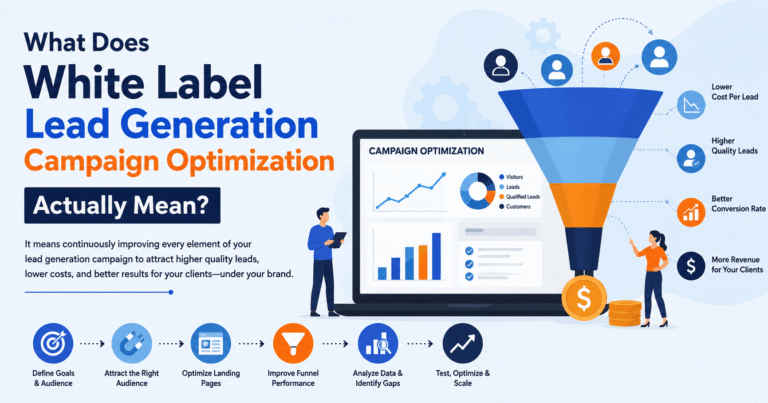
What Does White Label Lead Generation Campaign Optimization Actually Mean?
White Label Lead Generation Campaign Optimization is the process of continuously improving lead-generation campaigns delivered by a specialist partner while the agency presents the service under its own brand.
The optimisation process can involve:
- Audience and market research
- Search intent analysis
- Google Ads campaign optimisation
- Meta Ads campaign optimisation
- Landing page optimization
- Conversion tracking
- Lead qualification
- Cost per lead optimization
- Lead quality analysis
- Creative and messaging testing
- Lead nurturing and conversion
- CRM integration
- Performance reporting
- Funnel optimisation
The key difference is that optimisation does not focus only on getting more leads.
It focuses on getting more useful leads at an economically sensible cost.
For example, an agency may generate 200 enquiries for a real estate client. On paper, that looks successful. But if most enquiries are outside the service area, have unrealistic budgets, or never answer the phone, the campaign may not be performing well from a business perspective.
That is why lead quality optimization should sit alongside lead volume.
Why Indian Agencies Struggle With Lead Generation Campaigns
The difficulty is rarely just the advertising platform.
Lead generation is a connected system. A weakness at any stage can affect the final result.
Consider the following journey:
Audience → Ad → Landing Page → Enquiry → Qualification → Follow-up → Sales
If the audience is wrong, the ad attracts the wrong people.
If the ad is poorly aligned with the offer, users may click but not enquire.
If the landing page is unclear, valuable traffic can disappear.
If tracking is inaccurate, the agency cannot identify what is actually working.
If the sales team responds slowly, good leads may become cold.
An experienced lead generation campaign management process therefore looks at the entire customer journey instead of making random changes inside the advertising account.
Google’s own guidance emphasises the importance of accurate conversion measurement because conversion data helps advertisers understand which campaigns, keywords and ads are driving valuable customer actions.
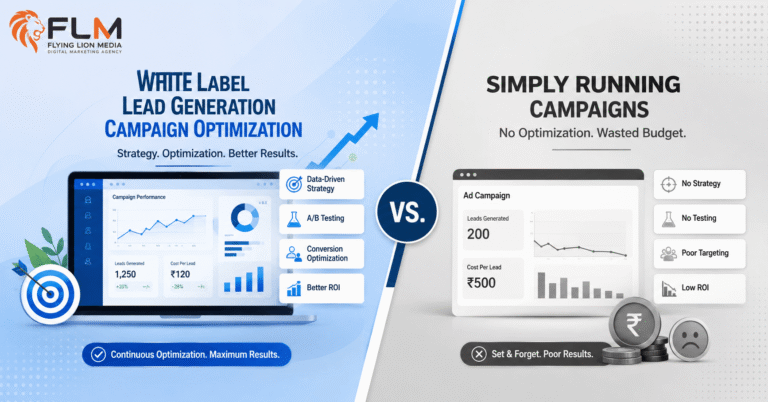
White Label Lead Generation Campaign Optimization vs. Simply Running Campaigns
There is an important difference between campaign execution and campaign optimization.
A basic campaign-management workflow might involve:
- Creating campaigns
- Adding audiences or keywords
- Writing advertisements
- Setting a budget
- Launching campaigns
- Sending monthly reports
Optimization goes further.
It asks:
- Which audience segments generate qualified enquiries?
- Which keywords attract commercial intent?
- Which ads create useful conversations?
- Which locations generate better opportunities?
- Which landing pages convert?
- What happens after a lead submits a form?
- Which campaigns generate sales-qualified leads?
- Is the cost per lead sustainable?
- Are conversion actions configured correctly?
- Which parts of the funnel are losing potential customers?
This distinction is particularly important when agencies use lead generation outsourcing for agencies.
The fulfillment partner should not simply complete a checklist. It should help the agency understand what the campaign data means and what should change next.
The Most Important Factors Affecting Lead Generation Performance
1. Audience Quality
A campaign cannot be optimized effectively if the target audience is poorly defined.
Start by documenting:
- Customer type
- Location
- Age or business profile where relevant
- Buying intent
- Industry
- Income or budget range where relevant
- Business size
- Pain points
- Decision-making role
- Purchase timeline
For B2B lead generation, the decision-maker may be completely different from the person who initially searches for the service.
For example, a manufacturer may need to reach procurement managers, plant heads, distributors or business owners rather than a broad “industrial audience.”
2. Search Intent and Campaign Intent
Not every click represents the same level of buying intent.
A user searching for:
“best CRM software for small business India”
has different intent from someone searching:
“CRM software pricing India demo.”
Similarly, a person searching:
“skin clinic near me”
may be closer to taking action than someone reading a general article about skincare.
For agencies, lead generation campaign strategy should therefore separate awareness traffic from commercial intent wherever possible.
3. Offer and Messaging
Even good targeting can fail when the offer is weak.
Compare:
Contact Us
with:
Request a Free Campaign Audit
The second option tells the visitor what they receive after taking action.
The offer must still be appropriate for the business. A healthcare provider, financial service, B2B manufacturer and SaaS company may need completely different conversion offers.
4. Landing Page Experience
A landing page should answer the visitor’s important questions quickly:
- What does the business offer?
- Is it relevant to me?
- Why should I trust the company?
- What happens next?
- How can I contact the business?
- What proof supports the claim?
Landing page optimization for lead generation should consider mobile usability, page speed, message alignment, form length, trust signals, CTA visibility and the relevance of the page to the advertisement.
5. Conversion Tracking
If an agency only measures form submissions, it may not know whether those submissions are valuable.
A stronger measurement structure can distinguish between:
Lead → Qualified Lead → Sales Opportunity → Customer
Google Ads now supports conversion goals around qualified leads and converted leads, helping advertisers connect online advertising activity with deeper stages of the sales funnel.
This is particularly useful for B2B campaigns where a submitted form is only the beginning of a long sales process.
A Step-by-Step White Label Lead Generation Optimization Process
Step 1: Understand the Client's Business
Before changing the campaign, understand:
- Main products or services
- Highest-value customers
- Target locations
- Average order value
- Sales cycle
- Main competitors
- Existing marketing channels
- Sales process
- Lead qualification criteria
For a white label partner, this information should come through a structured onboarding process.
Without business context, campaign optimisation becomes guesswork.
Step 2: Audit Existing Campaign Data
Review:
- Impressions
- Clicks
- CTR
- CPC
- Leads
- Cost per lead
- Conversion rate
- Location performance
- Device performance
- Audience performance
- Search terms
- Ad performance
- Landing page performance
Do not automatically treat the lowest CPL as the best campaign.
A campaign producing leads at ₹300 may be less valuable than one producing qualified leads at ₹800.
Step 3: Analyse Lead Quality
This is where many lead generation campaigns fall short.
Ask the sales team:
- How many leads were contacted?
- How many were relevant?
- How many were qualified?
- How many requested pricing?
- How many booked a meeting?
- How many became opportunities?
- Why were leads rejected?
Create a simple lead-quality classification:
A — High-quality opportunity
Matches the target customer and has genuine buying intent.
B — Potential opportunity
Relevant but needs further qualification.
C — Poor-fit lead
Outside location, budget, service or target audience.
D — Invalid/spam
Fake, duplicate or irrelevant enquiry.
This information should influence future campaign decisions.
Step 4: Optimize Campaign Targeting
Depending on the platform, optimisation may include:
- Refining keywords
- Adding negative keywords
- Adjusting geographic targeting
- Reviewing audience segments
- Removing weak placements
- Improving demographic targeting where appropriate
- Separating high-intent campaigns
- Testing new audience groups
Google specifically recommends using more specific keywords and negative keywords when businesses have traffic but insufficient conversions.
Step 5: Improve Ads and Creative
For Google Ads, review:
- Headlines
- Descriptions
- Keyword-to-ad relevance
- Offers
- Calls to action
- Extensions/assets
For Meta campaigns, examine:
- Creative formats
- Hooks
- Visual messaging
- Audience response
- Lead form friction
- Offer positioning
The goal is not to make every advertisement sound clever.
The goal is to make the right audience understand the value of the offer quickly.
Step 6: Optimize the Landing Page
Test one meaningful variable at a time where practical.
Potential improvements include:
- Stronger headline
- Clearer CTA
- Shorter form
- Better trust signals
- Relevant case evidence
- Better mobile layout
- More specific service information
- Location relevance
- FAQ section
- Stronger offer
For example, an Ahmedabad-based B2B service provider may benefit from a page specifically explaining its service area, industries served, process and enquiry expectations rather than sending every visitor to a generic homepage.
Step 7: Connect Campaign Data With the CRM
A lead should not disappear after a form submission.
The CRM or lead-management system should ideally record:
- Source
- Campaign
- Date
- Lead status
- Qualification
- Sales stage
- Follow-up status
- Revenue or opportunity value where appropriate
This makes lead generation ROI optimization much more realistic.
Step 8: Feed Quality Data Back Into the Campaign
If certain campaigns consistently produce poor-fit leads, the agency should investigate why.
If another campaign produces fewer leads but better opportunities, it deserves attention.
Google’s current lead-generation guidance recommends using deeper funnel signals such as qualified or converted leads where appropriate, rather than relying only on shallow conversion events.
How Agencies Should Measure Campaign Optimization
A practical dashboard should include more than impressions and clicks.
Top-of-Funnel Metrics
- Impressions
- Reach
- CTR
- CPC
- Search visibility
Lead Metrics
- Leads
- Conversion rate
- Cost per lead
- Lead source
- Lead volume by location
Quality Metrics
- Qualified leads
- Qualification rate
- Sales opportunities
- Appointment rate
- Lead-to-opportunity rate
Business Metrics
- Customer acquisition cost
- Revenue from campaigns
- Opportunity value
- Customer lifetime value where measurable
- Return on advertising spend where applicable
The exact metrics should depend on the client’s business model.
A local dentist does not need the same dashboard as a SaaS company with a six-month sales cycle.
Two Practical Business Scenarios
Scenario 1: Local Service Business With Plenty of Traffic but Few Enquiries
Imagine a hypothetical home renovation company targeting Ahmedabad.
The website receives visitors from Google Ads, but enquiries remain low.
An inexperienced approach might simply increase the advertising budget.
An optimization review would first examine:
- Search terms
- Mobile experience
- Service-page relevance
- Location targeting
- CTA placement
- Form usability
- Phone-call tracking
- WhatsApp enquiry tracking
- Competitor offers
The issue may not be insufficient traffic. The campaign may be attracting users who are researching general renovation ideas rather than actively looking for a contractor.
Lesson: Before increasing spend, determine whether the existing traffic has the right intent.
Scenario 2: Real Estate Campaign With Too Many Poor-Quality Leads
Imagine a hypothetical property developer running Meta lead campaigns across a major Indian city.
The campaign generates a high number of enquiries, but sales representatives report that many prospects are not financially qualified or are interested in a different location.
The optimization process could involve:
- More specific audience targeting
- Better qualification questions
- Clearer property pricing or budget positioning
- Location-specific creatives
- Separate campaigns for different projects
- CRM-based lead-quality tracking
- Retargeting engaged prospects
The objective is not necessarily to maximize the number of forms.
It is to improve the proportion of enquiries that the sales team can realistically work with.
How White Label Lead Generation Differs Across Indian Industries
Real Estate
Focus heavily on:
- Location
- Property type
- Budget
- Buyer intent
- Project-specific messaging
- Lead qualification
- Follow-up speed
Healthcare
Campaigns need careful attention to:
- Location
- Treatment/service intent
- Trust
- Appointment actions
- Phone calls
- Mobile experience
- Appropriate messaging
B2B Manufacturing
B2B lead generation services need a different approach.
Focus on:
- Product specifications
- Industrial applications
- Buyer roles
- Geographic markets
- Commercial keywords
- RFQ/demo enquiries
- Long sales cycles
A manufacturer may receive fewer leads than a consumer business but still generate valuable opportunities.
Education
Consider:
- Admission cycles
- Course-specific intent
- Location
- Parent/student audiences
- Seasonal demand
- Enquiry follow-up
- Counselling bookings
Ecommerce
The focus generally shifts toward:
- Product discovery
- Conversion rate
- Product-page experience
- Cart behaviour
- Customer acquisition cost
- Repeat purchases
- Revenue
SaaS
Track:
- Demo requests
- Trial registrations
- Qualified accounts
- Sales opportunities
- Activation
- Customer acquisition cost
Common White Label Lead Generation Mistakes
Myth 1: More Leads Always Mean Better Performance
Fact: Lead volume without lead quality can create additional work for sales teams without improving business outcomes.
Myth 2: The Lowest CPL Is Always the Winner
Fact: A low CPL can be misleading if the leads are poorly qualified.
Myth 3: Increasing the Budget Fixes Poor Performance
Fact: More budget can amplify an existing problem. Targeting, offer, tracking and conversion experience should be reviewed first.
Myth 4: One Campaign Structure Works for Every Client
Fact: A local clinic, real estate developer, SaaS company and manufacturer have different buying journeys and should not automatically use the same structure.
Myth 5: Campaign Optimization Means Changing Something Every Day
Fact: Constant changes can make it difficult to understand which adjustments actually influenced performance. Changes should be based on meaningful evidence and the campaign’s learning requirements.
When Should an Agency Consider White Label Lead Generation Services?
White label lead generation services can make sense when an agency:
- Regularly receives lead-generation requests
- Has more clients than its internal team can comfortably manage
- Wants to add performance marketing without hiring specialists immediately
- Needs campaign management expertise
- Wants standardized reporting
- Needs support with landing pages and conversion tracking
- Has strong sales capabilities but limited fulfillment capacity
- Wants to expand its service portfolio
A white label partnership should not be selected only because it appears inexpensive.
The more important questions are:
Can the partner understand different industries?
Can it maintain campaign quality as client volume increases?
Does it provide transparent reporting?
Can it work with the agency’s workflow?
Can it distinguish lead volume from lead quality?
Does it communicate problems instead of hiding them?
Flying Lion Media’s broader white label approach focuses on helping agencies add services without having to build every specialist capability internally. Its white label digital marketing offering includes campaign strategy, execution, optimization, reporting and fulfillment support.
Why Optimization Should Be Part of the White Label Delivery Model
A white label provider should not disappear after campaign launch.
A practical delivery workflow should look something like:
Client onboarding → Business research → Campaign strategy → Tracking setup → Launch → Data collection → Lead-quality review → Optimization → Reporting → Next-month strategy
This creates a feedback loop.
The agency can see what is working, what is not, and what needs to change.
This is also why reporting should explain business outcomes rather than simply list advertising metrics. Flying Lion Media’s own white label reporting approach emphasises connecting marketing activity with meaningful client objectives and recommendations.
For agencies considering broader fulfillment support, a structured white label model can provide operational capacity while the agency retains control of its client relationships and brand.
How to Choose a White Label Lead Generation Partner
Before signing an agreement, ask potential partners:
Do they understand lead quality?
A provider that reports only leads and CPL may not understand the full sales funnel.
Do they have a repeatable onboarding process?
Good onboarding reduces assumptions.
Can they work across industries?
Your clients may not all have the same audience, sales cycle or conversion process.
How do they handle tracking?
Ask how website forms, calls, WhatsApp enquiries, CRM stages and advertising conversions are measured.
What does their reporting include?
Look for insights and recommendations rather than screenshots and vanity metrics.
How do they communicate problems?
A good partner should tell you when the offer, landing page, audience, budget or sales process is limiting performance.
Can they scale with your agency?
The partner should be able to handle changing client volumes without sacrificing quality.
Conclusion
White Label Lead Generation Campaign Optimization is not simply about reducing CPL or increasing the number of forms.
For agencies, the real objective is to create a repeatable system that connects:
Audience → Campaign → Landing Page → Lead → Qualification → Sales → Business Outcome
The strongest lead generation performance optimization processes combine campaign data with real sales feedback.
That means reviewing search intent, audience quality, landing pages, conversion tracking, lead quality, CRM data and customer acquisition economics together.
For Indian agencies, this approach is particularly valuable because clients can range from local businesses in Ahmedabad and Surat to national ecommerce companies, healthcare providers, manufacturers, education institutes, SaaS businesses and real estate companies. Each requires a different combination of targeting, messaging, budget and conversion strategy.
If your agency is selling lead generation but campaign fulfillment is becoming difficult to manage internally, the next step is not automatically to hire more people or spend more money.
First, review your delivery process.
Identify where campaigns are losing quality, where tracking is weak, where leads are being wasted and where optimization is taking too much internal time.
Then decide whether specialist lead generation outsourcing for agencies can give your team the capacity and expertise it needs while allowing you to remain focused on client relationships and growth.
Flying Lion Media can help agencies evaluate their lead-generation requirements and build a practical fulfillment approach based on their clients, markets, services and goals. The right strategy depends on the business—not on a one-size-fits-all campaign template.

One Response