

A successful lead generation campaign is not simply about generating a large number of leads. For agencies offering services to clients, the real challenge is building a repeatable white label lead generation funnel that attracts the right audience, captures their information, qualifies prospects, nurtures interest, and delivers sales-ready opportunities.
This becomes especially important when an agency manages multiple clients. Each client may have different target audiences, offers, budgets, industries, locations, and sales processes. Without a structured funnel, campaigns can generate plenty of inquiries but still produce poor-quality leads.
A well-designed White Label Lead Generation Funnel Strategy creates a system behind the campaigns so agencies can scale fulfillment while maintaining consistency and lead quality.
Google recommends creating helpful, reliable, people-first content rather than content designed primarily to manipulate search rankings. That same principle applies to lead generation: the funnel should be designed around the prospect’s needs and buying journey, not simply around generating form submissions.
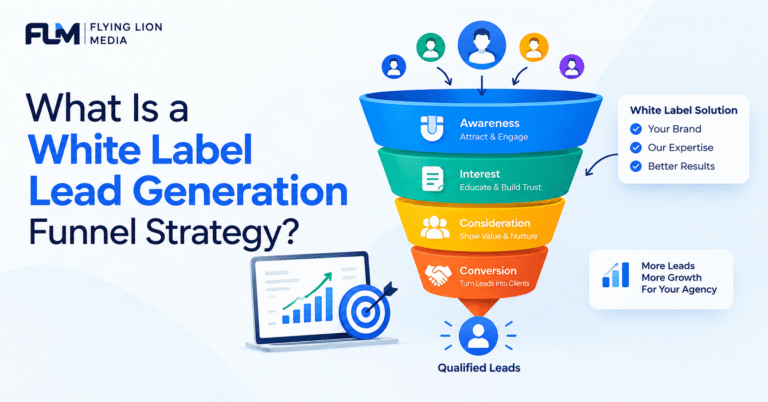
What Is a White Label Lead Generation Funnel Strategy?
A White Label Lead Generation Funnel Strategy is a structured process used by agencies and white label marketing partners to attract potential customers, capture their information, qualify them, nurture them, and move suitable prospects toward a sales conversation—while allowing the agency to deliver the service under its own brand.
A typical funnel looks like this:
Traffic → Landing Page → Lead Capture → Qualification → Lead Nurturing → Sales Handoff → Conversion
The important distinction is that white label fulfillment happens behind the scenes.
For example, a digital marketing agency may sell lead generation services to a real estate company under its own brand. A white label partner can manage campaign setup, landing pages, tracking, lead qualification workflows, reporting, and optimization while the agency maintains the client relationship.
The result is a scalable fulfillment model without requiring the agency to build a large internal lead generation team.
Why Agencies Need a Structured Lead Generation Funnel
Many agencies focus heavily on traffic generation.
They launch:
- Google Ads campaigns
- Meta Ads campaigns
- SEO campaigns
- LinkedIn campaigns
- Landing pages
- Lead forms
- Retargeting campaigns
But traffic alone does not create predictable revenue.
A visitor needs a reason to take the next step. That action needs to be captured, evaluated, followed up, and measured.
A funnel provides that structure.
HubSpot describes lead generation funnels as a process that attracts, qualifies, and nurtures prospects, with different activities appropriate for the top, middle, and bottom of the funnel.
For agencies, this means campaign performance should not be evaluated only by impressions, clicks, or raw lead volume.
Instead, the agency should understand:
Where did the lead come from?
Did the lead match the target customer profile?
Did the prospect engage with the offer?
Was the lead qualified?
Did sales follow up?
Did the opportunity become revenue?
That is where a strategic funnel becomes valuable.
The 7 Stages of a White Label Lead Generation Funnel
A practical white label funnel can be divided into seven stages.
1. Audience Research
2. Traffic Acquisition
3. Landing Page Conversion
4. Lead Capture
5. Lead Qualification
6. Lead Nurturing
7. Sales Handoff and Optimization
Each stage has a specific purpose.
1. Start With the Ideal Customer Profile
Before creating campaigns, define the client’s Ideal Customer Profile (ICP).
This is one of the most important parts of a white label lead generation strategy because poor targeting at the beginning creates problems throughout the funnel.
An ICP can include:
- Industry
- Business size
- Location
- Job role
- Income or purchasing capacity
- Business problem
- Buying intent
- Budget
- Service requirements
- Decision-making authority
For an Indian client, location can be particularly important.
A business targeting customers in Ahmedabad may require a very different campaign structure from a company targeting customers across Mumbai, Delhi NCR, Bengaluru, or India-wide.
Similarly, a B2B SaaS company may target decision-makers such as founders, marketing heads, or operations managers, while a local healthcare business may focus on patients within a specific service area.
Example
Instead of targeting:
“People interested in digital marketing”
a more useful audience definition could be:
“Indian small and mid-sized businesses looking for outsourced lead generation services and already investing in online advertising.”
The second audience provides much stronger direction for campaign messaging and qualification.
2. Generate Targeted Traffic
Once the audience is defined, the next stage is traffic acquisition.
Depending on the client’s industry and buying journey, agencies can use:
- Google Search Ads
- Meta Ads
- LinkedIn Ads
- SEO
- Content marketing
- Local SEO
- Remarketing
- Email marketing
- Industry partnerships
- Organic social media
The key is intent matching.
Someone searching for:
“best lead generation agency for real estate”
has a different level of intent from someone searching:
“what is lead generation?”
The first person may be closer to contacting an agency, while the second person is still researching.
Your funnel should therefore provide different experiences for different levels of intent.
3. Build a Conversion-Focused Landing Page
Sending every campaign visitor to a generic homepage can create unnecessary friction.
A dedicated landing page should generally align with:
Keyword → Ad → Offer → Landing Page → CTA
For example:
Google Search: White Label Lead Generation Services
↓
Ad: White Label Lead Generation for Agencies
↓
Landing Page: White Label Lead Generation Services
↓
CTA: Request a Strategy Consultation
This creates message consistency.
A strong landing page should clearly communicate:
The Problem
What challenge is the target customer facing?
The Solution
How does the service address that problem?
The Benefits
What practical business outcomes can the customer expect?
The Proof
Can you demonstrate experience through case studies, testimonials, examples, processes, or relevant expertise?
The CTA
What should the visitor do next?
Avoid making the visitor search for the next step.
4. Create the Right Lead Capture Mechanism
Not every prospect is ready to book a sales call immediately.
That is why agencies should create different conversion opportunities.
Depending on the client, these might include:
- Free consultation
- Strategy session
- Website audit
- SEO audit
- Lead generation audit
- Downloadable guide
- Pricing consultation
- Product demo
- Free assessment
- Quote request
- Callback request
For higher-intent prospects, a direct consultation may work best.
For visitors earlier in their buying journey, a useful resource can create the first conversion.
The objective is not simply to collect contact information.
The objective is to exchange genuine value for meaningful information.
5. Qualify Leads Before Sending Them to Sales
This is one of the most important components of a white label lead generation funnel.
A campaign can produce 500 leads and still perform poorly if only a small percentage are relevant.
Lead qualification can include:
- Location
- Industry
- Company size
- Service required
- Budget range
- Buying timeline
- Business requirement
- Decision-making role
- Previous marketing activity
For example, a lead form could ask:
What service are you interested in?
- SEO
- Google Ads
- Meta Ads
- Lead Generation
- Website Development
Another question could be:
What is your approximate monthly marketing budget?
This information helps separate casual inquiries from potentially valuable prospects.
MQL and SQL definitions should also be agreed upon between marketing and sales. A Marketing Qualified Lead generally represents a prospect considered suitable for further marketing or sales attention, while a Sales Qualified Lead is considered ready for direct sales engagement.
6. Build a Lead Nurturing Workflow
Not every lead will convert immediately.
Some prospects need:
- More information
- Case studies
- Pricing clarification
- Product education
- Testimonials
- Follow-up calls
- Additional proof
- Time to make a decision
This is where lead nurturing becomes important.
A basic nurturing sequence could look like:
Day 1: Thank-you email + requested resource
Day 3: Educational content related to the prospect’s problem
Day 5: Case study or success example
Day 8: Explanation of the service/process
Day 12: Common objections and answers
Day 15: Consultation CTA
The exact timing should depend on the industry and sales cycle.
For high-ticket B2B services, prospects may require significantly more nurturing than customers purchasing a lower-cost service.
7. Create a Clear Sales Handoff
The funnel should not stop when a lead enters the CRM.
There needs to be a clear process for transferring qualified opportunities to the sales team.
For example:
New Lead → Contacted → Qualified → MQL → SQL → Opportunity → Customer
CRM lifecycle stages can help teams consistently track how contacts progress through the funnel.
A white label provider should also clearly define:
- Lead delivery method
- Lead qualification criteria
- Lead routing
- Follow-up responsibility
- Response time expectations
- Duplicate lead handling
- Invalid lead handling
- Reporting process
- Optimization process
This prevents confusion between the agency, fulfillment partner, and client.
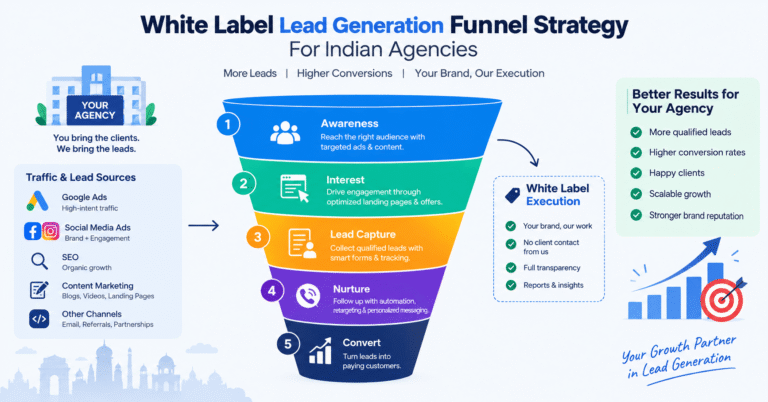
White Label Lead Generation Funnel Strategy for Indian Agencies
Indian agencies often serve a wide range of businesses, from startups and local businesses to established companies and multinational organizations.
Therefore, funnel strategy should be adapted according to:
Location
Campaigns may target:
- Ahmedabad
- Mumbai
- Delhi NCR
- Bengaluru
- Hyderabad
- Pune
- Chennai
- Surat
- Jaipur
- Kolkata
- Pan-India audiences
Language
Depending on the target audience, campaigns may use:
- English
- Hindi
- Regional-language messaging
- English + regional-language combinations
Price Sensitivity
Indian buyers can have very different expectations depending on industry, location, company size, and service category.
Instead of using one generic offer, agencies should test offers against specific audience segments.
Trust
Trust can significantly influence conversion, particularly for service businesses.
Useful trust elements include:
- Client testimonials
- Case studies
- Industry experience
- Team information
- Transparent process
- Clear deliverables
- Relevant certifications
- Reviews
- Portfolio examples
How White Label Partners Improve Funnel Scalability
Building a funnel for one client is manageable. But when an agency is handling 10, 20, or even 50 clients, building and maintaining individual funnels can quickly become difficult without standardized systems. This is where lead generation strategies for agencies become especially important, particularly when combined with a scalable white label fulfillment model.
A white label partner can create repeatable processes for:
Campaign setup
Audience research
Landing page development
Lead form creation
CRM integration
Lead qualification
Email automation
Retargeting
Tracking
Reporting
Campaign optimization
The agency can then focus more heavily on:
Client acquisition
Strategy
Account management
Sales
Business development
This creates a clear division between client-facing strategy and behind-the-scenes fulfillment, allowing the agency to scale its services without adding the same level of operational workload for every new client.
White Label Lead Generation Funnel Metrics to Track
A good funnel needs measurable KPIs.
Do not measure only lead volume.
Track metrics such as:
Funnel Metric | What It Tells You |
Impressions | Visibility |
CTR | Ad/message relevance |
Landing Page Conversion Rate | Page effectiveness |
Cost Per Lead | Acquisition efficiency |
Lead Quality Rate | Quality of generated leads |
MQL Rate | Percentage becoming marketing qualified |
SQL Rate | Percentage becoming sales qualified |
Appointment Rate | Sales intent |
Show-Up Rate | Appointment quality |
Opportunity Rate | Pipeline potential |
Customer Conversion Rate | Revenue effectiveness |
Cost Per Acquisition | Overall acquisition efficiency |
This gives agencies a much clearer view of campaign performance.
For example, if CPL is decreasing while lead quality is also declining, simply celebrating the lower CPL could be misleading.
The better question is:
Are we generating more valuable opportunities at an acceptable acquisition cost?
Common White Label Lead Generation Funnel Mistakes
1. Focusing Only on Lead Volume
More leads do not automatically mean better campaign performance.
A smaller number of highly relevant prospects may be more valuable than hundreds of unqualified inquiries.
2. Using the Same Funnel for Every Client
A real estate company, SaaS company, manufacturer, education provider, and healthcare business should not necessarily use the same funnel.
Each industry has different:
- Buyer journeys
- Objections
- Decision-makers
- Sales cycles
- Offers
- Conversion triggers
3. Sending Paid Traffic to the Homepage
A campaign-specific landing page can provide a more relevant experience than sending every visitor to a generic homepage.
4. Ignoring Lead Qualification
If sales teams constantly receive irrelevant inquiries, they can lose confidence in the marketing campaign.
Qualification should therefore be part of the funnel—not something added after lead generation.
5. Poor Follow-Up
Even a strong campaign can underperform if leads are contacted too slowly or inconsistently.
Marketing and sales should agree on ownership and follow-up processes before launching campaigns.
6. Reporting Vanity Metrics
Impressions and clicks are useful, but they do not tell the complete business story.
Agencies should connect campaign activity with:
Leads → Qualified Leads → Opportunities → Customers
How to Optimize a White Label Lead Generation Funnel
Funnel optimization should be continuous.
Start by identifying the weakest stage.
For example:
High Traffic + Low Conversion
Investigate the landing page, offer, messaging, CTA, and audience alignment.
High Lead Volume + Low Lead Quality
Review targeting, keywords, audience exclusions, ad messaging, and form qualification.
Good Leads + Low Sales Conversion
Investigate sales follow-up, pricing, offer positioning, sales qualification, and customer objections.
Good Conversion + High Acquisition Cost
Test:
- New audiences
- Search terms
- Ad creatives
- Landing pages
- Offers
- Bidding strategies
- Retargeting
- Geographic targeting
This approach is more useful than changing everything simultaneously.
Example of a White Label Lead Generation Funnel
Consider an agency serving a B2B manufacturing client.
Stage 1 — Awareness
Google Search Ads and SEO attract users searching for relevant manufacturing solutions.
Stage 2 — Consideration
Visitors reach a service-specific landing page explaining capabilities, industries served, and differentiators.
Stage 3 — Lead Capture
The visitor requests a consultation or quotation.
Stage 4 — Qualification
The form collects information about:
- Company
- Requirement
- Location
- Project type
- Expected quantity
- Timeline
Stage 5 — Nurturing
Qualified prospects receive relevant case studies, product information, and follow-up communication.
Stage 6 — Sales
Sales contacts the prospect and conducts discovery.
Stage 7 — Opportunity
Qualified prospects move into the CRM sales pipeline.
Stage 8 — Optimization
The agency analyzes which keywords, campaigns, landing pages, and audience segments generate the best opportunities.
This creates a complete system rather than a disconnected advertising campaign.
Conclusion
A successful White Label Lead Generation Funnel Strategy is built around one central idea: generate the right opportunities, not simply more leads.
For agencies, the strongest funnel combines accurate audience targeting, relevant landing pages, compelling offers, lead qualification, nurturing, CRM processes, sales handoffs, and continuous optimization.
This approach is particularly useful when an agency needs to manage lead generation for multiple clients without building every fulfillment capability internally.
The goal should be a repeatable system where every stage is measurable and improvable:
Attract → Capture → Qualify → Nurture → Convert → Optimize
When that system is standardized, agencies can scale lead generation services more efficiently while maintaining greater control over campaign quality and client experience.

One Response